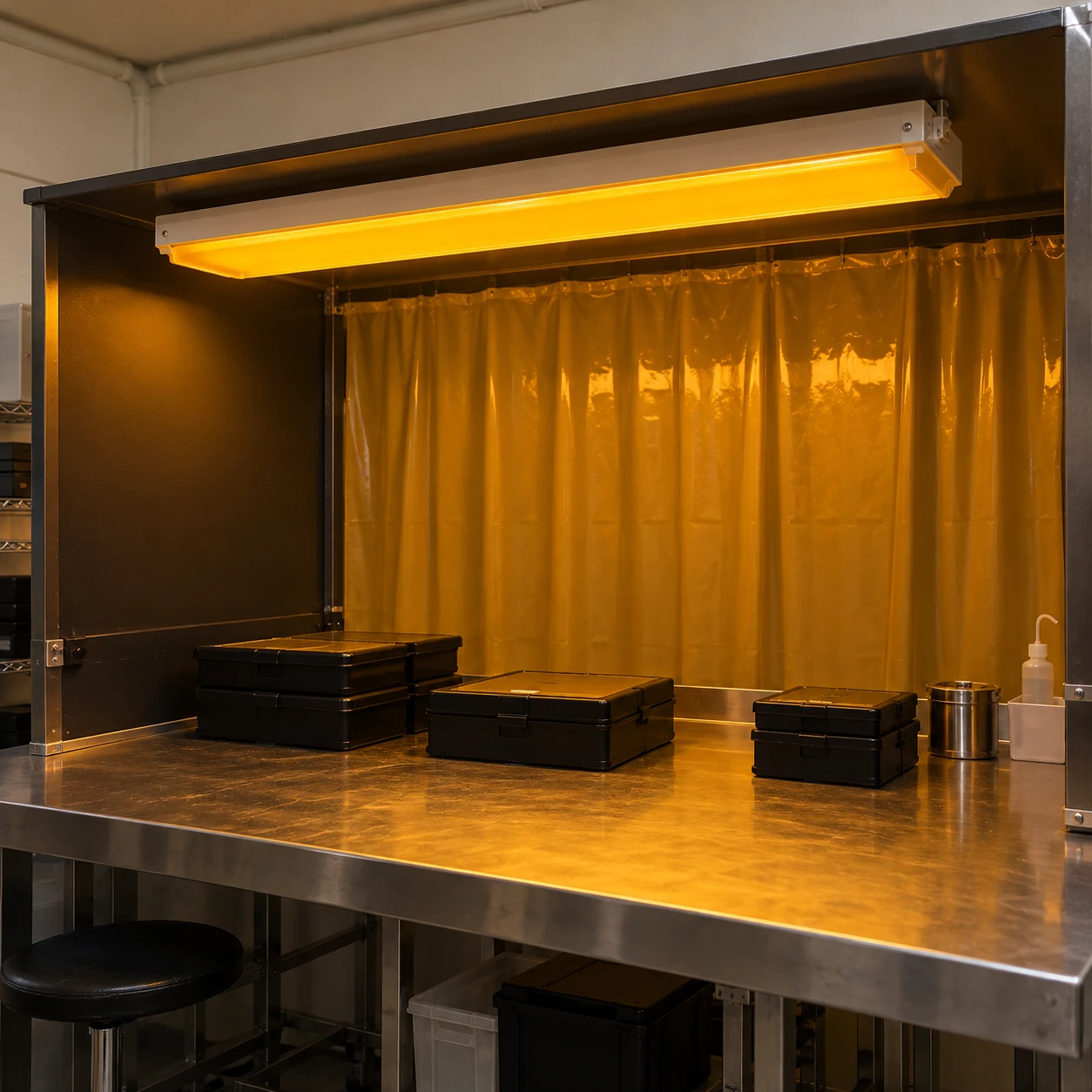
Cleanroom Lighting
specialized cleanroom lighting options
| Narrow grid formats | 600 × 150; 900 × 150; 1200 × 150 mm (L × W), with depth selected separately |
|---|---|
| Optical function | White-light inspection or process-specific yellow/amber spectrum |
| Spectral documentation | Actual spectral output assessed against the material sensitivity and exposure conditions |
| Control selection | Compatible dimming, separate operating modes or process-related switching |
| Emergency option | Dedicated emergency configuration and testing arrangement where required |
| Enclosure selection | Material, optical face, sealing and evidence matched to cleaning and environmental exposure |
Housing and grid formats do not define spectral, emergency or hazardous-area performance. Each specialist function requires a matching complete configuration and its own applicable evidence.
Spectral output, inspection optics, controls, housing and specialist functions can be customized to suit the process requirements.
Specialized cleanroom lighting is selected when ordinary white ambient lighting does not answer the process requirement. The additional function should be defined precisely, whether it concerns spectrum, inspection, emergency operation or the fixture's environment.
For photosensitive work, specify the spectrum
A lamp that appears yellow or amber can still emit wavelengths that affect a sensitive material. The visible colour name is not enough: compare the actual spectral output with the material supplier's sensitivity information and the permitted exposure conditions.
Different ways of producing yellow light are not interchangeable. A converted or filtered white source can behave differently from a dedicated narrow-spectrum source. Exposure duration and stray light from windows, adjacent rooms or portable equipment also matter. Select the complete lighting arrangement with the process owner rather than assuming that an amber-looking diffuser guarantees compatibility.
For visual inspection, control contrast
Surface defects may be easier to see with a particular direction or distribution of light, while colour comparison may need a suitable colour-rendering specification. Increasing general room brightness alone can intensify reflections on glossy objects and make some features harder to distinguish.
Use representative workpieces and the intended viewing position when assessing an inspection arrangement. Agree the task result as well as the source specification, including whether local task lighting must remain separate from the room's ambient lighting.
For cameras, evaluate the acquisition conditions
Temporal variation in light output can interact with exposure time and moving products. Assess the proposed driver, dimming level and optical arrangement with the actual imaging process. A satisfactory human view does not establish camera compatibility.
If the application needs synchronized or dedicated machine-vision illumination, specify that equipment explicitly. An ordinary ceiling light should not be represented as a controlled inspection source simply because it uses LEDs.
Keep emergency and process modes distinct
A normal white-light maintenance mode, a reduced-output production mode and emergency operation perform different jobs. Define who can select each mode, the intended restoration behaviour and the required testing arrangements. The emergency system needs its own project criteria for coverage and operation.
Existing emergency lighting and exit sign options can be considered as a separate part of the schedule. Their selection should not depend on an unverified assumption that every specialist process light also provides emergency illumination.
Spectral output, inspection optics, controls, housing and specialist functions can be customized to suit the process requirements.