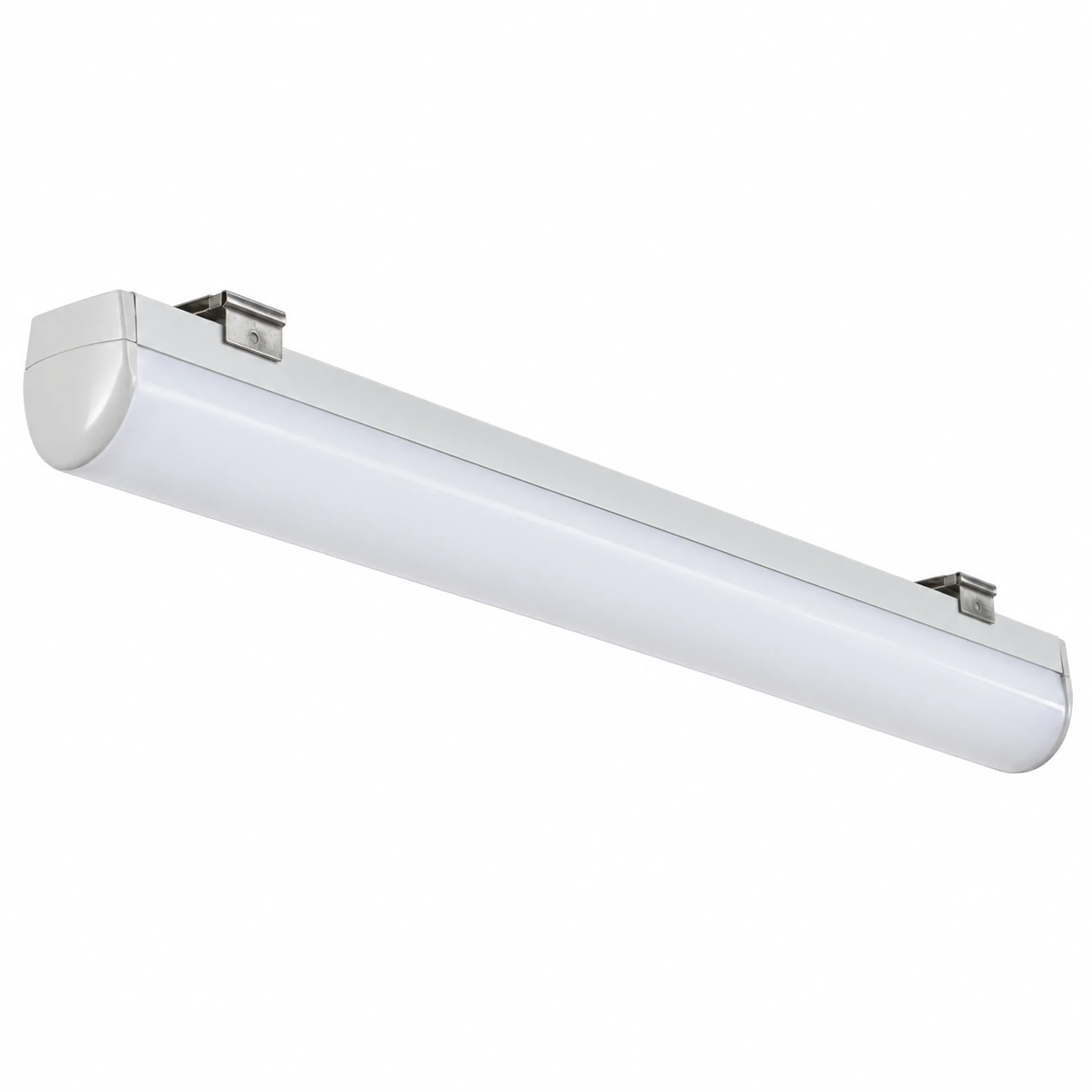
Cleanroom Lighting
Cleanroom Teardrop Lights
| Body dimensions, L × W × H (mm) | 600 × 50 × 90; 900 × 50 × 90; 1200 × 50 × 90; 1500 × 50 × 90 |
|---|---|
| Nominal input by length | Approximately 12 / 17 / 23 / 28 W respectively |
| White-light configuration | 4000 K; opal diffuser; alternative optics by application |
| Supply | 220–240 V AC, 50/60 Hz |
| Mounting | Direct ceiling-grid attachment; individual or continuous rows |
| Controls and service | Switched or compatible DALI driver; removable profile diffuser |
Dimensions describe the luminaire body. Grid clips, cable connections and service space are additional; output and enclosure protection depend on the selected assembly.
Mounting, length, controls and light distribution can be customized for the room layout and working task.
Cleanroom Teardrop Lights place a narrow light source beneath the ceiling grid while leaving more of the surrounding filter face unobstructed. Their shaped diffuser helps air pass around the fitting, but a useful installation still depends on grid position, working-plane illumination and access for cleaning.
A narrow fitting in a ceiling that also supplies air
A cleanroom ceiling often has several competing jobs: delivering filtered air, lighting the work, supporting services and providing maintenance access. A broad surface-mounted fitting occupies space below the supply face and creates an obstruction in the downward air path. A teardrop luminaire concentrates the light source beneath a narrow grid member and gives the air a smoother shape to pass around.
The profile reduces the size and abruptness of the obstruction; it does not make the air pattern independent of the room. The distance below the filter, adjacent fittings, equipment height and return-air arrangement still influence the flow. Position the light with the ceiling and process layout, rather than adding rows after the filter arrangement has been fixed.
Start with the grid attachment
The grid width, attachment method and permitted loading determine how the fixture can be supported. A clip that fits one ceiling rail may interfere with a gasket or service opening on another. Continuous rows also need a consistent alignment method and allowance for end connections. Electrical linking does not replace mechanical support at the required points.
For a retrofit, the practical drawing shows the underside of the grid, available fixing surfaces and the nearby filter access path. This reveals conflicts that a room plan alone can miss, especially around lights placed beside removable filter modules.
Then light the actual task
Light at the ceiling is not the same as useful light on a bench. The working height, fixture spacing and distribution determine how evenly components can be seen. A narrow luminaire may need a different layout from a broad panel, even where their total lumen outputs are similar.
For reflective parts or polished work surfaces, consider the operator's viewing direction. Moving a row or changing the optical distribution can reduce a distracting reflection more effectively than increasing output. Colour rendering and camera compatibility also matter where inspection depends on identifying defects.
Choose a service route before closing the ceiling
A removable profile diffuser allows access from the room side, but that does not automatically make every internal part easy to replace. The driver location, wiring connectors and ceiling attachment all affect the work required. A remote driver may simplify access at a service point while introducing cable routing and compatibility constraints. An integral driver keeps the assembly together but requires adequate thermal conditions and a clear replacement procedure.
Maintenance in a controlled area also has a process consequence. Opening a diffuser above exposed work can release accumulated particles or interrupt production. Locate serviceable parts and plan the cleaning procedure so that the lamp can be maintained without unnecessary disturbance to the work below.
The diffuser and enclosure are separate selection questions
The curved cover should be compatible with the wiping method and cleaning chemistry. Strong cleaners can affect plastics, seals or coatings differently. A smooth outside profile helps wipe-down, but it does not establish a washdown rating, resistance to every disinfectant or a room cleanliness classification. Select enclosure protection from the documented complete luminaire.
Where the process needs a restricted spectrum, use a purpose-selected amber cleanroom light. A standard white teardrop fitting cannot be made process-safe merely by reducing its brightness. Where a broad flush light distribution is preferred, compare the mounting and service approach of a cleanroom panel light.
Mounting, length, controls and light distribution can be customized for the room layout and working task.