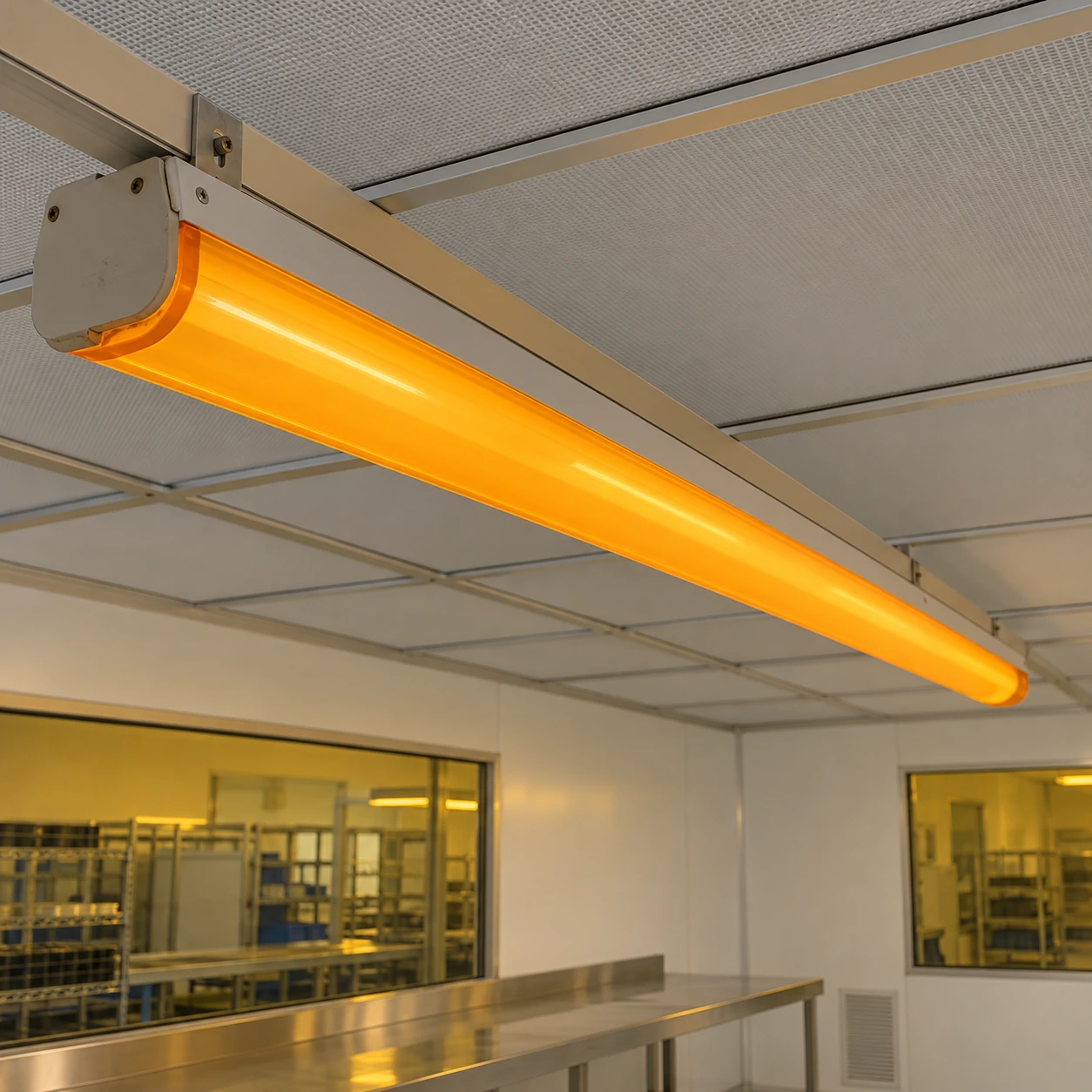
Cleanroom Lighting
Amber Cleanroom Lights
| Selective-amber body sizes, L × W × H (mm) | 600 × 50 × 90; 1200 × 50 × 90 |
|---|---|
| Nominal input for these lengths | 18 W; 36 W respectively |
| Optical choices | Selective amber LED module; filtered-white versions require their own spectral data |
| Supply | 220–240 V AC, 50/60 Hz |
| Mounting and housing | Narrow ceiling-grid luminaire; white-coated housing with profile diffuser |
| Control | Switched operation or compatible dimming; white-light access mode only where process permits |
Match the full spectral distribution and exposure conditions to the material. A colour name alone does not specify a wavelength cutoff or establish process compatibility.
Spectrum, mounting, length and operating controls can be customized around the process and its validated lighting conditions.
Amber Cleanroom Lights provide task illumination where an exposed material is sensitive to part of the visible or ultraviolet spectrum. The useful specification is the light reaching the material over its exposure time, not simply an orange-looking lamp or a warm colour temperature.
Specify the light the material can tolerate
Photoresists, coatings and other light-sensitive materials do not all respond to the same wavelengths. Their response can also depend on formulation, process stage and exposure time. A lamp described as amber may emit a narrow band of light, use a filter over a white source, or simply look amber to the eye. These are different optical arrangements.
The useful starting point is the material's sensitivity information and the maximum permitted exposure at the relevant process stage. Compare that with the luminaire's spectral power distribution, including any small emission outside the intended band. A nominal colour temperature is not an adequate substitute for a spectrum when excluding shorter wavelengths is essential.
Selective emission and filtering solve the problem differently
| Optical arrangement | How it works | What to evaluate |
|---|---|---|
| Selective amber LEDs | The light source itself emits mainly within a selected spectral region. | The measured spectrum of the finished luminaire, output at the work and suitability for the sensitive material. |
| White source with a filter | A filter removes part of a broader source spectrum. | The filter transmission curve, leakage at joints and changes caused by damage, ageing or cleaning. |
| Switchable amber and white operation | Different lighting modes support processing and other tasks. | How white mode is prevented during sensitive exposure and how the operating state is made clear. |
Selective emission can avoid a separate filter layer, while filtering may suit an established light engine or fixture arrangement. Neither approach is universally better. The complete optical assembly, including the cover, determines the light leaving the fitting. Substituting an apparently similar LED module or diffuser during maintenance can alter that result.
Control exposure across the room
The ceiling lights are only one possible light source. Door windows, inspection instruments, equipment indicators and neighbouring workstations can introduce unwanted wavelengths. A well-selected amber luminaire will not compensate for white light reaching the material from an open door. Review the boundary around the sensitive operation as well as the lamp schedule.
Exposure also accumulates over time. A material left under a relatively low level for a long handling period can receive more unwanted exposure than a quickly transferred item under a brighter source. Set operating conditions around the real workflow, including delays, cleaning and maintenance. Validate the process using the selected lighting and actual material rather than treating a generic wavelength label as an approval.
Preserve useful visibility
Restricting the spectrum changes how colours appear. Operators may find labels, wire colours or surface marks harder to distinguish even when the area seems bright. Test the tasks that matter: reading markings, aligning parts, identifying contamination and seeing changes in surface condition. Additional output cannot restore colour information that the source does not emit.
Make the operating mode dependable
If white light is needed for setup or cleaning, separate that permission from ordinary dimming. A control arrangement can use a clearly defined mode, access restriction or process interlock according to the equipment design. The emergency-lighting requirement must also be considered independently; normal amber process lighting is not automatically an emergency system.
Keep replacement parts within the optical specification
Record the selected spectrum, diffuser construction, cleaning method and replacement components with the facility information. That helps prevent a future repair from restoring visible brightness while changing process compatibility. For the mechanical relationship between narrow fittings and ceiling air delivery, see Cleanroom Teardrop Lights. The procurement brief should pair this mounting information with the material sensitivity and operating sequence.
Spectrum, mounting, length and operating controls can be customized around the process and its validated lighting conditions.