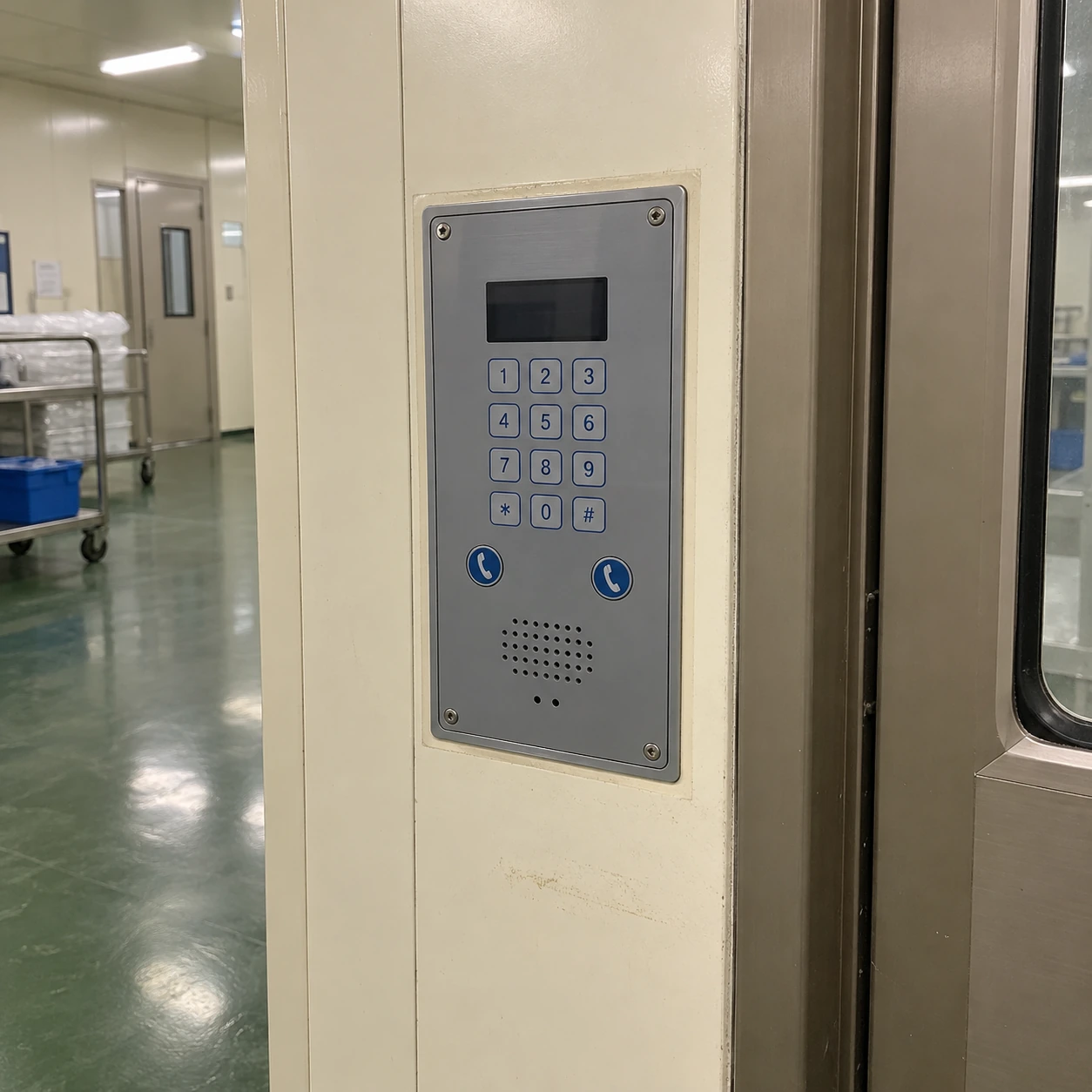
Cleanroom Intercom Systems
Cleanroom Intercom Systems
| Station face formats, W × H (mm) | 125 × 280; 165 × 280 |
|---|---|
| Mounting | Flush installation with matched back box; surface mounting with suitable enclosure |
| Audio operation | Hands-free duplex; controlled talk mode where required by the acoustic conditions |
| Connection | IP intercom network; SIP integration where supported by the selected station and server |
| Power | IEEE 802.3af PoE; compatible local power option for the selected hardware |
| Call functions | Direct-call keys, caller indication and optional supervised station or relay interfaces |
Face dimensions are not wall cut-out dimensions. Allow for the selected back box, cable space and the finished wall connection.
Station format, call routing and mounting details can be configured for the cleanroom application.
A cleanroom intercom lets staff exchange instructions across a controlled boundary without opening a door or passing a handset between operators. The useful system combines a cleanable station with clear speech, a reliable answering point and a connection that fits the facility network.
Give each call a clear destination
A station beside an airlock may need to call the packing supervisor, while a production-room station may need maintenance or a control desk. A short direct-call arrangement makes those tasks easier with gloves. A directory is useful when users regularly need several departments, but an oversized contact list can slow a simple request.
Define who answers during each shift and what happens when that person is busy. A ring group or an agreed alternative destination is more useful than leaving a call indication active at an unattended desk. Automatic answering can suit some internal workflows; it should be selected with the room's privacy and operating procedures in mind.
Communication and access are separate decisions
A spoken acknowledgement does not establish that a door is closed or a room is ready for entry. If a station provides a release contact, it should send a request to the approved access logic. The intercom should not replace the door contacts and release conditions of a Door Interlock System.
Position the microphone for the work
Fan noise, masks and hard room surfaces can make a loud call difficult to understand. Increasing speaker volume alone may produce more echo without improving the words heard at the other end. Position the station near the operator's normal speaking location and away from the strongest local airflow or a noisy machine enclosure.
A sealed audio surface is useful for cleaning, but it changes the acoustic path. Hands-free duplex allows natural conversation; a controlled talk mode can be preferable where background noise repeatedly triggers the microphone. The choice should be checked with ventilation running and with the clothing used during normal work.
Build the station into the room boundary
New panel installation
A matched recess and back box can give a compact wall connection. The wall opening needs support and a sealed cable route; the visible trim must not be relied on to cover an unfinished penetration.
Existing room retrofit
A surface enclosure reduces the amount of wall cutting but projects into the working space. Put it where trolley movement and routine wiping will not damage the edges or the cable entry.
Future service
Agree how the station is removed and resealed. Access to connectors should be possible without damaging the surrounding panel or allowing loose material to fall into the room.
Keep the complete communication path available
PoE simplifies the station cable arrangement, but power to the network switch and availability of the call server still matter. For local-power versions, the supply must match that specific station. SIP support also needs an agreed feature set: basic calling does not automatically include every paging, priority or supervision function offered by a dedicated intercom server.
Handover should include the call destinations, network settings, approved cleaning method and a short fault guide. Test an actual conversation, busy handling and restoration after a planned power interruption. A station that appears online can still have a blocked acoustic surface or an unsuitable audio setting.
For connection to an established telephone extension plan, compare Cleanroom Telephones. Select the communication workflow first, then the station and installation arrangement that support it.
Station format, call routing and mounting details can be configured for the cleanroom application.