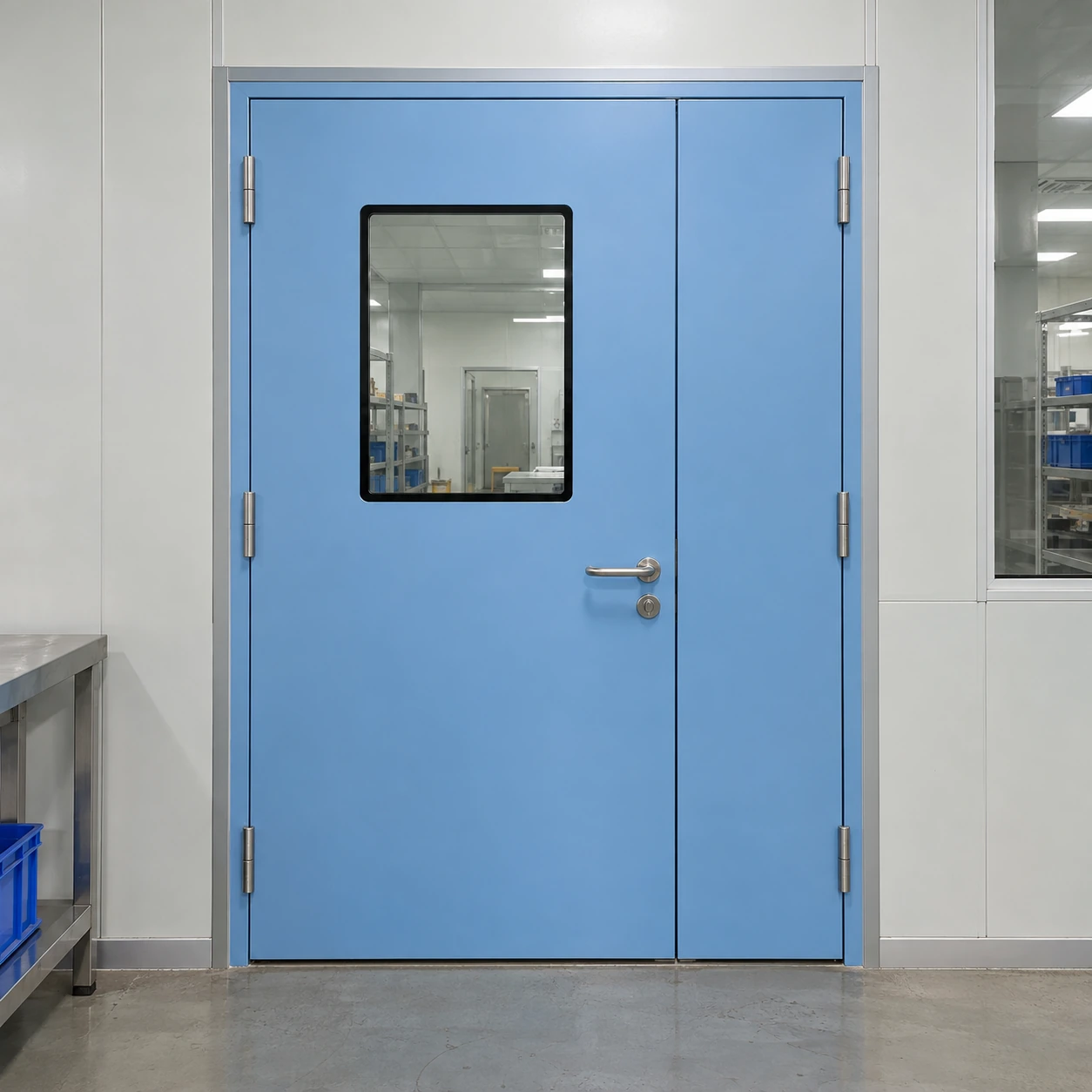
Cleanroom Doors / Windows
steel cleanroom doors
| Door arrangement | Single leaf; double leaf; active leaf with narrower secondary leaf |
|---|---|
| Nominal door sizes, W × H × T (mm) | 900 × 2100 × 42; 1828 × 2100 × 42 |
| Surface | Coated steel skin; colour and coating selected for the cleaning regime |
| Frame and edges | Formed steel or aluminium frame; sealed perimeter junction |
| Hardware | Stainless hinges and lever; closer, kick plate and vision-panel options |
| Access | Manual operation; interlock or powered operation by matched package |
Size options describe the nominal door format. The structural opening, outside frame and clear passage are specified separately; configuration approval governs the supplied assembly.
Leaf construction, finish, glazing and hardware can be configured for the room and traffic requirements.
Steel cleanroom doors use formed metal skins around a core and reinforced hardware zones. A sound design combines flatness, durable finishing and reliable closure without adding unnecessary weight or complexity.
The core and edges support the face sheets
The metal skin provides the exposed surface, but the internal structure helps the leaf remain stable. Core selection, bonding and perimeter construction influence how the door resists bending during operation. A loose or uneven assembly can become difficult to latch even when the paint still looks acceptable.
Hardware positions need suitable reinforcement. Hinges, closers and latches apply concentrated loads that should not depend only on a thin face sheet. The backing arrangement should be established before hardware is fitted, particularly when a powered operator or larger vision panel is involved.
Coating quality includes hidden edges
The broad coloured face is easy to inspect; cut-outs, folded seams and lower corners deserve equal attention. Damage at these locations can expose the substrate and create a maintenance problem in a wet or frequently cleaned area.
Protective film helps during handling but should be managed according to the finish instructions. Leaving construction debris trapped around hardware or attempting an incompatible touch-up can damage a sound coating. The supplied repair method should restore adhesion and a cleanable surface.
Choose steel for the actual environment
A coated-steel assembly can be practical for dry production, packing and laboratory support routes. Persistent wetting or a demanding chemical regime may justify a different coating or material. The decision should cover the frame and small fittings as well as the leaf.
The presence of a non-combustible metal skin does not establish the fire performance of the complete door. Fire-resisting openings require their own evidenced assembly.
Keep the installed door square and supported
A twisted frame can force the leaf to contact at one corner and leave a gap at another. Applying more latch force does not restore the geometry. Correct frame fixing, wall backing and consistent clearances make the seal and closer easier to adjust.
For paired doors, the meeting edge must work with the active and inactive leaf hardware. The secondary leaf should be secure during normal use but available when the larger passage is needed. Its operating sequence should be understandable to the people who move equipment.
Use a complete specification
A practical order identifies the leaf and frame finish, core construction, door arrangement, glazing, gasket and hardware package. These choices should describe one coordinated assembly. Selecting the cheapest component from several unrelated door systems often moves the integration work to the installation site.
For manufacturing and supply controls specific to coated steel, see China steel cleanroom doors; for an actual rated opening, use fire rated cleanroom doors.
Leaf construction, finish, glazing and hardware can be configured for the room and traffic requirements.