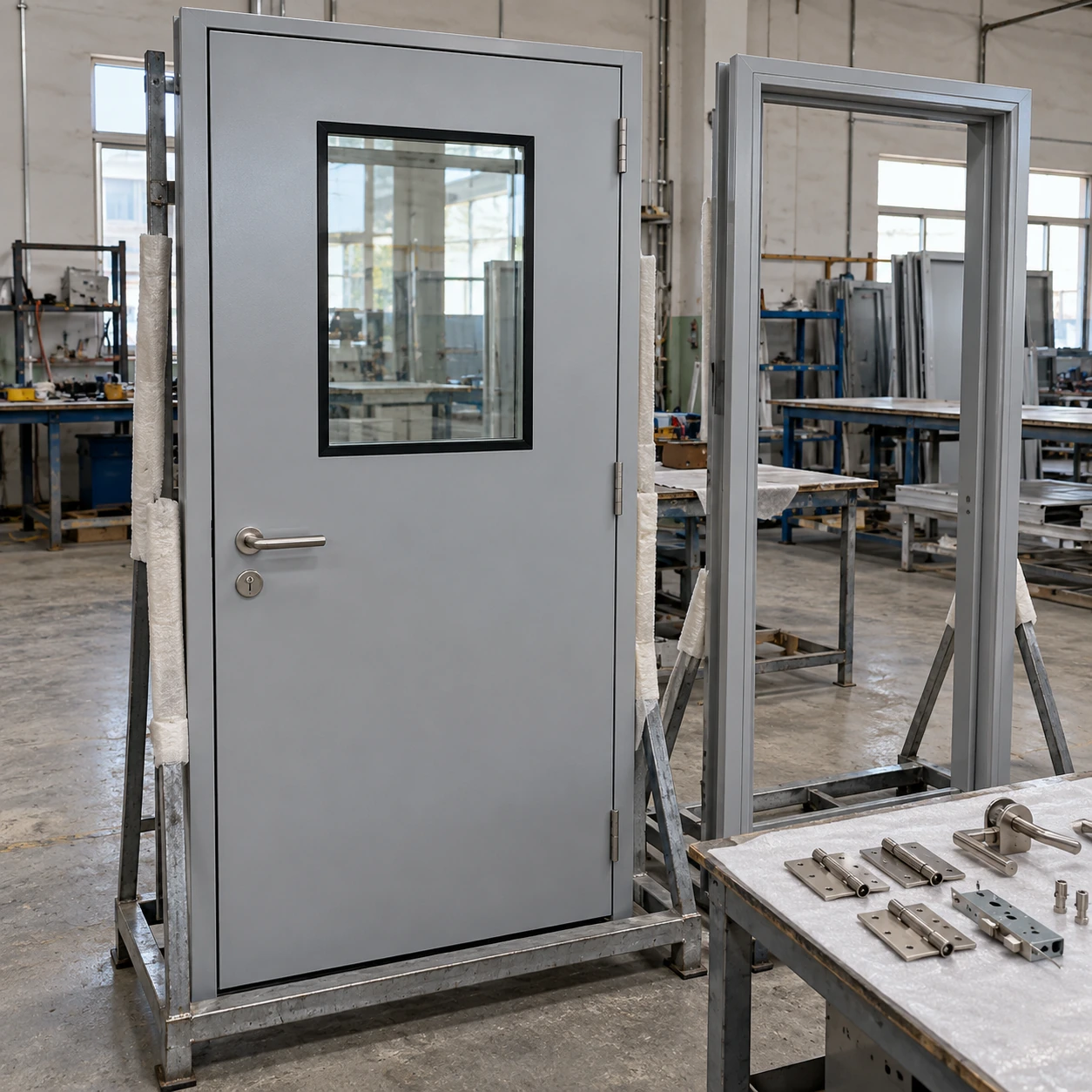
Cleanroom Doors / Windows
china steel cleanroom doors
| Door arrangement | Single leaf; double leaf; active leaf with narrower secondary leaf |
|---|---|
| Nominal door sizes, W × H × T (mm) | 900 × 2100 × 42; 1828 × 2100 × 42 |
| Surface | Coated steel skin; colour and coating selected for the cleaning regime |
| Frame and edges | Formed steel or aluminium frame; sealed perimeter junction |
| Hardware | Stainless hinges and lever; closer, kick plate and vision-panel options |
| Access | Manual operation; interlock or powered operation by matched package |
Size options describe the nominal door format. The structural opening, outside frame and clear passage are specified separately; configuration approval governs the supplied assembly.
Steel doorset construction, finish, hardware and packing can be configured for your project.
Sourcing steel cleanroom doors from China works best when the purchase describes the construction behind the finish. shengtongjh coordinates the doorset specification and supply package, with manufacturing evidence tied to the selected supplier and assembly.
Define the metal construction before the colour
A quotation for a painted steel door can cover different face sheets, core materials and edge details. These choices affect flatness, weight and the way hardware is supported. The specification should identify the leaf and frame construction separately, including how the glazing opening and lower edge are closed.
Metal thickness should be stated with a clear basis rather than inferred from the total leaf thickness. A thick-looking door can have thin skins around a deep core. Neither dimension alone establishes stiffness, impact suitability or a fire rating.
Review the stages that influence fit
Forming and reinforcement
Folded edges and hinge backing need consistent geometry. Misplaced reinforcement can leave a later hardware change unsupported even if the visible face is undamaged.
Assembly and finish
The core and skins should form a stable leaf. The finish must protect cut edges and hardware openings as well as the broad surface, with a suitable repair method for handling damage.
Matched fitting
Leaf, frame, seals and hardware should be checked as a set. A collection of correctly sized parts can still close poorly if their tolerances or hardware positions do not work together.
Make inspection evidence specific
Useful records identify the actual opening number, handed arrangement, dimensions and hardware. Clear photographs of hinge and strike details can supplement measurements, but do not prove concealed construction or rated performance.
Where fire resistance or a defined leakage performance is required, obtain evidence for that exact assembly and permitted options. A factory quality certificate is different from product performance evidence.
Protect the assembly through shipping
Frames can be distorted by poor support and finished faces can be marked by loose accessories. Separate hardware packing, edge protection and a stable rack help preserve the fitted condition. Parts removed for transport need a clear reassembly sequence.
The packing list should connect each leaf and frame to its opening, especially where several visually similar handed doors are supplied.
Keep the destination installation in scope
The installer needs the correct wall-opening allowance, backing and perimeter detail before the door arrives. Avoid leaving site personnel to cut an oversized opening or invent a frame extension after delivery. Electrical items, if included, should be identified by their actual ratings and interface requirements.
For the wider export package across materials and operating types, see cleanroom doors from China. Coated-steel construction remains a product choice, not a claim of universal suitability for every destination or cleaning process.
Steel doorset construction, finish, hardware and packing can be configured for your project.