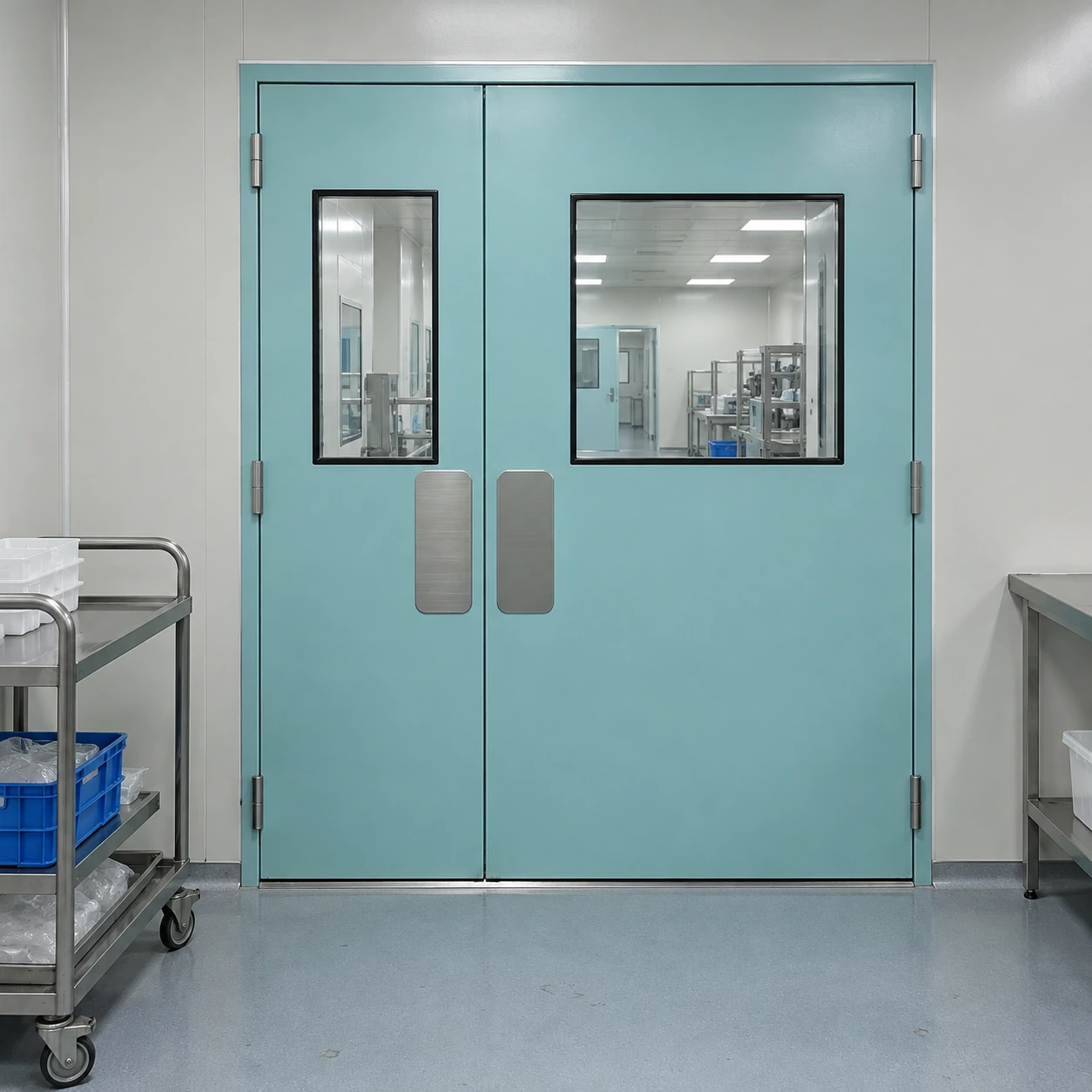
Cleanroom Doors / Windows
pharmaceutical cleanroom doors
| Door format | Single leaf; equal or unequal double leaf |
|---|---|
| Nominal door sizes, W × H × T (mm) | 900 × 2100 × 42; 1828 × 2100 × 42 |
| Leaf finish | Powder-coated steel, stainless steel or aluminium skin |
| Frame | Aluminium profile or formed steel; matched to the wall system |
| Sealing | Perimeter gasket; bottom drop seal option |
| Glazing and hardware | Flush vision panel; lever or push plate; closer and access-control options |
Nominal door sizes are not clear-passage or wall-opening dimensions. Frame envelope, handing and usable opening are defined by the selected doorset drawing.
The doorset can be configured for your pharmaceutical process, room finishes and movement schedule.
Pharmaceutical cleanroom doors have to suit the work on both sides of the opening. A personnel change area, a powder-handling room and a washed equipment room can demand different surfaces, seals and access arrangements.
Let the process determine the door details
Powder production can leave deposits around handles and at the meeting stile of paired leaves. These details need to be accessible during cleaning. A washed preparation room places different demands on sealant, leaf edges and floor junctions. A dry corridor may allow a simpler coated-metal construction.
Material choice alone does not resolve these differences. The design of the glazing edge, the way the frame closes against the partition and the ability to inspect the lower corners all influence how the opening can be maintained between activities.
Separate three duties
Product protection, containment of process material and building fire protection are different requirements. They may occur at the same opening, but each needs its own design basis. A door labelled for pharmaceutical use does not establish any of them by itself.
Make the route work during a batch
Operators carrying containers need enough approach space to use the handle without setting material on the floor. A narrow active leaf may be convenient for personnel while a second leaf provides equipment access, but routine trolley traffic should not require awkward release of concealed bolts every few minutes.
Where batches or cleaning states must remain separated, access indication can show whether an opening is available for use. Door contacts can report position to an interlock or monitoring system. That indication must support the operating procedure rather than imply that a closed leaf proves the room has been cleaned.
For sterile medicinal-product areas, airlock arrangements should follow the applicable contamination-control strategy. Non-sterile pharmaceutical rooms still need process-specific segregation, but should not be assigned sterile-area grades merely because the door surface is smooth.
Commission the installed boundary
Frame and wall
Opening reinforcement carries the hardware loads. A continuous, maintainable perimeter joint closes the space between that frame and the room finish.
Leaf and floor
The leaf should latch consistently without dragging. A bottom seal that compensates for a large floor error can create excessive resistance and uneven contact.
Controls and procedures
Normal access, rejected requests, cleaning access and emergency release should have distinct, understandable responses. The facility defines who can reset or override an interlock.
Keep later changes traceable
A replacement seal or coating repair can alter cleaning compatibility. A new closer can change operating effort and timing. Retaining the approved doorset details helps maintenance teams identify equivalent parts and decide which changes require further assessment.
For a material-focused option, review aluminium-profile pharmaceutical doors; for sterile routes, use the dedicated sterile-environment door guidance.
The doorset can be configured for your pharmaceutical process, room finishes and movement schedule.