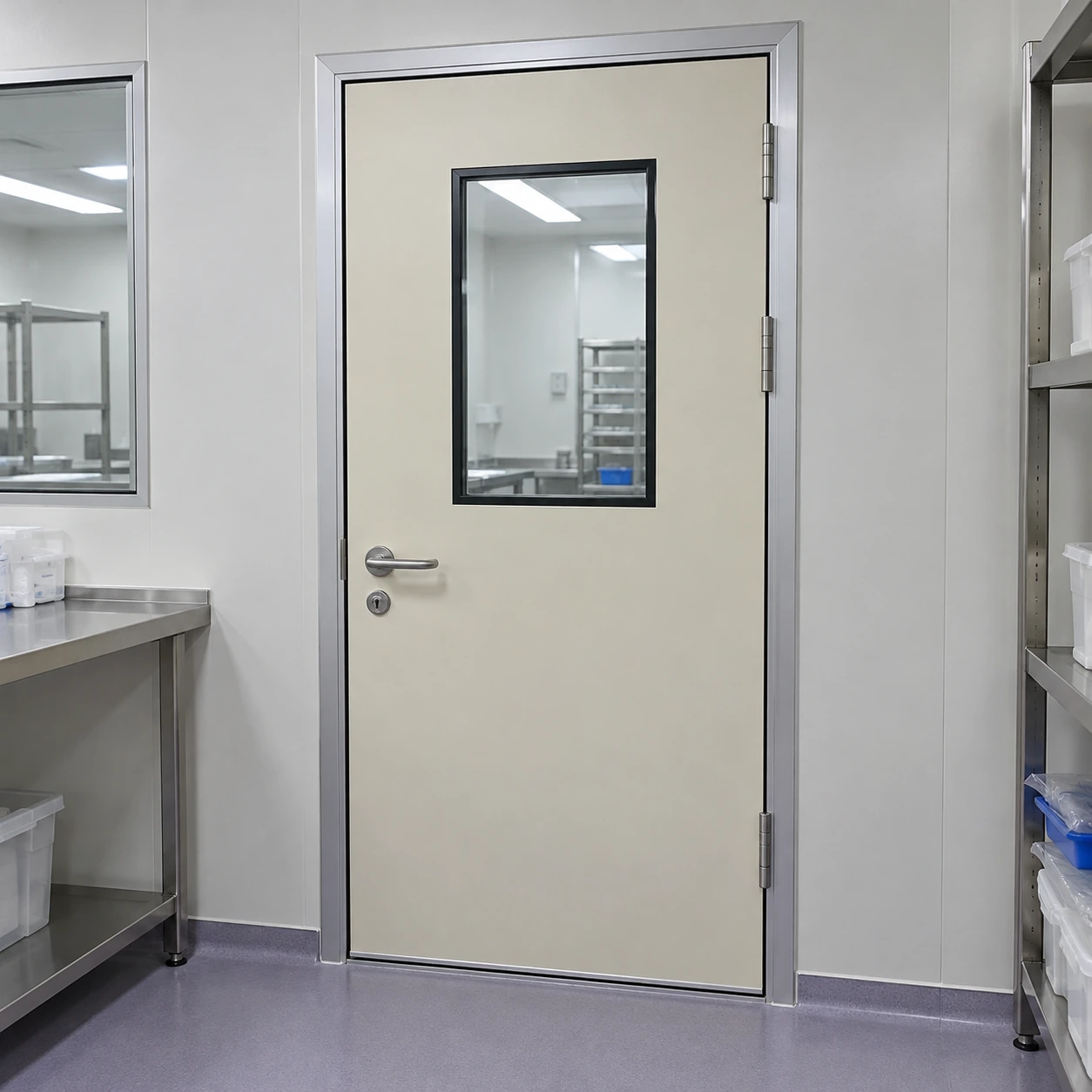
Cleanroom Doors / Windows
aluminum profile cleanroom doors for pharmaceutical
| Frame | Rounded extruded aluminium; anodized or coated finish |
|---|---|
| Nominal door sizes, W × H × T (mm) | 900 × 2100 × 42; 1828 × 2100 × 42 |
| Leaf infill | Coated metal skin or selected hygienic panel |
| Wall interface | Profile matched to panel thickness and opening reinforcement |
| Sealing | Replaceable frame gasket and bottom-seal options |
| Fittings | Flush glazing; adjustable hinges; latch, closer and interlock options |
The aluminium profile describes the frame construction, not necessarily the leaf skin. Clear passage and overall frame dimensions depend on the selected profile.
The profile system, surface finish and access arrangement can be configured for the pharmaceutical application.
For pharmaceutical rooms, an aluminium-profile door is useful only when the extrusion, leaf, seals and wall connection form a maintainable boundary. The most important details are often the narrow junctions around the opening rather than the broad door face.
Follow the cleaning path around the frame
A wipe moves from the wall onto the frame, around the glazing and across the leaf. Every step, exposed fixing and unsealed cover joint interrupts that path. Rounded profiles can help, but a rounded cover with an open rear edge can still retain residue. The installed corner detail is more informative than the profile shape in isolation.
Profiles designed to clamp around panels can be practical where wall modules are replaced or modified. The connection still needs a defined backing and sealing method. Tightening the frame against an unsupported panel edge can distort the opening and change gasket contact.
The finish has to survive the actual routine
Anodizing and coating are different surface systems. Their suitability depends on the cleaning agent, concentration, exposure and the way the surface is dried. Glazing seals and frame-joint sealant should be considered at the same time; selecting a compatible metal finish while ignoring the elastomers leaves an incomplete specification.
Areas that receive repeated wiping around readers and handles often wear differently from the main leaf. Hardware placement should allow cleaning without forcing the operator to rub repeatedly across a sharp trim edge.
Keep the gasket replaceable
A seal channel should retain the correct profile without requiring improvised adhesive repairs. Continuous contact around the corners matters as much as compression along straight lengths. Access to the channel allows routine replacement without removing the surrounding partition.
Excessive compression can increase opening effort and distort a lightweight leaf. Insufficient compression leaves an inconsistent boundary. Alignment, latch position and closer adjustment work together to establish the intended contact.
Integrate access equipment without creating hidden openings
A reader, indicator or electric lock introduces mounting points and cable routes. Where these pass through the frame or wall, the penetrations need a planned closure. Mounting equipment later can leave inaccessible holes behind trim and make the room finish harder to maintain.
For an airlock, position contacts and lock feedback should support the agreed sequence. A reader granting permission is not proof that the opposite leaf is closed, and a closed-position signal does not establish a clean or recovered room state.
Specify by room duty
A dry packaging corridor may suit a coated-metal infill and a relatively simple profile frame. A room with a more demanding disinfection or decontamination regime can require a different finish, seal and joint construction. Sterile-area requirements are determined through the facility strategy, not by the presence of aluminium profiles.
For broader process routing, see pharmaceutical cleanroom doors. Keep the approved profile, gasket and hardware references with the facility record so replacements preserve the chosen interface.
The profile system, surface finish and access arrangement can be configured for the pharmaceutical application.