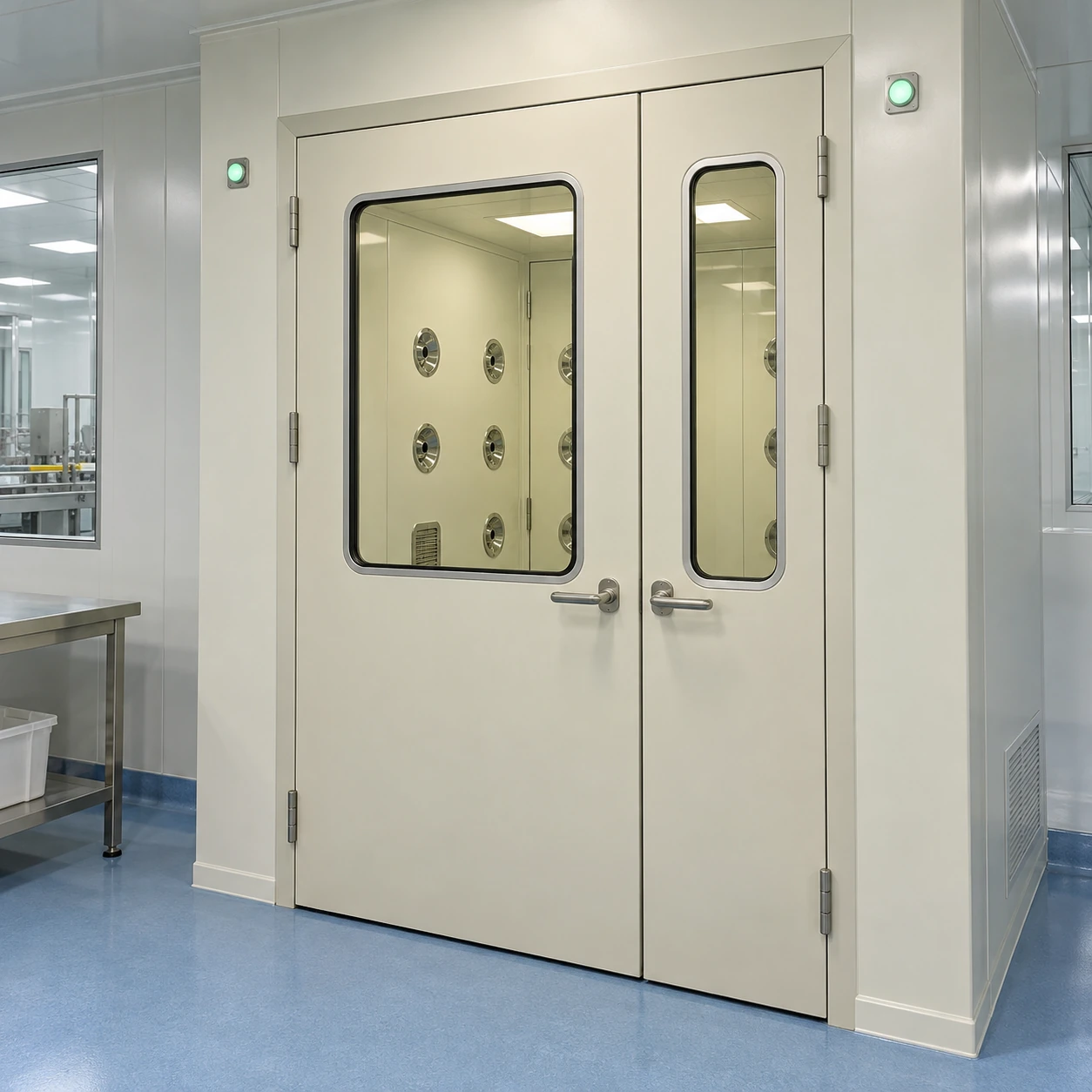
Cleanroom Doors / Windows
cleanroom doors for sterile environments
| Door format | Single leaf; equal or unequal double leaf |
|---|---|
| Nominal door sizes, W × H × T (mm) | 900 × 2100 × 42; 1828 × 2100 × 42 |
| Leaf finish | Powder-coated steel, stainless steel or aluminium skin |
| Frame | Aluminium profile or formed steel; matched to the wall system |
| Sealing | Perimeter gasket; bottom drop seal option |
| Glazing and hardware | Flush vision panel; lever or push plate; closer and access-control options |
Nominal door sizes are not clear-passage or wall-opening dimensions. Frame envelope, handing and usable opening are defined by the selected doorset drawing.
Door construction, seals and airlock interfaces can be configured for the specific sterile-process application.
Doors serving sterile-process environments support separation and controlled movement. Their contribution comes from cleanable construction, predictable closure and integration with the facility contamination-control strategy; the door itself does not make a room or product sterile.
Protect the transition between areas
A direct opening between areas can undermine separation whenever it is used. An airlock creates an intermediate space in which personnel or material movement can be managed. Its usefulness depends on the room geometry, air supply and operating sequence as well as the two doors.
For facilities applying EU GMP Annex 1, airlock entry and exit doors should not open simultaneously. The guidance distinguishes interlocks for routes to Grade A and B areas from the minimum visual or audible warning approach for routes to Grade C and D. The selected controls must follow the facility assessment; a generic timer is not evidence that an airlock has recovered.
From request to release
Request access
The user receives an understandable available or occupied indication. The control system considers the other leaf position and any process conditions required by the area.
Close and establish the boundary
A closed-position signal should correspond to a physically closed leaf. An ill-adjusted contact can report closure before the seal is engaged, allowing the sequence to advance prematurely.
Release the next stage
Any delay or monitored condition is established through the facility operating strategy. A recovery period should account for the real load and movement, not be copied from another airlock.
Every junction becomes a cleaning surface
The junction around a vision pane, the hinge recess and the underside of a handle are easy to overlook when selecting a smooth door face. Recessed hardware can simplify wiping, provided its edges are sealed and the component remains accessible for maintenance.
Seal and coating compatibility depends on the disinfectant, concentration, contact time and repeated exposure. A material that survives occasional wiping may behave differently under a routine decontamination cycle. Compatibility belongs to the whole selected assembly, including adhesives and small trims.
Failure behaviour needs an operating procedure
An interlock fault must be visible to the operator rather than becoming a reason to defeat the system permanently. Emergency release and evacuation requirements must be coordinated with normal segregation. After an interruption, the facility decides when the affected area can return to operation.
Changing a closer, replacing a gasket or adjusting a bottom seal can affect room behaviour. These interventions should be linked to the facility change-control and verification process.
Keep the product boundary clear
This is a selection of access doors for controlled premises. It is not a sterile transfer device or a substitute for a validated transfer process. Where items need surface bio-decontamination during transfer, assess a dedicated VHP pass-through chamber separately from the personnel entrance.
Door construction, seals and airlock interfaces can be configured for the specific sterile-process application.