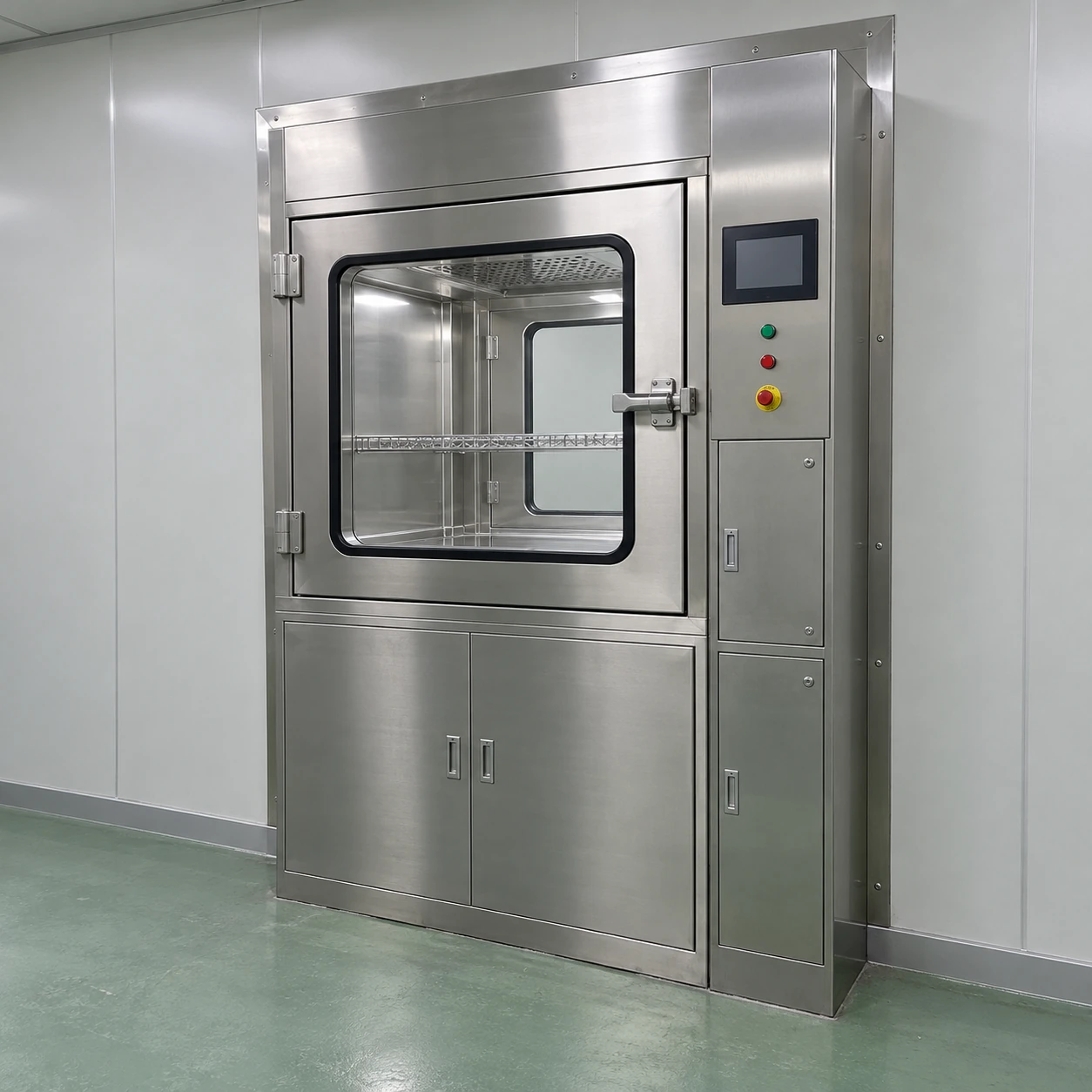
Pass Boxes & Material Transfer
VHP Pass-Through Chambers
| Chamber / cabinet W × D × H (mm) | 600 × 600 × 600 / 1200 × 660 × 2000; 800 × 800 × 800 / 1400 × 860 × 2200; 1000 × 1000 × 1000 / 1600 × 1060 × 2200 |
|---|---|
| Material options | 316 or 316L stainless chamber; 304 exterior or full 316L construction |
| Transfer arrangement | Opposed interlocked doors; shelves, load supports and wall interfaces to suit the selected configuration |
| Treatment system | Vaporized hydrogen peroxide generator integrated with the chamber or coordinated as a separate package |
| Air and gas management | H14 supply/exhaust filtration where specified; ducted extraction or engineered catalytic gas removal |
| Door sealing | Peroxide-compatible seals, with inflatable sealing available on selected constructions |
| Controls and records | PLC/HMI, door status, recipe selection, cycle records and fault reporting |
| Monitoring | Process H₂O₂, temperature, humidity and chamber pressure; suitable low-level residual monitoring |
| Electrical option | 380–400 V AC, three phase for selected VHP packages; final supply and load follow the matched system |
| Release requirements | Qualified load cycle and approved residual-peroxide criteria, linked to receiving-door control |
Dimensions are chamber and cabinet configuration options, excluding installation clearances. Door opening, load capacity, utilities and the complete option combination are defined in the agreed equipment specification.
Chamber dimensions, loading supports, wall connections and control interfaces can be customized for your material-transfer application.
VHP Pass-Through Chambers provide an enclosed route for transferring compatible materials into controlled production areas. A sealed chamber, vaporized hydrogen peroxide system and monitored release sequence connect surface bio-decontamination with the practical demands of loading, unloading and maintaining separation between rooms.
Define what must cross the boundary
A transfer chamber is useful when cleaned tools, components or material containers need a controlled surface treatment before entering a protected production area. The process depends on vapour reaching the required surfaces. It does not establish sterility inside a sealed container or compensate for dirt left on an item.
Start with the intended load families and the receiving process. Packaging, elastomers, adhesives and plastics may absorb peroxide or change after repeated exposure. Absorption can extend gas removal, while some materials also reduce the vapour available during treatment. These effects explain why two loads of similar size can require different qualified cycles.
Usable capacity starts at the opening
The chamber envelope is only one part of the loading geometry. The clear door opening, shelf height and support arrangement must allow the item to enter, sit securely and leave without awkward handling. Keep space for the circulation path required by the chosen system; filling every available gap is not a reliable way to increase output.
Hand-loaded trays and wheeled loads need different arrangements. A raised cabinet can suit small components, while cart transfer may require a larger floor-level construction, compatible wheels and a continuous transfer surface. Define the loaded cart outline rather than relying on its empty dimensions.
Fit the equipment into the room boundary
Coordinate wall thickness, perimeter sealing and access on both sides. A service compartment that can only be opened from the receiving room can complicate maintenance and room recovery. Door swing, shelf withdrawal and access to filters, seals and instruments need space beyond the cabinet outline.
Include the adjoining room pressures and the available utility routes in the layout review. An integrated generator reduces separate equipment connections; a remote generator changes the service location, connecting pipework and control responsibilities.
Specify the air path and the peroxide-removal path
Particulate filtration and peroxide removal perform different jobs. A HEPA filter controls particles; it should not be treated as the component that makes a peroxide-containing discharge suitable for release.
| System function | What it means for installation and use |
|---|---|
| Chamber circulation | Arrange the load and supports so the selected air-distribution system can reach the surfaces included in qualification. |
| Facility extraction | Agree the exhaust connection, airflow conditions, treatment responsibility and effect on room pressure with the facility design. |
| Catalytic removal | Define the catalyst, monitoring and discharge arrangement as a complete engineered package; room discharge must be specifically assessed. |
Some chamber designs use vacuum-assisted gas removal. That is a different chamber and utility specification, requiring suitable pressure construction and compatible loads. It cannot be assumed to be an interchangeable option on an ordinary atmospheric transfer cabinet.
Separate treatment evidence from release evidence
Has the load received the qualified process?
Qualification links the defined load arrangement with the intended microbiological outcome. Cycle records then show whether a routine run met its approved conditions. An empty-chamber result or a generic reduction claim does not cover every future combination of packaging and components.
Can the receiving door be released?
Residual peroxide is a separate acceptance condition. A sensor chosen for treatment concentrations may be unsuitable for low-level release measurements. Specify the required range, response, location and calibration, together with the door interlock and fault response. A timer alone cannot show that residuals satisfy the approved release limit.
Include loading, preparation, exposure, gas removal and unloading in the throughput discussion. Quote comparisons based only on exposure time can miss the stage that actually limits transfers per shift.
Agree the delivered scope before procurement
A useful acceptance package addresses chamber integrity, door sequencing, alarms, air-system checks, instrument calibration and records, with load qualification responsibilities assigned separately. Identify what is demonstrated at the equipment source and what must be completed after installation in the actual rooms.
Specify access to replacement seals, filters, catalysts and sensors as applicable, plus the records needed after a significant repair or load change. For transfers requiring filtered airflow without a peroxide process, compare the Electronic Interlock Dynamic Pass Box.
Send the largest loaded item, material and packaging list, transfer demand and wall layout to shengtongjh. We coordinate equipment sourcing against that scope, including the proposed generator, utilities and documentation required for your acceptance process.
Chamber dimensions, loading supports, wall connections and control interfaces can be customized for your material-transfer application.