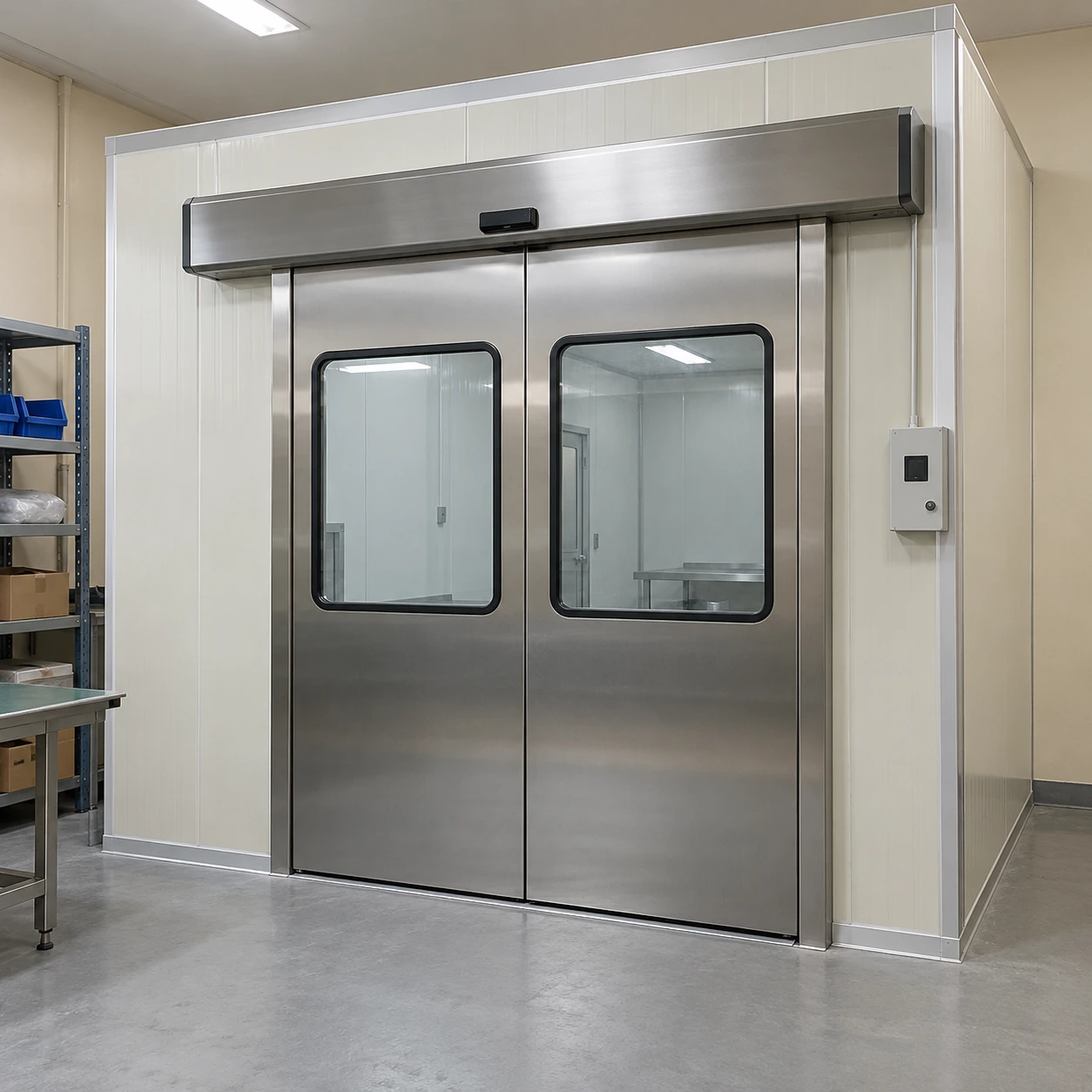
Cleanroom Doors / Windows
cleanroom doors uae
| Operation | Automatic single sliding or bi-parting door |
|---|---|
| Clear passage widths (mm) | Single slide: 1200–1600; bi-parting: 1600–2000 |
| Opening height | Selected with operator headroom and installation drawing |
| Activation | Touchless switch, push button or access-control signal |
| Safety and release | Presence protection, obstruction response and manual-release provision |
| Electrical interface | Voltage, frequency, alarm inputs and interlock logic to the selected drive |
Options describe a coordinated automatic doorset. Electrical ratings and emergency behaviour are specified for the selected operator; a touchless trigger alone is not a safety sensor.
Door operation, finish, sensors and system interfaces can be configured for the UAE project.
For UAE controlled-area projects, a door package may need to connect with access control, building alarms and the room-management system. The leaf and operator should be specified with those interfaces, not added to them as an afterthought.
Assign a purpose to every signal
An access reader authorises entry, a position contact reports the leaf state and a presence detector protects movement. These signals are not interchangeable. A system that treats permission as proof of closure can release another airlock door too early.
The control schedule should identify normal entry, denied access, obstruction, loss of power and alarm operation. Each condition needs an agreed response and a clear owner for testing it.
Resolve competing priorities
Process segregation, security and safe escape can place different demands on a lock or powered leaf. The project design must establish how those demands are coordinated. A generic instruction to keep all doors locked on a fault is not a suitable default for every opening.
Any manual release should be usable by the intended people and should have a defined reset procedure. Restoring power should return the system to a controlled state rather than create unexpected movement.
Give the operator a proper installation zone
The head support carries the moving door and its drive. It must suit the wall construction and leave access for cover removal and service. Pipes, cable trays or a suspended ceiling can make a nominally adequate opening unsuitable for a particular operator envelope.
Sensor positioning should reflect the actual corridor and cart route. A broad detection field can cause unnecessary opening from crossing traffic; an overly narrow one can fail to cover the intended users. The selected package needs an installation-specific safety assessment and commissioning.
Identify the applicable conformity route
MoIAT provides a conformity-certificate service for products subject to UAE technical regulations. The importer and relevant project parties should establish whether and how those requirements apply to the supplied assembly and electrical components. A generic cleanroom-door description does not establish that determination.
Project fire and building requirements should be handled with the responsible local design and approval parties. Documentation for one component or destination should not be presented as blanket approval for the complete doorset.
Make commissioning responsibilities visible in the order
The door supplier, access-control contractor and facility team should agree who tests each interface. An operator moving correctly on a local button does not demonstrate the complete interlock or alarm sequence.
shengtongjh coordinates the door and procurement information; installation, local approvals and ongoing servicing are defined by the agreed project scope. For a simpler manual entrance, compare swing cleanroom doors. Where operating efficiency matters, assess opening time and leakage with the facility conditions.
Door operation, finish, sensors and system interfaces can be configured for the UAE project.