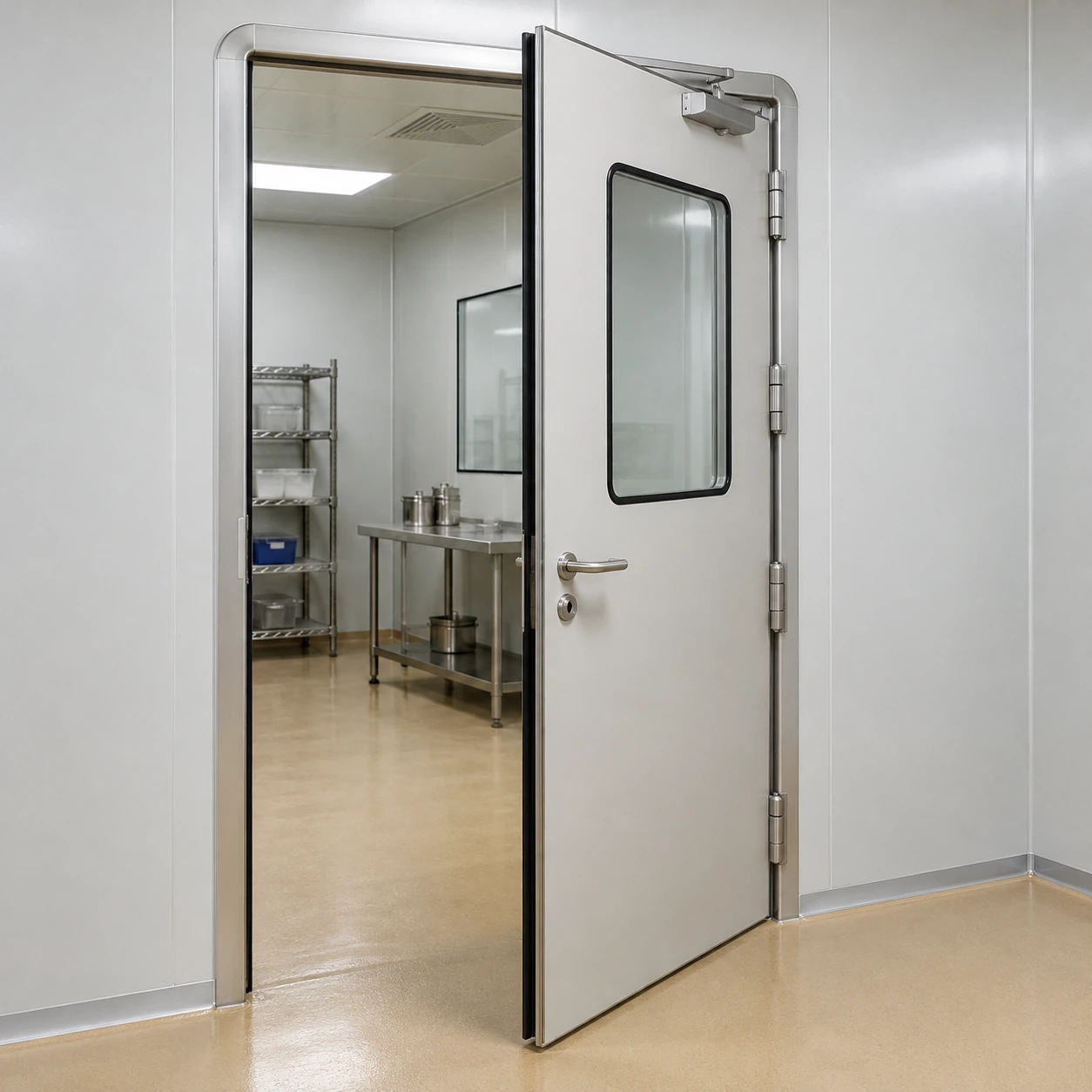
Cleanroom Doors / Windows
swing cleanroom doors
| Door format | Single leaf; equal or unequal double leaf |
|---|---|
| Nominal door sizes, W × H × T (mm) | 900 × 2100 × 42; 1828 × 2100 × 42 |
| Leaf finish | Powder-coated steel, stainless steel or aluminium skin |
| Frame | Aluminium profile or formed steel; matched to the wall system |
| Sealing | Perimeter gasket; bottom drop seal option |
| Glazing and hardware | Flush vision panel; lever or push plate; closer and access-control options |
Nominal door sizes are not clear-passage or wall-opening dimensions. Frame envelope, handing and usable opening are defined by the selected doorset drawing.
Leaf arrangement, handing, glazing and closing hardware can be configured for the application.
Swing cleanroom doors rotate on a defined hinge line and close against a stop and seal. Their simple movement can be convenient for personnel access, provided the swing arc, opening effort and closing sequence suit the room.
Give the swing arc a permanent place
The space swept by the leaf should remain usable after benches, waste bins and trolleys have been installed. A door that opens neatly on a drawing can become awkward if a workstation occupies the handle approach or a stored cart prevents full travel. Choosing the handing is therefore a layout decision, not a final hardware detail.
A single-action door has a defined closing stop. A double-action traffic door moves in both directions and needs a different hardware and sealing arrangement. They should not be treated as interchangeable simply because both use hinges. Where room separation is important, the selected closing geometry needs to match that duty.
Why a door can feel heavy
The user works against the closer, seal friction and any pressure force acting on the leaf. A latch rubbing on its strike adds another resistance. Increasing closer force may make an imperfect door shut, while also making routine entry harder.
Correct the cause in order: support and align the frame, establish consistent leaf clearances, adjust the latch and seal contact, then set the closer for controlled travel. The final adjustment should be made under the normal room operating conditions, not only with ventilation switched off.
Choose the right pair
Equal double leaves can suit frequent movement of wide loads. An unequal pair gives personnel a convenient active leaf while reserving the smaller leaf for occasional access. The secondary leaf must be simple enough to operate when needed, yet reliably secured during normal use.
A pair with an overlapping meeting stile may require a defined closing order. The inactive-leaf bolts, coordinator and closer settings should be considered together so the leaves finish closed rather than leaning against each other.
Keep sealing and access compatible
A perimeter gasket can close the jamb and head gap. The bottom needs its own solution: a suitable floor detail, drop seal or other specified arrangement. A raised threshold may improve one aspect of closure while creating an obstacle for carts; it should not be added casually to a material route.
Flush vision glazing helps users see the opposite approach before pushing the leaf. Hardware that can be wiped without inaccessible recesses supports routine cleaning. Accessible hinge and closer adjustments make normal wear easier to address without disturbing the wall joint.
Where there is insufficient swing space, compare sliding door layouts. Automatic operation can also be considered when manual effort or hands-occupied access is the main constraint, but it adds controls and service requirements.
Leaf arrangement, handing, glazing and closing hardware can be configured for the application.