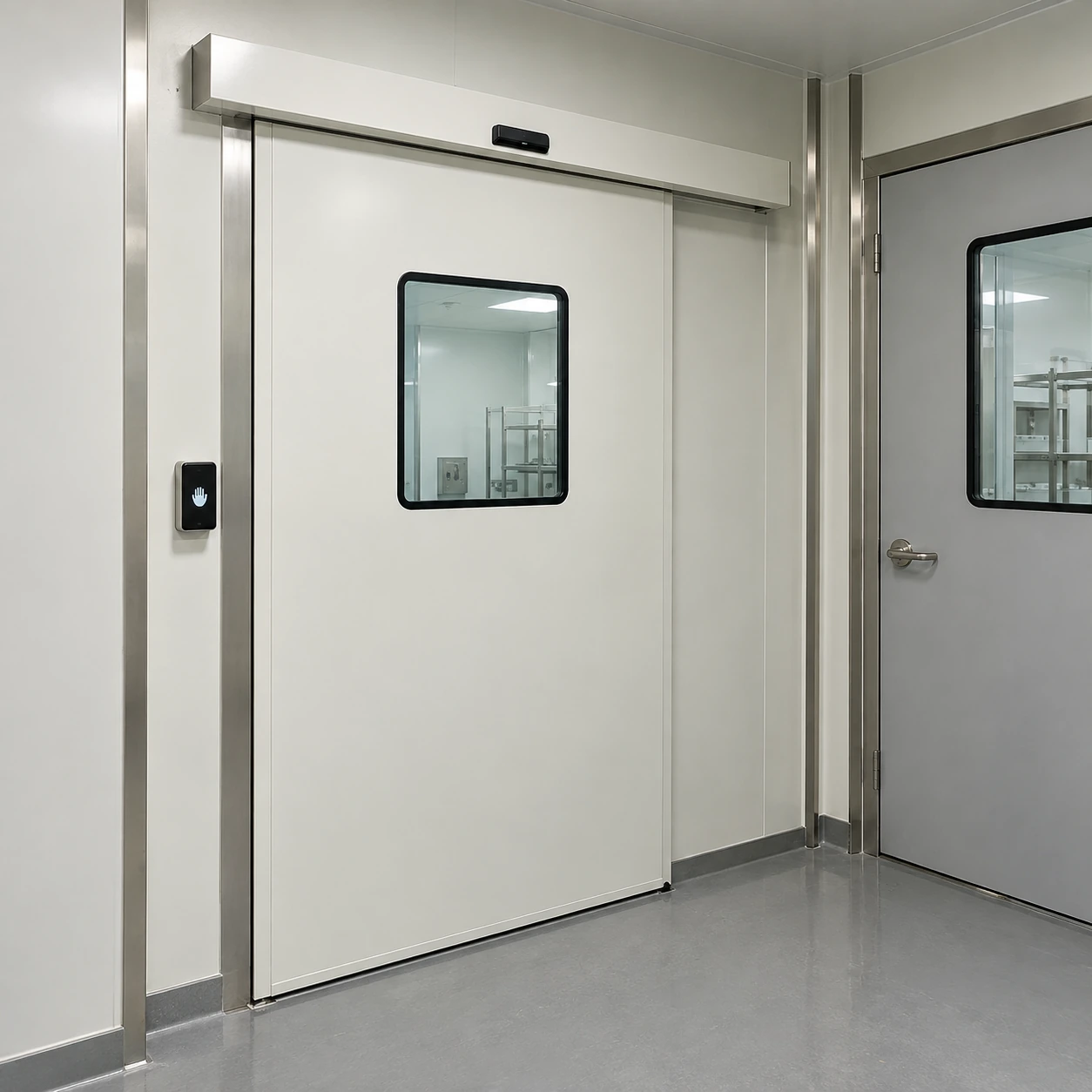
Cleanroom Doors / Windows
energy saving automatic cleanroom doors
| Operation | Automatic single sliding or bi-parting door |
|---|---|
| Clear passage widths (mm) | Single slide: 1200–1600; bi-parting: 1600–2000 |
| Opening height | Selected with operator headroom and installation drawing |
| Activation | Touchless switch, push button or access-control signal |
| Safety and release | Presence protection, obstruction response and manual-release provision |
| Electrical interface | Voltage, frequency, alarm inputs and interlock logic to the selected drive |
Options describe a coordinated automatic doorset. Electrical ratings and emergency behaviour are specified for the selected operator; a touchless trigger alone is not a safety sensor.
Activation, opening travel, control sequence and sealing can be configured for the traffic pattern and environmental requirements.
Energy saving automatic cleanroom doors address avoidable air exchange and operating time as part of the room system. A small motor-power figure alone does not explain the energy used to keep the surrounding space conditioned.
Separate the three loads
| Load | What influences it | Useful design response |
|---|---|---|
| Door-drive electricity | Operator design, standby demand, moving mass and cycles. | Select a suitable operator and maintain smooth mechanical travel. |
| Closed-door leakage | Seal contact, frame junction and room pressure. | Use the appropriate closure and maintain alignment and seals. |
| Exchange during passage | Opening size, duration, traffic and adjacent conditions. | Control unnecessary activation and coordinate the movement sequence. |
These loads interact. A tighter seal may need a deliberate compression movement, while a faster closing setting may be unsuitable for the users. A credible assessment compares the installed system under an actual traffic pattern.
Count unnecessary openings first
A motion detector facing a crossing corridor can open the door for people who never enter. Repositioning the detection zone or using deliberate touchless activation can reduce this wasted movement. The trigger should still be accessible to people carrying material and should not encourage them to prop the door open.
Daily open duration depends on both the number of cycles and the time each opening remains available. Reducing a long hold time may help, but only after allowing for slow users, loaded carts and safe detection. Safety protection should never be disabled to shorten the cycle.
Use partial opening deliberately
Some operators can provide different opening widths for personnel and larger loads. This can reduce the opening exposed during routine passage when the function is supported by the chosen system. The route and sensor coverage must remain adequate in each mode.
Where an airlock is required, coordinated doors can reduce direct connection between rooms. Its recovery and access timing follow the facility design. A delay that is unnecessarily long can disrupt work; one that is too short may defeat the intended separation.
Repair the boundary before claiming savings
A damaged gasket, dragging guide or distorted frame can leave a door incompletely closed. Repeated automatic retries increase wear and may keep the opening exposed. Mechanical inspection and adjustment can therefore be more useful than replacing an otherwise suitable operator.
Temperature and humidity differences, pressure, traffic and HVAC control all affect the outcome. No universal saving percentage applies to every cleanroom door. A meaningful comparison records those conditions and the before-and-after opening behaviour.
Review automatic door control options alongside the sealing and layout choices. The aim is reliable, appropriately timed access that the facility can sustain in normal operation.
Activation, opening travel, control sequence and sealing can be configured for the traffic pattern and environmental requirements.