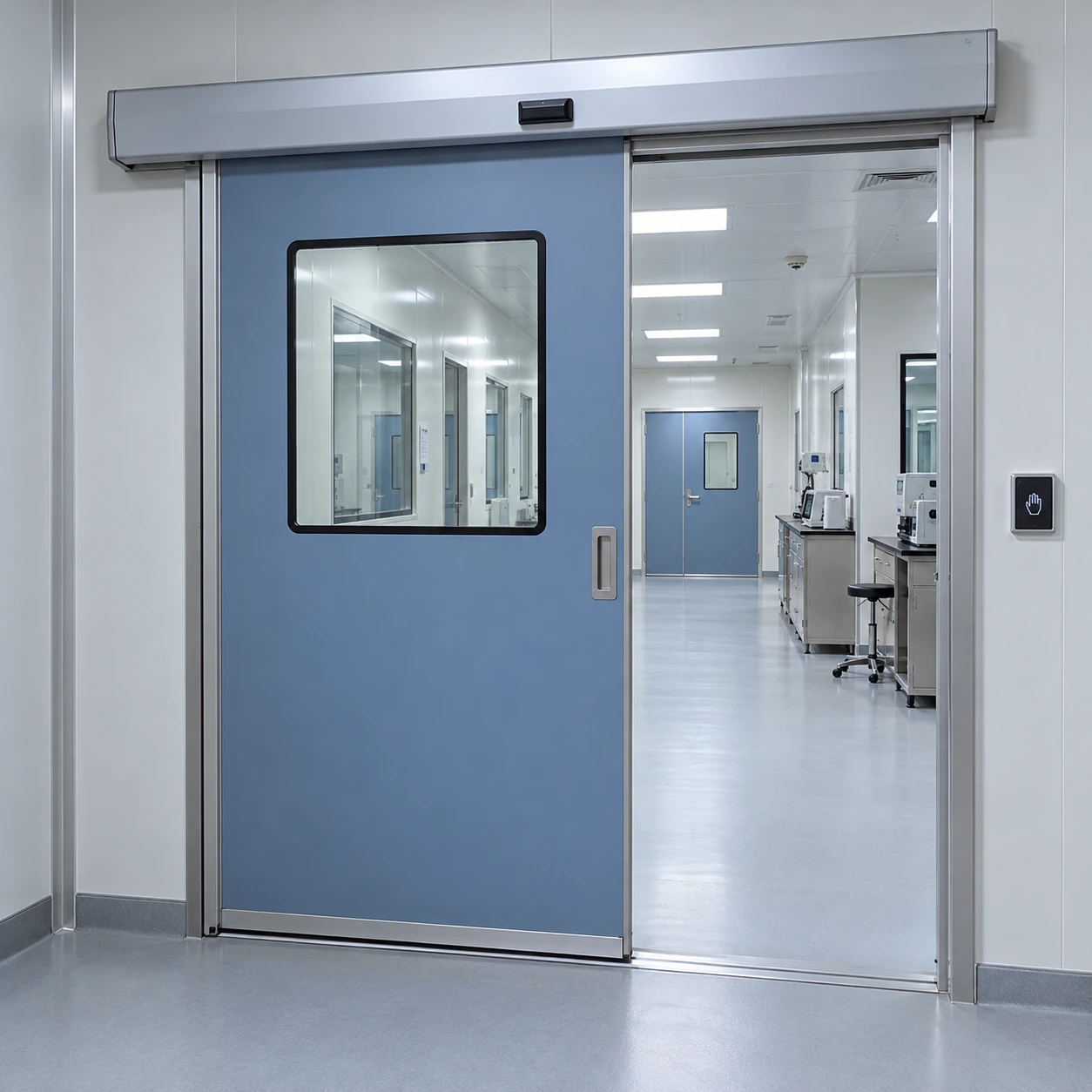
Cleanroom Doors / Windows
automatic cleanroom doors
| Operation | Automatic single sliding or bi-parting door |
|---|---|
| Clear passage widths (mm) | Single slide: 1200–1600; bi-parting: 1600–2000 |
| Opening height | Selected with operator headroom and installation drawing |
| Activation | Touchless switch, push button or access-control signal |
| Safety and release | Presence protection, obstruction response and manual-release provision |
| Electrical interface | Voltage, frequency, alarm inputs and interlock logic to the selected drive |
Options describe a coordinated automatic doorset. Electrical ratings and emergency behaviour are specified for the selected operator; a touchless trigger alone is not a safety sensor.
Door opening, activation devices and control interfaces can be configured for your application.
Automatic cleanroom doors move the leaf through a powered operator. The useful package includes the trigger, movement protection, door-position feedback, manual release and service access as well as the motor.
Separate the request to open from protection during movement
A touchless switch tells the controller that somebody wants to pass. A presence detector helps protect the occupied opening. One device does not necessarily perform both jobs. Its coverage must suit people, carts and the approach from each side rather than just the centre of the doorway.
Unwanted triggering also matters. A sensor aimed into a busy crossing corridor can keep a door cycling when nobody intends to enter. A deliberate activation point may be preferable for restricted access, while a well-positioned automatic trigger can make a frequent trolley route easier to use.
Specify the whole operating sequence
Standby
The system knows the leaf position and any access or interlock conditions. A closed command alone should not be used as proof that the boundary is established.
Passage
Opening and hold-open time accommodate the actual users and loads. Obstruction response and protection at closing or trapping edges follow the assessed installation risks.
Return
The leaf closes in a controlled way and completes its sealing movement where a compression-seal design is selected. A fault remains visible instead of being hidden by repeated automatic retries.
Power failure is part of the design
Whether the door unlocks, remains in position or moves to a designated state depends on its role, selected operator and applicable safety requirements. Manual operation needs to be physically usable by the intended people. A battery option is not a substitute for defining how the opening is used during an interruption.
Restoration also needs attention. The door should not unexpectedly trap a person who is moving it manually when power returns. Alarm release and normal airlock logic must have a documented priority appropriate to the facility.
Leave space to maintain the operator
The top enclosure needs room for opening, belt or roller access and safe isolation. Mounting it tightly beneath a pipe can turn a routine service task into wall or ceiling removal. The supporting structure must carry the moving assembly without relying on a thin panel skin.
Keep sensor windows, guides and seals accessible for cleaning. A cover that looks tidy but creates a concealed dirt shelf can undermine the reason for selecting a cleanroom door.
Commission with real traffic
Empty-opening movement proves very little about a loaded cart or a person approaching slowly. Installation checks should use the intended traffic patterns and verify the agreed controls and emergency procedures. For operational efficiency, see energy saving automatic cleanroom doors, where opening frequency and duration are considered separately from motor power.
Door opening, activation devices and control interfaces can be configured for your application.