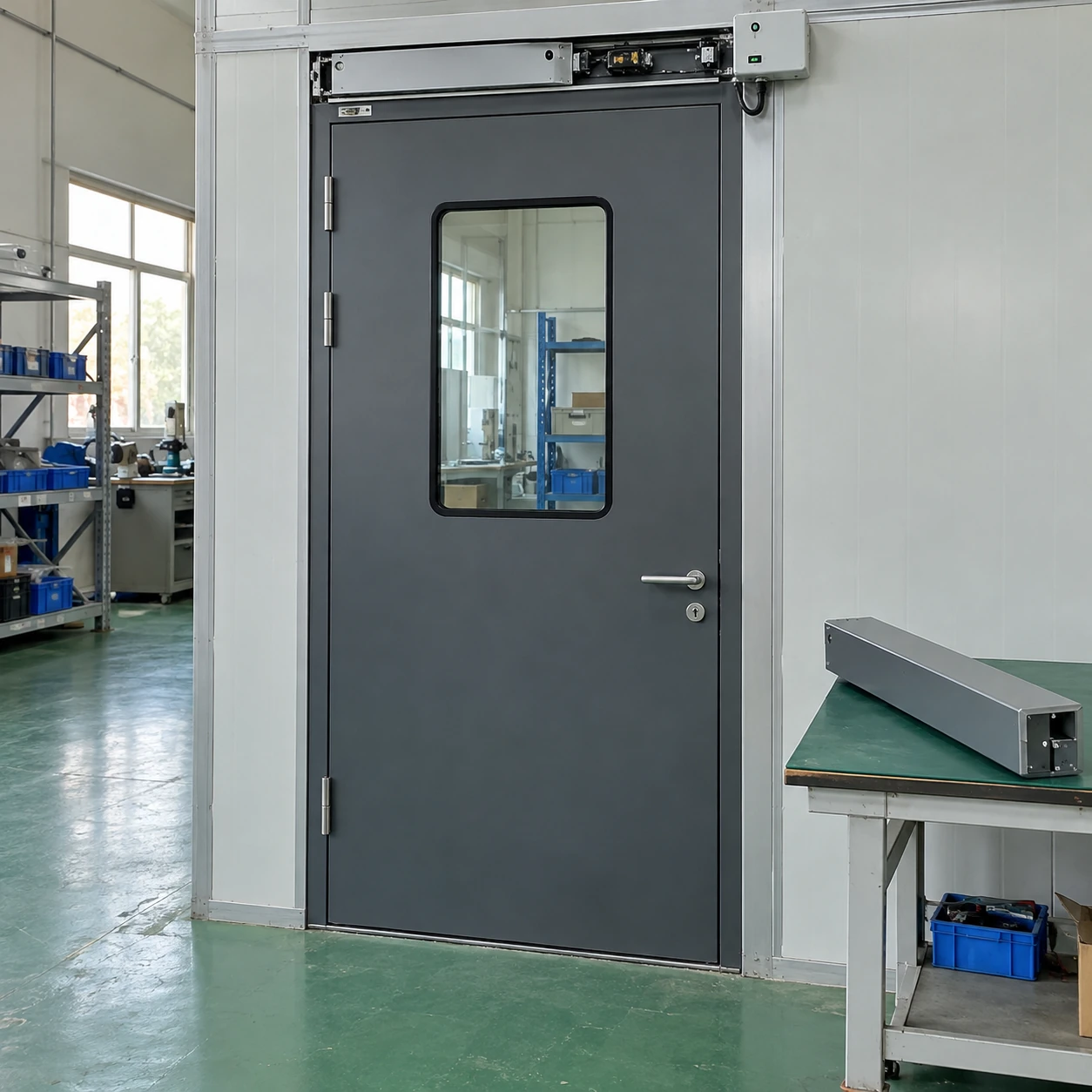
Cleanroom Doors / Windows
cleanroom doors kuwait
| Door format | Single leaf; equal or unequal double leaf |
|---|---|
| Nominal door sizes, W × H × T (mm) | 900 × 2100 × 42; 1828 × 2100 × 42 |
| Leaf finish | Powder-coated steel, stainless steel or aluminium skin |
| Frame | Aluminium profile or formed steel; matched to the wall system |
| Sealing | Perimeter gasket; bottom drop seal option |
| Glazing and hardware | Flush vision panel; lever or push plate; closer and access-control options |
Nominal door sizes are not clear-passage or wall-opening dimensions. Frame envelope, handing and usable opening are defined by the selected doorset drawing.
Door hardware, service access and accessory supply can be configured for the Kuwait facility and its maintenance plan.
For a Kuwait facility, a cleanroom door should remain serviceable after the installation team has left. Door selection should connect the daily operating method with the maintenance skills, component access and spare parts available to the site.
Choose complexity that the site can maintain
A manual hinged assembly may be suitable where traffic is moderate and simple maintenance is important. A powered sliding door can improve hands-occupied passage, but its controls, sensors and release mechanism need an identified service route. The decision should follow the operating need rather than the assumption that automation is always an upgrade.
For a powered option, the operator enclosure should be reachable without removing permanent services. Safe isolation and manual movement procedures need to be available to the maintenance team.
Keep the critical spares identifiable
A spare seal is useful only if its section and fitting method match the frame. A replacement controller is useful only if its configuration and interfaces can be restored. Retain references for seals, hinges, closers, locks and any specialised control components.
Common consumable parts can be included with the initial supply where appropriate. The quantity should follow the number of openings and expected service duty, not an unsupported universal replacement interval.
Use fault symptoms to guide maintenance
| Observed problem | Areas to investigate |
|---|---|
| Leaf rubs or latches inconsistently | Frame movement, hinge alignment, floor contact and strike position. |
| Automatic door reopens repeatedly | Obstruction, sensor coverage, guide resistance and the configured protection response. |
| Uneven seal contact | Leaf geometry, gasket seating, latch adjustment and the lower floor detail. |
These symptoms are reasons for a competent assessment, not instructions to disable a safety function or increase motor force. Correcting the mechanical cause is usually preferable to concealing it with a control adjustment.
Prepare a coherent shipment
Kuwait Customs' commercial import procedure identifies the declaration and supporting commercial, origin and transport documents, with packing information for multiple items. The importer or broker should confirm the current requirements and product classification for the actual package.
Door assemblies, spare parts and powered accessories should be itemised clearly. The receiving team also needs to know which components belong to each opening so spare items are not mistakenly installed as alternatives.
Handover should support real use
Include final drawings, hardware references and the agreed operating and release procedures. The local installation and maintenance responsibilities should be explicit; shengtongjh coordinates procurement without implying a Kuwait service office.
Compare swing doors with automatic doors against the facility's actual traffic and service arrangements.
Door hardware, service access and accessory supply can be configured for the Kuwait facility and its maintenance plan.