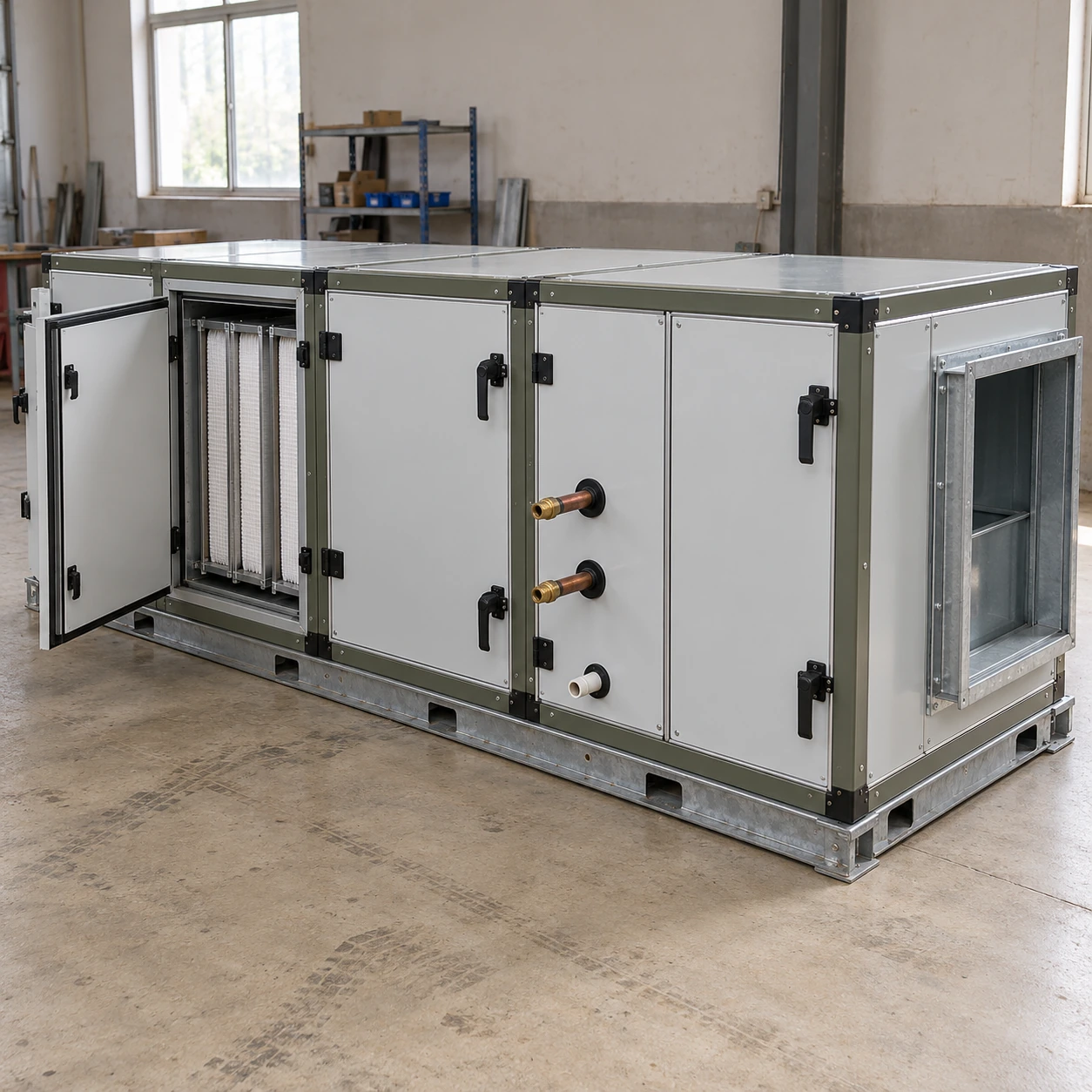
Air Handling Units
air handling units
| Airflow duty options | 2000 / 5000 / 10000 m³/h; fan selection at the required system pressure |
|---|---|
| Casing W × H (mm) | 890 × 690; 1190 × 890; 1590 × 1090 |
| Casing construction | Insulated double-skin panels; coated outer skin with galvanized or stainless inner surface |
| Functional sections | Intake or mixing, filtration, cooling/heating, fan and discharge; recovery or acoustic sections as specified |
| Coil arrangement | Chilled-water, hot-water or matched DX coil; drain pan for cooling duty |
| Fan arrangement | EC direct-drive or motor with variable-frequency drive, selected for the duty point |
| Filtration | Panel prefilter with fine-filter stage where required; differential-pressure monitoring |
| Controls | Fan command/status, temperature control, filter alarm and agreed building-control interface |
| Installation | Indoor sectional assembly; weather-protected outdoor construction by specification |
Casing dimensions exclude the base, top dampers and projecting connections. Overall length follows the selected sections; the installation envelope also includes door opening and component-removal space.
Airflow duty, section arrangement, casing dimensions, connection positions and controls can be customized for your application and installation space.
Air handling units bring fans, filters and air-treatment components into a coordinated assembly. They move air through a building or process area while the selected coils, dampers and filtration stages address its temperature, moisture and particle-control needs. shengtongjh coordinates configurations for commercial facilities, production buildings, laboratories and controlled environments.
Define the air path before the cabinet
The first decision is what air enters the unit and where it goes. A recirculation arrangement returns part of the room air to the AHU; a dedicated outdoor-air arrangement conditions incoming ventilation air; a supply-and-extract arrangement handles two distinct streams. These choices change the coil load, damper layout, fan arrangement and available heat-recovery options.
An AHU with a water coil relies on an external source of hot or chilled water. A DX coil needs a compatible refrigeration system and its control arrangement. The casing itself does not establish cooling capacity. Where chilled water is the chosen approach, coordinate the unit with the air cooled chiller and the distribution circuit.
A useful section sequence
Air normally passes through an intake or mixing arrangement and filtration before reaching the treatment and fan sections. The final order depends on the duty: fan placement changes the pressure at the cooling-coil drain, while additional filters or sound attenuators change the pressure losses and the space required.
Access sections are working space inside the assembly. They allow inspection between components and can make coil cleaning or filter replacement practical. Removing them simply to shorten the unit can create a lasting service problem.
Check three selections together
Airflow and pressure
State the required airflow together with the resistance of the connected system. Ducts, terminals and accessories consume pressure outside the AHU, while coils and filters consume pressure inside it. The fan selection must account for both, with a clear definition of the quoted external pressure.
Air and water conditions
Cooling performance depends on entering-air temperature and moisture, water or refrigerant conditions, and the required leaving-air state. A coil chosen only from a nominal capacity can miss the moisture-removal duty when the outdoor-air proportion changes.
Filter loading and access
A filter's resistance changes as it loads. Allow for the selected replacement condition when reviewing fan operation, and provide pressure measurement across the filter stage. A finer filter also needs the right frame seal and enough space for removal.
Fit the unit and its maintenance route
Check the delivery route, largest shipping section and available lifting method before fixing the final arrangement. A sectional unit can enter a restricted plantroom in parts, but the site still needs space to join, align and seal those sections. Confirm the side of access and coil connections on the same drawing.
Routine filter access and full coil withdrawal are different space requirements. Pipework, cable trays and nearby walls should allow both the intended service work and removal of the largest replaceable component. Keep the drain pan accessible and reserve sufficient base height for the specified condensate arrangement.
Choose the casing for the location
An indoor plantroom and an exposed roof require different enclosure details. Outdoor equipment needs weather protection at panel joints, access doors and air openings, with a support arrangement suited to the site. Insulation and thermal breaks also matter where cold internal surfaces meet warm, humid surrounding air.
For frequent wet cleaning or demanding air streams, review the internal surface, drain pan and fasteners together. A stainless liner is one material option; it does not by itself establish hygienic performance, corrosion suitability for every chemical, or a room cleanliness class.
Request a selection that can be checked
A useful quotation identifies the duty point, coil conditions, filter arrangement, component access and connection locations. Include the available space and any limits on sound, electrical supply or shipping sections. Drawings and selected component data should describe the same arrangement.
For offices, retail or hospitality projects, see commercial air handling units. For coordination with plant, terminal devices and controls, see hvac air handling units, or send the operating requirements through the quotation enquiry.
Airflow duty, section arrangement, casing dimensions, connection positions and controls can be customized for your application and installation space.