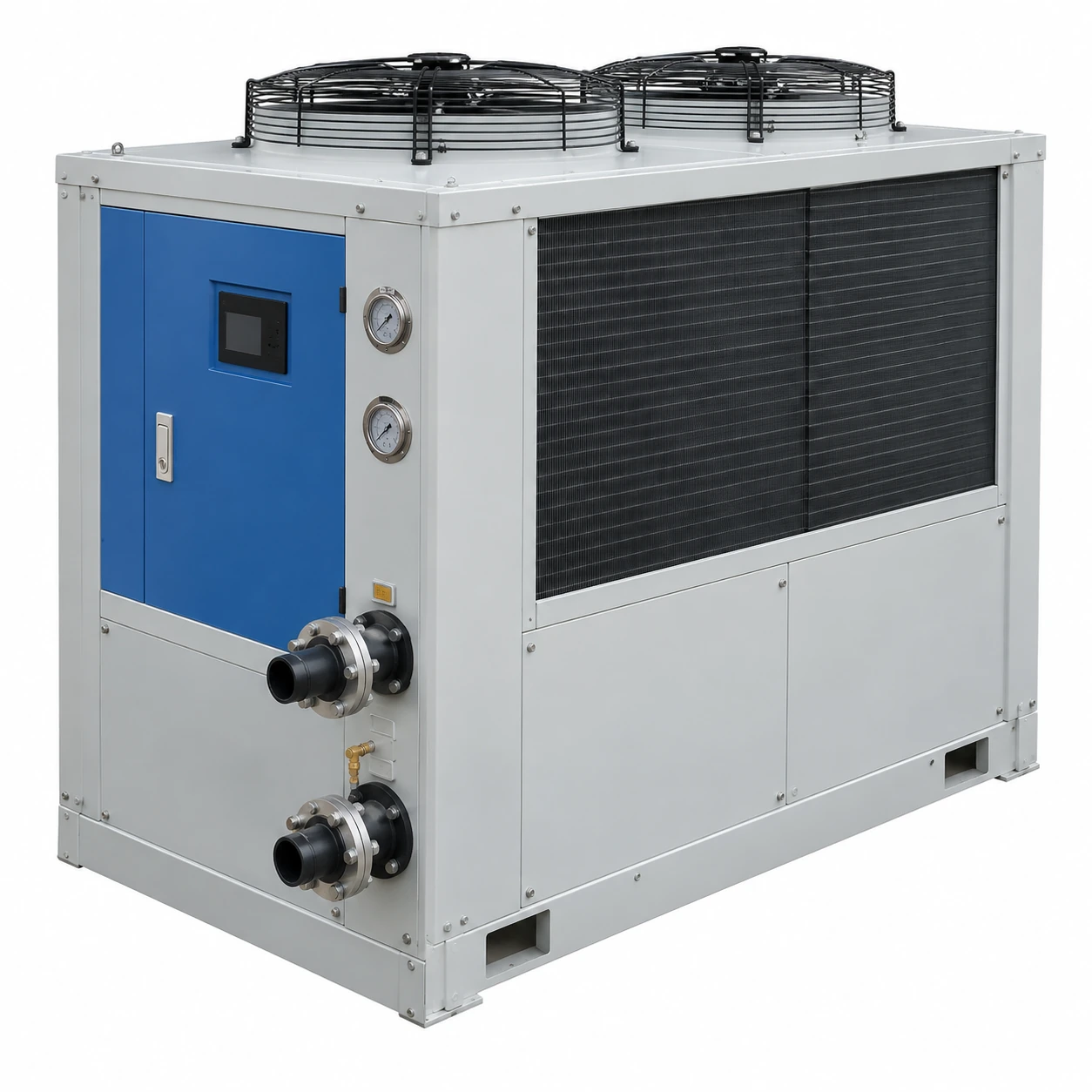
Air-Cooled Chillers
air cooled chiller
| Brand | shengtongJH |
|---|---|
| Product range | Industrial process-water chillers; compact packaged and outdoor central configurations |
| Capacity selection | 1–500 US refrigeration tons across the range; approximately 3.52–1,758 kW |
| Leaving-water selection | Common positive-temperature duties: 7°C, 10°C or 15°C; equipment selected for the actual return temperature and ambient |
| Refrigeration arrangement | Scroll or screw compressors with air-cooled finned condensers |
| Water circuit | Integral pump/tank on compact packages; separate hydraulic module on larger systems |
| Cabinet construction | Coated steel enclosure; corrosion-protection options for the installation environment |
| Size options, L × W × H (mm) | Compact envelopes around 1,000 × 650 × 1,150; larger packaged envelopes around 2,500 × 1,700 × 2,000; central units sized separately |
| Electrical supply | 220–240 V single-phase on selected small units; 380–415 V three-phase configurations for larger equipment |
| Controls | Water-temperature control, flow proving, refrigeration protection and remote alarm options |
Capacity, dimensions and electrical details are selected as one matched configuration. Final performance is specified at the agreed fluid and ambient conditions.
Cooling duty, hydraulic equipment, enclosure and controls can be customized for your process and installation conditions.
An air cooled chiller removes heat from a circulating liquid and releases it to the surrounding air. It supplies chilled water to production equipment without a separate cooling-tower circuit, making it useful where water treatment, tower maintenance or available plant space would complicate installation.
Process cooling
Keep the machine within its useful temperature range
In a moulding machine, heat exchanger or production cooling jacket, the cooling water carries away process heat. When that water becomes too warm, the process may drift even though the machine itself is running normally. A chiller adds active refrigeration so the supply temperature does not depend solely on outdoor conditions, as it would with a simple dry cooler.
The useful starting point is the heat entering the water, the required supply temperature and the acceptable return temperature. Equipment motor power alone is not the cooling load: only the portion of energy transferred into the cooling circuit should be counted, together with other process heat sources.
Three connections determine whether it works on site
Heat into the evaporator
Water must reach the evaporator at a suitable flow and quality. A blocked strainer or incompatible fluid can limit cooling even when the compressor has enough capacity.
Heat out through the condenser
The fans need an unobstructed air path. Warm discharge air returning to the coil raises the temperature seen by the machine and can reduce available cooling.
Cooling into the process
The pump must overcome the actual pipe and equipment resistance. A large pump motor or a large chiller label does not prove that sufficient water reaches the production tool.
Packaged unit or separate plant?
A compact package puts the chiller, tank and pump close to a single process. It simplifies local piping but introduces heat and noise near the work area. Outdoor central equipment serves several loads and moves heat rejection outside, with additional pipework, insulation and plant controls.
Make maintenance part of the selection
Allow access to the coil face, water strainer, pump and electrical enclosure. Choose coil protection for a corrosive site and a cleaning method compatible with its fins and coating. Isolation valves and drain points make servicing possible without emptying the whole production network.
For a shared factory loop, explore the system arrangement before choosing the individual unit.
Cooling duty, hydraulic equipment, enclosure and controls can be customized for your process and installation conditions.