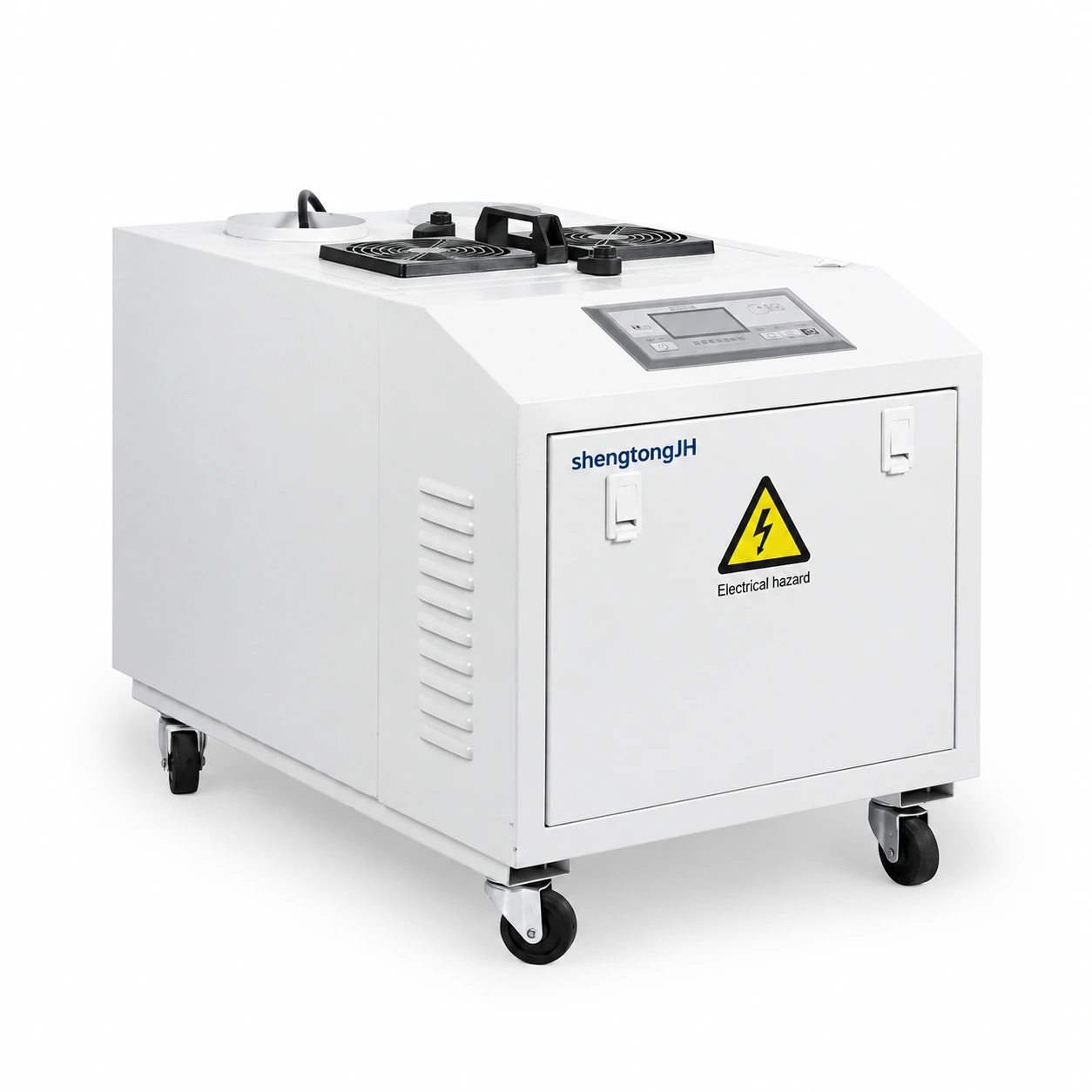
Cabinet appearance and connection layout vary with the selected capacity.
Ultrasonic Humidifiers
humidifier ultrasonic humidifier
| Specification | 9 kg/h | 12 kg/h |
|---|---|---|
| Brand | shengtongJH | |
| Humidification capacity | 9 kg/h | 12 kg/h |
| Rated input power | 0.9 kW | 1.2 kW |
| Power supply | 220 V AC, 50 Hz | |
| Cabinet dimensions (mm) | 650 × 450 × 465 | |
| Net weight | 35 kg | 40 kg |
| Mist outlet arrangement | 2 × nominal 110 mm PVC | |
| Cabinet fan airflow | 350 m³/h | 450 m³/h |
| Humidity sensing | Electronic humidity sensor | |
| Positioning | Floor-standing cabinet with swivel casters | |
Capacity, connections and configuration can be selected for your application. Installation drawings define orientation and service clearances.
A useful humidification setup connects the cabinet, water supply, mist distribution and humidity sensing to the same task. Selecting the machine alone leaves important parts of the result to chance.
A complete installation
Start with where moisture is being lost
Dry incoming air, open loading doors, extraction systems and moisture-sensitive materials can all change the demand on a humidifier. Two rooms of equal floor area can need very different output. Heating can also lower relative humidity without removing water from the air. Record the operating temperature, present humidity and target range before selecting capacity.
A room-volume estimate is useful for describing the space, but it is not a complete sizing method. Fresh-air volume, leakage and the process moisture load determine how much water must be added. shengtongJH can organize the equipment selection around these inputs so the humidifier, water treatment and distribution arrangement are considered together.
Four parts that need to work together
Water preparation
Check dissolved minerals and the required inlet conditions. A sediment filter catches particles but does not remove dissolved salts. Where mineral carryover matters, suitable demineralization belongs in the equipment plan.
Mist delivery
Keep the discharge clear of nearby products, walls and electrical equipment. Outlet routing must let the mist enter moving air without accumulating liquid in low points.
Room mixing
The cabinet fan transports mist; it does not guarantee uniform humidity throughout a large room. Shelving and machines can create sheltered areas that need a different distribution arrangement.
Feedback
Place the humidity sensor where it represents the controlled area. A probe sitting in the mist plume may stop the machine before the rest of the room reaches the intended condition.
Resolve the symptom before increasing output
If the area near the outlet is damp while the far end remains dry, first examine distribution and mixing. More output can make the wet area worse. If humidity falls whenever an extraction fan starts, the changing ventilation load may be more significant than the room dimensions. If readings fluctuate with temperature, review both measurements together.
After installation, compare humidity at representative locations while the normal process is running. Observe floors, cold surfaces and stored materials as well as the displayed reading. These checks reveal whether the system is adding moisture where it is useful.
Build the purchase around the whole route
Include water treatment access, a practical drain arrangement, the electrical supply, outlet routing and a service position in the layout. For the machine itself, see ultrasonic humidifier operation and maintenance. If the equipment must move between work areas, review the portable configuration.
Capacity, distribution and associated equipment can be configured for your application. Send the room conditions and intended operating pattern with your inquiry.