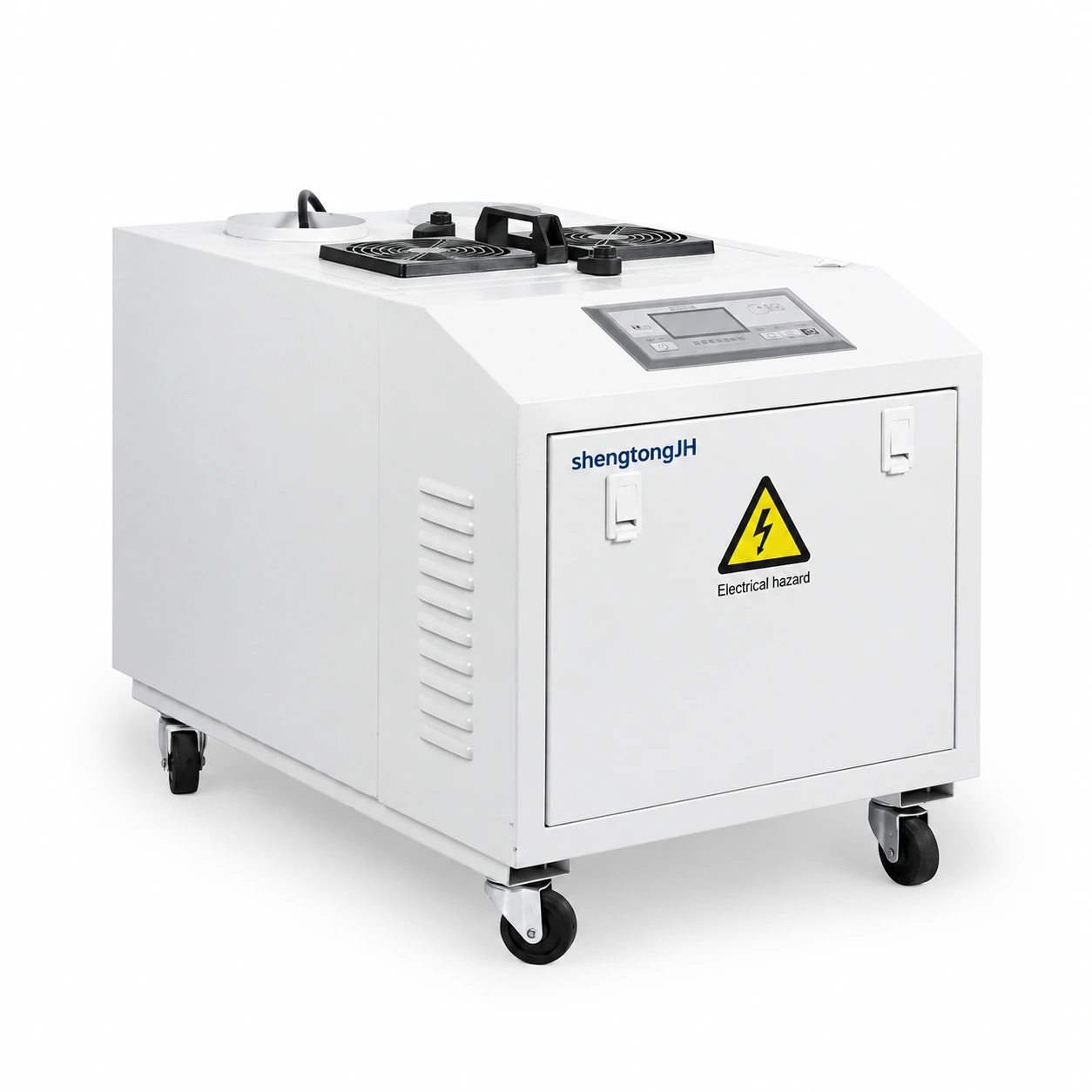
Cabinet appearance and connection layout vary with the selected capacity.
Ultrasonic Humidifiers
ultrasonic humidifier portable
| Specification | 3 kg/h | 6 kg/h |
|---|---|---|
| Brand | shengtongJH | |
| Humidification capacity | 3 kg/h | 6 kg/h |
| Rated input power | 0.3 kW | 0.6 kW |
| Power supply | 220 V AC, 50 Hz | |
| Cabinet dimensions (mm) | 530 × 360 × 470 | 510 × 360 × 465 |
| Net weight | 22 kg | 28 kg |
| Mist outlet arrangement | 1 × nominal 110 mm PVC | |
| Cabinet fan airflow | 180 m³/h | 350 m³/h |
| Humidity sensing | Electronic humidity sensor | |
| Positioning | Floor-standing cabinet with swivel casters | |
Capacity, connections and configuration can be selected for your application. Installation drawings define orientation and service clearances.
A wheeled industrial humidifier can be repositioned as work areas change. Portable means movable within a planned installation; it does not mean cordless, self-contained or suitable for every nearby socket.
Mobility with a workable connection plan
The hoses and cable move with the machine
Before choosing a location, identify the water supply, drainage arrangement and electrical connection. A position that looks convenient for the cabinet may create a long hose run or a cable across a busy aisle. Keep these services supported and protected without pulling on the cabinet connections.
The smaller configuration reduces the equipment envelope, but the operating footprint also includes opening access, hose bends and mist clearance. Check doorways, thresholds and the final service position. Do not assess portability from the cabinet dimensions alone.
Relocate in a controlled sequence
Stop and prepare
Switch off and isolate the equipment. Follow the supplied procedure for the water chamber before movement; do not move a running cabinet or assume a full reservoir is safe to transport.
Clear the route
Disconnect or secure services appropriately. Check the floor, thresholds and caster path. Use suitable handling assistance for the equipment mass rather than lifting by a pipe or control panel.
Set the new position
Place the cabinet on a stable, level surface and secure it against unintended movement. Keep the fan intake open and direct the outlet away from people, electrical equipment and exposed goods.
Reconnect and observe
Check for leaks, confirm the correct electrical supply and inspect the discharge during restart. Reassess the humidity-sensor position because the original location may no longer represent the treated area.
A wheeled cabinet is not a handheld humidifier
This equipment format suits movable industrial installations with planned services. It should not be selected as a small domestic or desktop appliance. Casters help with positioning on suitable floors; they do not make stairs, uneven ground or frequent lifting part of normal operation.
If several work zones need humidity simultaneously, repeatedly moving one cabinet may not solve the problem. Separate equipment or a distribution system can be more appropriate. If only one work area operates at a time, a relocation plan can make the movable format useful without unnecessary fixed installations.
Watch the new area after each move
A different room may have colder surfaces, more extraction or less air movement. Begin with the specified control setup and observe both humidity readings and nearby surfaces. If the outlet area becomes damp, review placement and distribution before increasing the output.
For installations that stay in place through long production shifts, see the industrial ultrasonic humidifier. Cabinet capacity, service connections and discharge arrangements can be selected for your application and movement requirements.