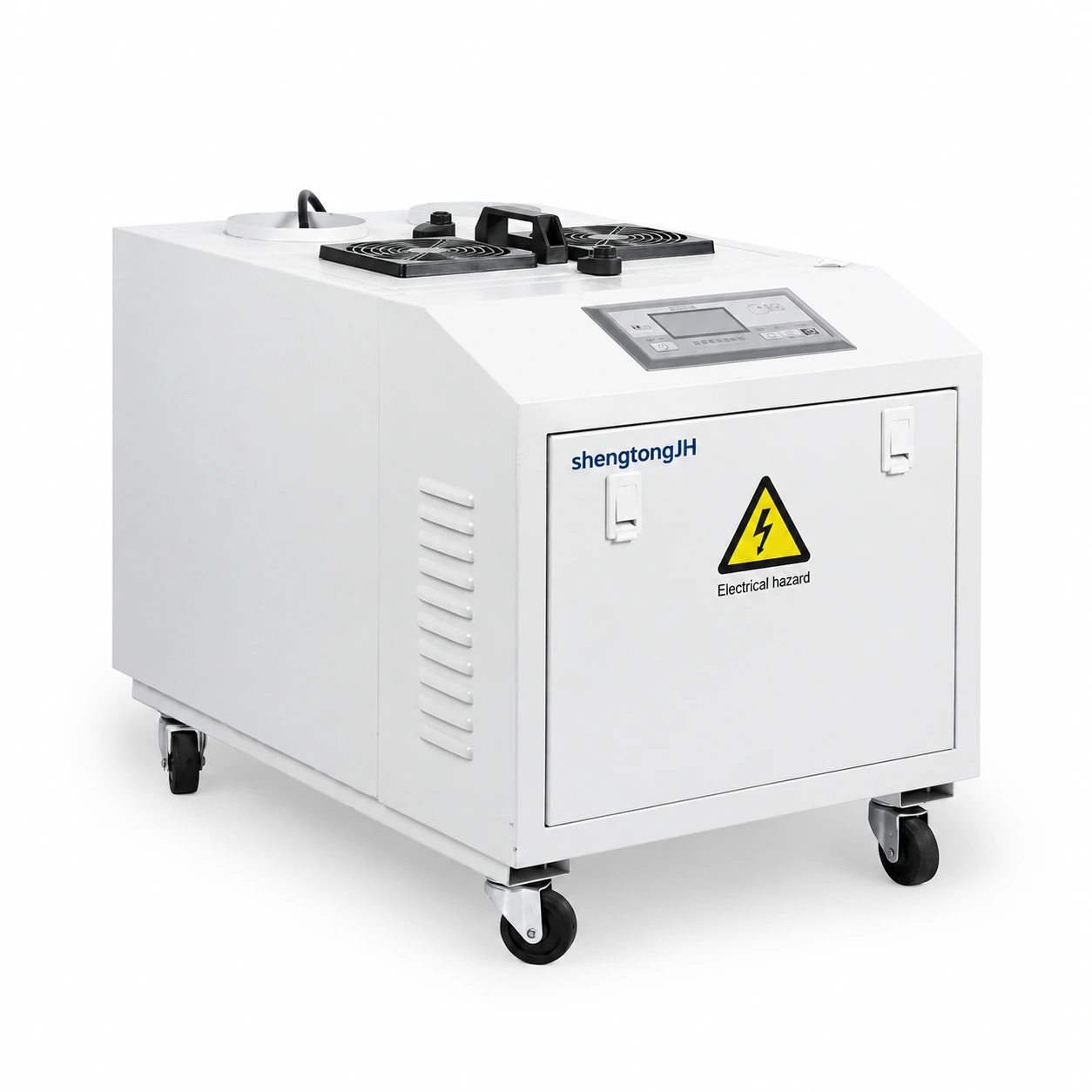
Cabinet appearance and connection layout vary with the selected capacity.
Ultrasonic Humidifiers
industrial ultrasonic humidifier
| Specification | 15 kg/h | 18 kg/h |
|---|---|---|
| Brand | shengtongJH | |
| Humidification capacity | 15 kg/h | 18 kg/h |
| Rated input power | 1.5 kW | 1.8 kW |
| Power supply | 220 V AC, 50 Hz | |
| Cabinet dimensions (mm) | 650 × 780 × 520 | |
| Net weight | 55 kg | |
| Mist outlet arrangement | 3 × nominal 110 mm PVC | |
| Cabinet fan airflow | 600 m³/h | |
| Humidity sensing | Electronic humidity sensor | |
| Positioning | Floor-standing cabinet with swivel casters | |
Capacity, connections and configuration can be selected for your application. Installation drawings define orientation and service clearances.
Industrial humidification has to follow the process through operating shifts, extraction changes and material movement. Output is one part of that specification; serviceability and distribution determine whether the installation remains practical.
Size for the operating shift
A production area may lose moisture continuously through ventilation and intermittently through doors or material transfers. Describe the normal operating condition and the most demanding credible condition separately. Selecting equipment only from a floor-area label overlooks the air being replaced and the process that is absorbing moisture.
For printing, packaging, textiles or other moisture-sensitive work, the acceptable humidity range comes from the material and process requirements. Humidification can support those conditions, but it does not independently guarantee product quality or replace a complete electrostatic-control programme.
Check the installation interfaces before ordering
Water
Account for the continuous demand, treatment-system output and cleaning needs. If a buffer tank is used, include its hygiene management and maintenance access in the arrangement.
Air distribution
Match the number and position of discharge routes to the work area. Several outlets do not automatically create balanced coverage; restrictions and branch routing can change the distribution.
Electrical supply
Match the delivered voltage and frequency to the destination. A plug adapter does not convert voltage or frequency. Include the water-treatment and distribution accessories when planning the electrical load.
Operation
Define where humidity is sensed, how demand changes during breaks and who maintains the equipment. Control-system integration should be specified explicitly rather than assumed.
One larger cabinet or distributed units?
A central cabinet can concentrate water service and maintenance at one location, but the distribution route may become longer. Separate units can serve distinct work areas and reduce the distance the mist must travel, while adding more service points and controls.
The useful choice depends on partitions, airflow and maintenance arrangements. Independent work zones do not necessarily need the same humidity at the same time. Avoid connecting them to a common control signal without examining how each zone behaves.
Make downtime manageable
Allow access to atomizing components, the fan and the water chamber without moving production machinery. Keep a record of the delivered component specification so replacement parts can be matched later. Where a humidity interruption would stop the process, assess standby capacity and an isolation arrangement as part of the project; neither is automatically included in a single cabinet.
shengtongJH provides an equipment procurement route for the humidifier and associated installation requirements. Include your process, operating hours, air exchange, target humidity, water quality and destination electrical supply when requesting a configuration. For a wider system-selection discussion, see humidification setup planning. Equipment and interfaces can be configured for your application.