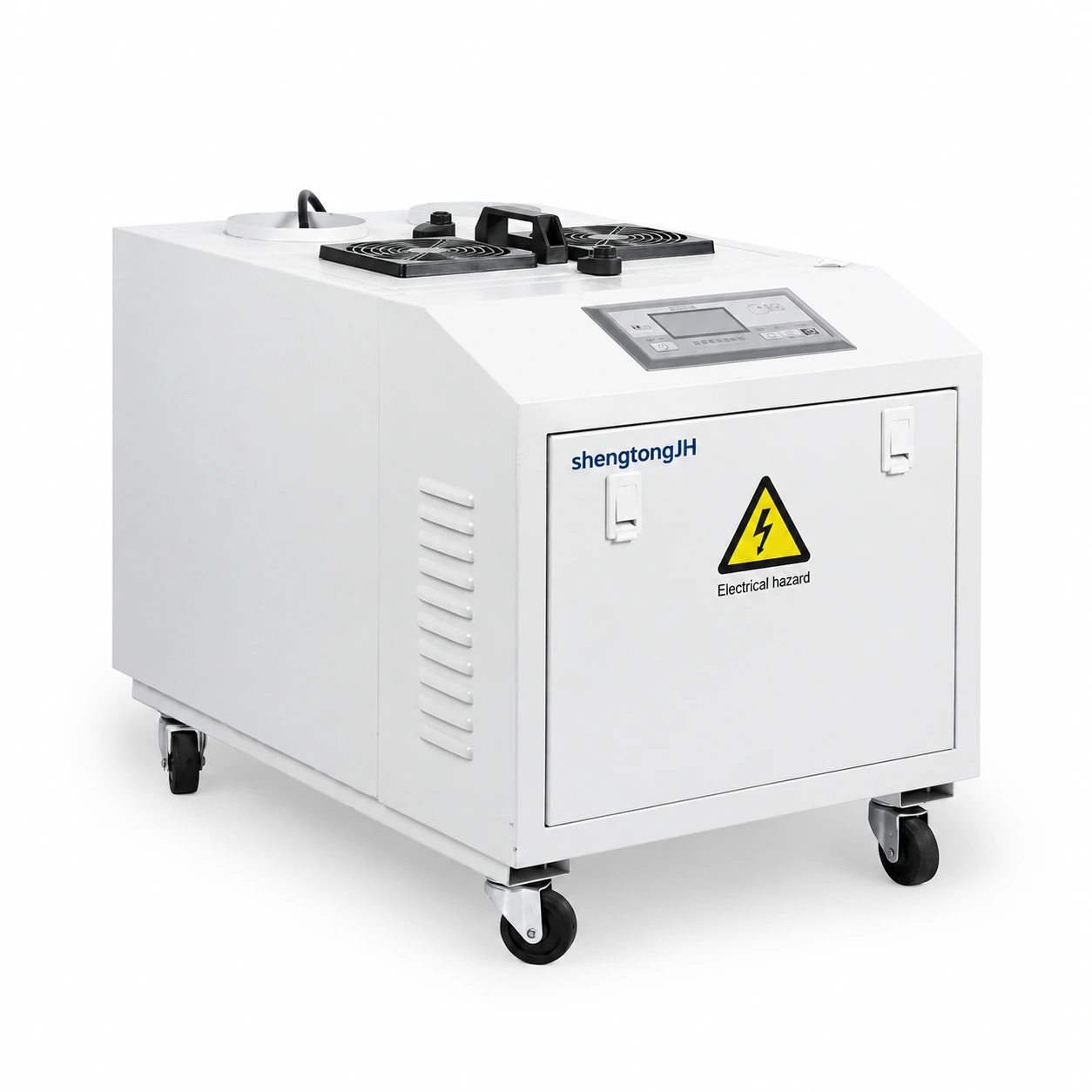
Cabinet appearance and connection layout vary with the selected capacity.
Ultrasonic Humidifiers
ultrasonic humidifier
| Specification | 6 kg/h | 9 kg/h | 12 kg/h |
|---|---|---|---|
| Brand | shengtongJH | ||
| Humidification capacity | 6 kg/h | 9 kg/h | 12 kg/h |
| Rated input power | 0.6 kW | 0.9 kW | 1.2 kW |
| Power supply | 220 V AC, 50 Hz | ||
| Cabinet dimensions (mm) | 510 × 360 × 465 | 650 × 450 × 465 | 650 × 450 × 465 |
| Net weight | 28 kg | 35 kg | 40 kg |
| Mist outlet arrangement | 1 × nominal 110 mm PVC | 2 × nominal 110 mm PVC | 2 × nominal 110 mm PVC |
| Cabinet fan airflow | 350 m³/h | 350 m³/h | 450 m³/h |
| Humidity sensing | Electronic humidity sensor | ||
| Positioning | Floor-standing cabinet with swivel casters | ||
Capacity, connections and configuration can be selected for your application. Installation drawings define orientation and service clearances.
An ultrasonic humidifier creates a fine water mist using vibrating transducers. A fan carries that mist out of the cabinet, where it must mix with the surrounding air and evaporate.
What happens inside the cabinet
The atomizing assembly acts on water held at the required operating level. Its vibration creates droplets without boiling the reservoir. The air-moving section then transports the mist towards the discharge connection. This explains why water quality, water level and an unobstructed air path all matter: an energized machine can still deliver a poor result if one of those conditions is wrong.
Rated output describes the selected equipment capacity. It is not a promise that every kilogram of discharged water will become useful room humidity under every condition. Air temperature, existing humidity and the distance available for absorption influence what happens after the mist leaves the outlet.
Choose an operating configuration, not just a larger number
A smaller capacity can be easier to manage in a modest, enclosed work area. A higher demand may need greater output or distributed equipment, depending on how the room is divided.
Continuous demand
Review sustained moisture loss, the available water supply and maintenance access. An upstream water-treatment system must keep up with the demand rather than briefly meeting a peak from a small storage volume.
Intermittent demand
Consider the control response during breaks, product changes and door openings. Too much output near the sensor can produce short operating cycles while distant areas remain below the intended humidity.
Service access
Leave space to reach the water chamber, air intake and electrical compartment. A cabinet that fits tightly between machines may become difficult to clean or repair.
Water quality affects both the equipment and the room
Ultrasonic atomization can carry dissolved material from the water into the air. Mineral deposits may also build up on wet components. Where deposits on goods or equipment are unacceptable, assess demineralized water rather than assuming a simple particle filter is enough.
Water treatment does not replace hygiene maintenance. Keep the water path clean, follow the supplied cleaning procedure and address standing water after interruptions. Do not add fragrances, disinfectants or process chemicals to the reservoir unless the equipment and application are specifically designed for them.
A maintenance routine that protects useful output
- Inspect the water chamber and atomizing surfaces for deposits before output declines significantly.
- Keep the fan intake and outlet path clear so mist does not collect inside the cabinet or discharge duct.
- Check that the humidity probe remains in a representative location after changes to the room layout.
- Isolate electrical power and water before servicing; use the supplied equipment procedure for cleaning and restart.
For discharge and absorption issues, read the cool mist configuration page. shengtongJH can coordinate capacity, water preparation and connection requirements for your application.