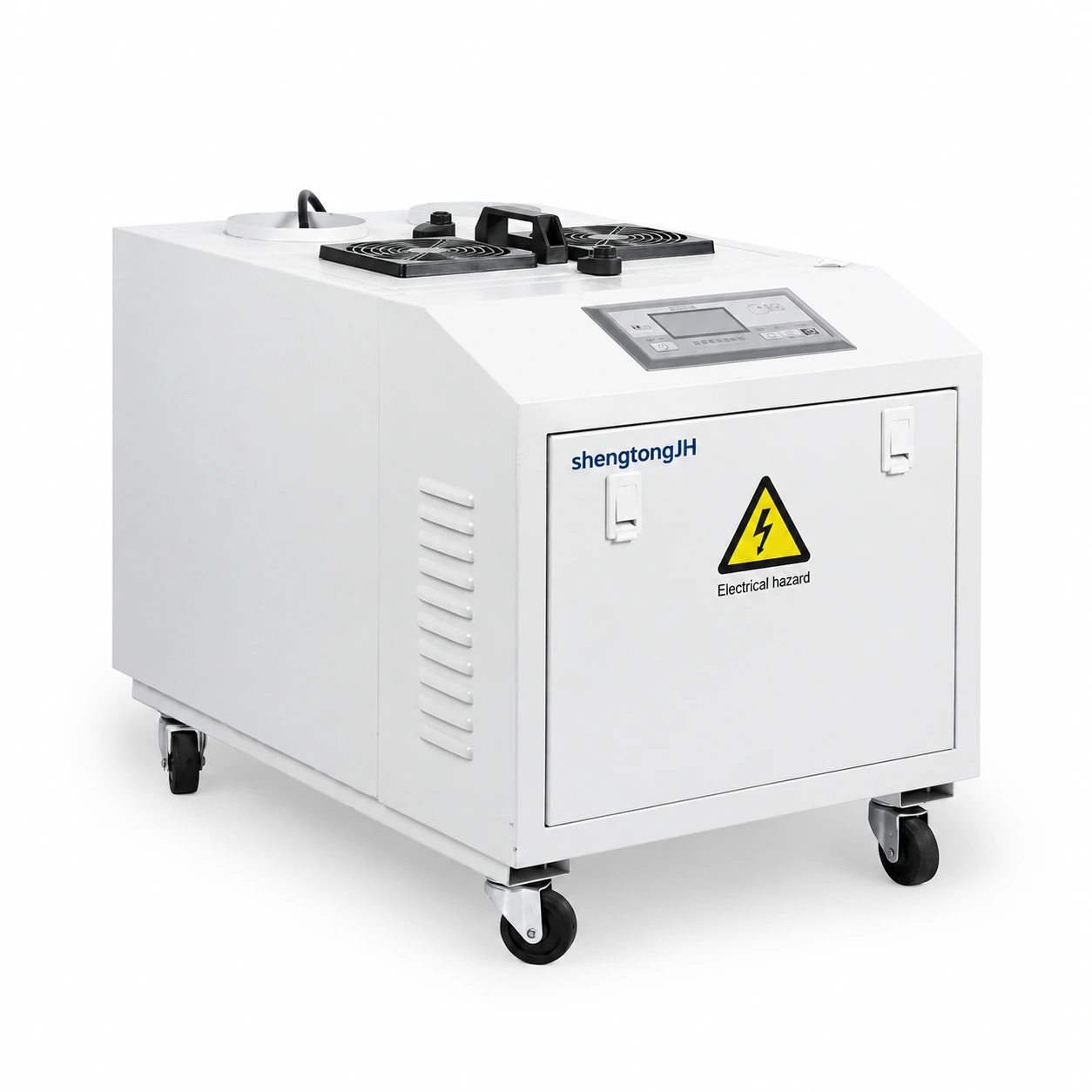
Cabinet appearance and connection layout vary with the selected capacity.
Ultrasonic Humidifiers
ultrasonic humidifier cool mist
| Specification | 12 kg/h | 15 kg/h |
|---|---|---|
| Brand | shengtongJH | |
| Humidification capacity | 12 kg/h | 15 kg/h |
| Rated input power | 1.2 kW | 1.5 kW |
| Power supply | 220 V AC, 50 Hz | |
| Cabinet dimensions (mm) | 650 × 450 × 465 | 650 × 780 × 520 |
| Net weight | 40 kg | 55 kg |
| Mist outlet arrangement | 2 × nominal 110 mm PVC | 3 × nominal 110 mm PVC |
| Cabinet fan airflow | 450 m³/h | 600 m³/h |
| Humidity sensing | Electronic humidity sensor | |
| Positioning | Floor-standing cabinet with swivel casters | |
Capacity, connections and configuration can be selected for your application. Installation drawings define orientation and service clearances.
Cool mist is useful only when it reaches air that can absorb it. The discharge position and air movement deserve as much attention as the humidifier output.
From visible mist to useful humidity
Give the droplets room to evaporate
A visible plume contains liquid droplets. Useful humidification occurs as water evaporates into the surrounding air. When the plume meets a nearby surface or enters air that is already close to saturation, some water may settle before it has been absorbed. Raising the output in this situation can increase wetting rather than improve the room condition.
Allow a clear discharge route and use the room's air movement deliberately. Avoid aiming mist directly at packed shelves, control cabinets or cold metal surfaces. There is no single clearance distance suitable for every installation: outlet design, airflow, temperature and humidity all affect the required absorption space.
Three wetting problems with different causes
Droplets close to the outlet
Look for an obstruction, excessive local output or weak mixing. Repositioning the discharge or reducing demand may be more useful than adding capacity.
Water inside a distribution run
Check for long unsupported sections, restrictions and low points that trap condensate. Outlet pipework needs suitable routing and support rather than improvised flexible lengths.
Moisture on a cold surface
Review the surface temperature and room moisture condition. Condensation can occur away from the visible plume when a surface is below the air's dew point.
Measure the occupied process area, not the plume
A humidity probe directly in the discharge can read high while the wider area stays dry. A probe near a cold wall or a draughty doorway can also give an unrepresentative result. Choose a location that reflects the process, then compare it with other points during normal production.
After adjusting output or outlet position, allow the room to respond before making another change. Frequent manual adjustments based on a single local reading can hide a distribution problem. In divided spaces, evaluate whether separate control areas are more appropriate than one machine serving every corner.
Cool mist is not a cooling-system rating
Evaporation takes heat from the surrounding air, but the humidifier is not a substitute for a specified air-conditioning system. Any temperature effect depends on the starting air conditions and the amount of water that evaporates. Do not choose it on an assumed room-temperature reduction.
For projects with sustained moisture demand, compare the industrial configurations. Output, distribution and control arrangements can be selected around your process and installation conditions.