Ultrasonic Cleaners
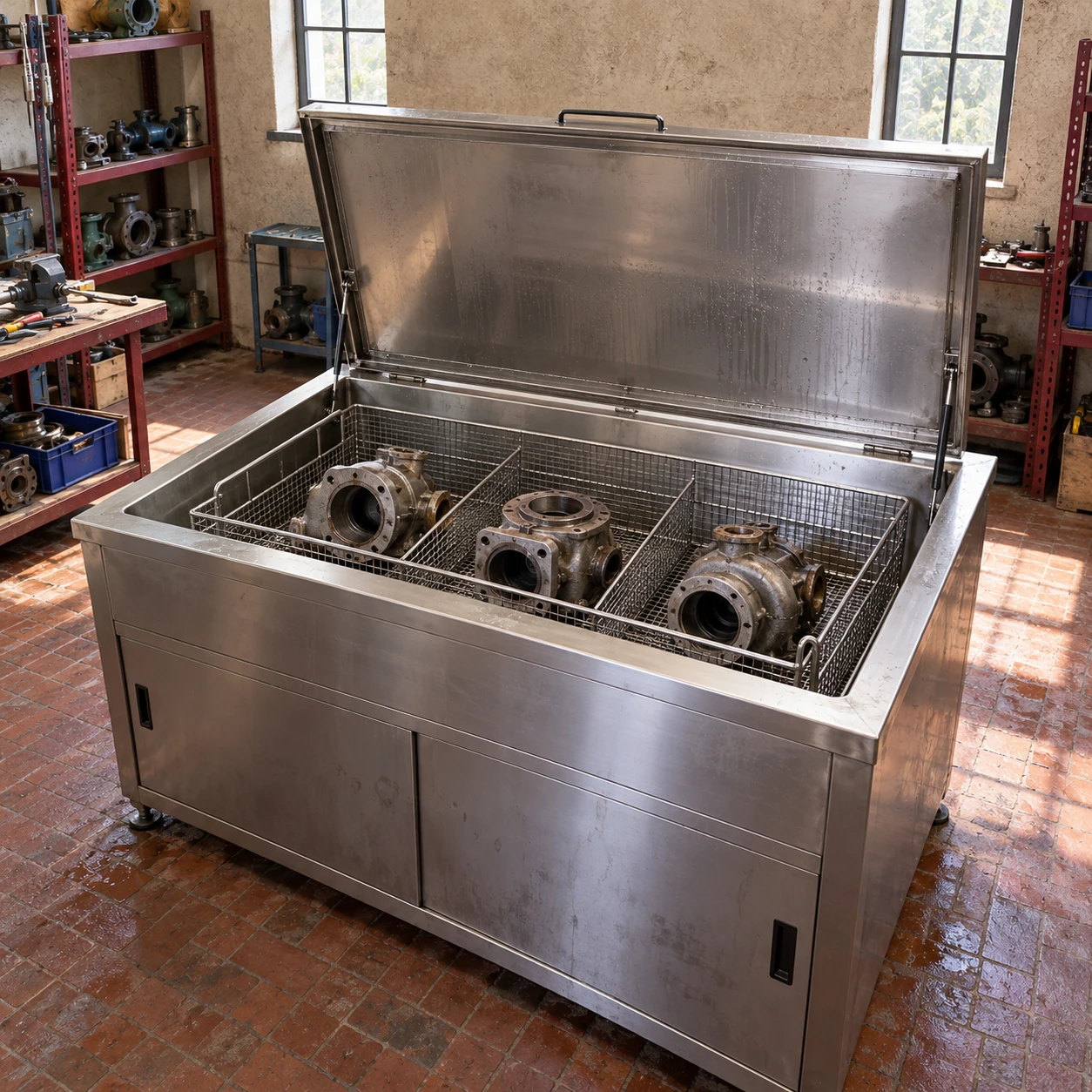
large ultrasonic cleaner
| Internal tank W × D × H (mm) | 600 × 450 × 450 / 1000 × 500 × 400 / 750 × 650 × 500 |
|---|---|
| External W × D × H (mm) | 780 × 550 × 800 / 1180 × 600 × 800 / 930 × 750 × 800 options, respectively |
| Ultrasonic frequency | 25 or 40 kHz, selected for the cleaning task |
| Nominal ultrasonic power | 1–2 kW across the listed tank families; generator matched to transducers |
| Heating / control | 4.8–7.2 kW options; thermostatic control up to 80 °C |
| Tank / frame | Welded stainless tank; 304 or 316L wetted construction selected for the solution |
| Loading / bath care | Suspended basket and lid; optional basket lift, filtration, oil separation and rinse stage |
| Electrical / discharge | 400 V three-phase, 50/60 Hz configuration; drain and overflow connection by tank design |
Internal tank dimensions are larger than the usable basket. Available immersion depth depends on working fill, basket suspension and part displacement.
Tank opening, basket layout and handling access can be adjusted to the size and shape of your work.
A large ultrasonic cleaner may be needed for one oversized part or for several smaller parts that must remain separated. These two requirements can lead to different tank proportions, basket designs and handling methods.
One large component
Check whether the complete component is suitable for immersion before selecting the bath. An assembly may contain a coating, seal or bonded feature that needs a different process from its main metal body.
Use the cleaning orientation to define the envelope. A hollow part may need to be angled so air can escape, which changes the required opening and basket shape. A geometrical fit measured in its storage position can be misleading.
A larger batch of small components
More floor area in the basket can help keep components apart. Simply increasing the pile depth can create covered surfaces and retain dirty solution between pieces.
Dividers or dedicated fixtures improve consistency when they support the parts with minimal obstruction. They must also fit the rinse and drying stages, or the load will need additional handling after cleaning.
Allow the part to travel through the entire station
The tank opening is only one checkpoint. Check the basket path from its incoming carrier, the clearance above the rim, the position where it drains and the transfer to the next stage. Heavy or awkward work may require an engineered lift and supports selected for the wet load.
Keep operators from reaching across the bath to retrieve a component or release a snagged basket. The loading arrangement should be comfortable at the actual operating height, with room to open and secure the lid.
There is a cost to unused volume
A very large bath can accommodate occasional work, but every routine cycle still has to heat and maintain its liquid. For a mixed workload, compare a large unit with a smaller dedicated bath for frequent parts. The choice should consider handling and bath-change time as well as the purchase price.
For long or deep components, use the dimensional approach described in industrial size ultrasonic cleaner. For many parts per cycle, see large capacity ultrasonic cleaner.
Confirm the result at the difficult surface
Inspect recesses and contact points after rinsing and drying. If those areas remain dirty, review liquid access, orientation and chemistry before assuming that an even larger tank or longer exposure will solve the problem.
Tank opening, basket layout and handling access can be adjusted to the size and shape of your work.