Ultrasonic Cleaners
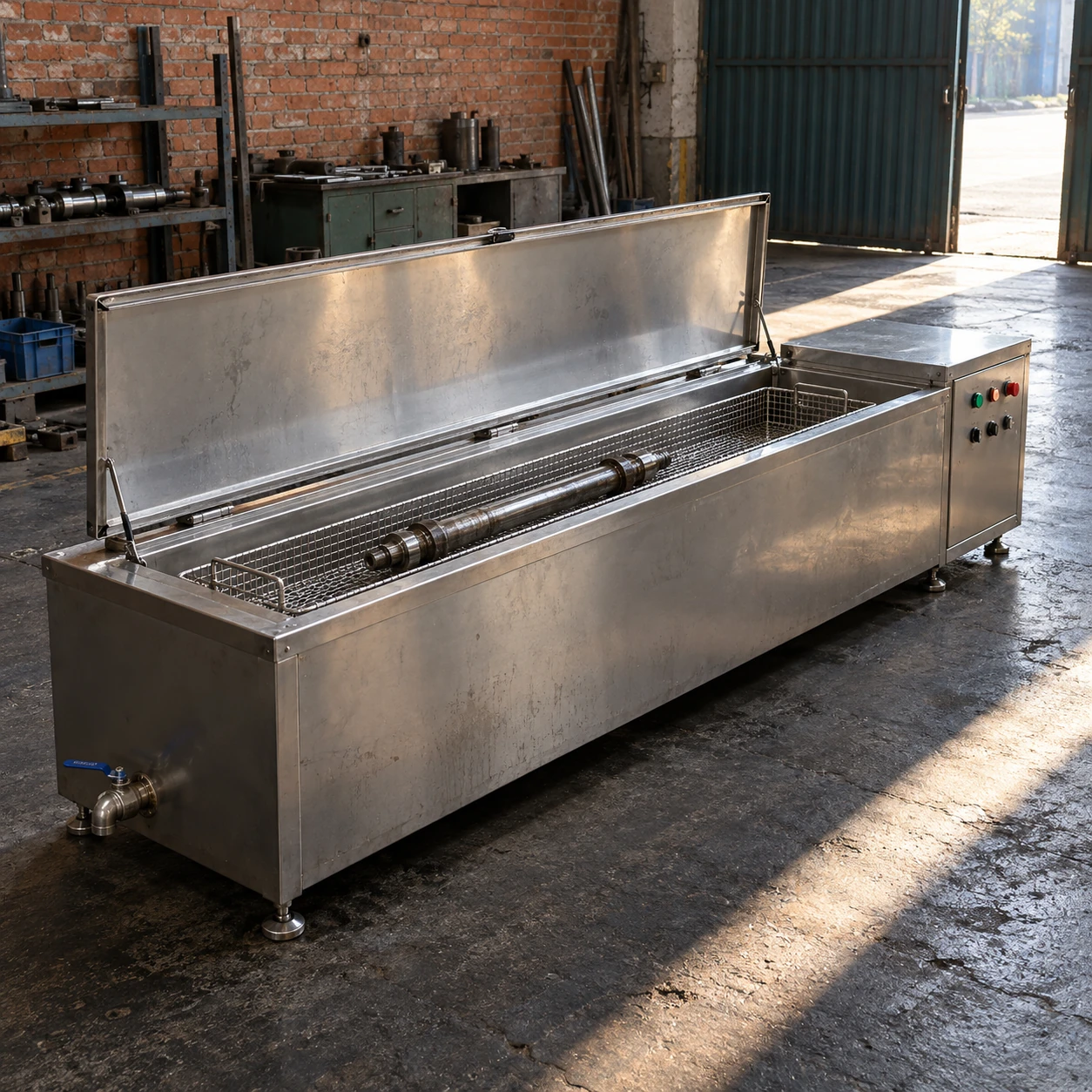
industrial size ultrasonic cleaner
| Internal tank W × D × H (mm) | 600 × 450 × 450 / 1000 × 500 × 400 / 750 × 650 × 500 |
|---|---|
| External W × D × H (mm) | 780 × 550 × 800 / 1180 × 600 × 800 / 930 × 750 × 800 options, respectively |
| Ultrasonic frequency | 25 or 40 kHz, selected for the cleaning task |
| Nominal ultrasonic power | 1–2 kW across the listed tank families; generator matched to transducers |
| Heating / control | 4.8–7.2 kW options; thermostatic control up to 80 °C |
| Tank / frame | Welded stainless tank; 304 or 316L wetted construction selected for the solution |
| Loading / bath care | Suspended basket and lid; optional basket lift, filtration, oil separation and rinse stage |
| Electrical / discharge | 400 V three-phase, 50/60 Hz configuration; drain and overflow connection by tank design |
W × D × H denotes front width, front-to-back depth and vertical height. Confirm the chosen orientation and basket dimensions on the equipment drawing.
Tank proportions, opening direction and installation interfaces can be adapted to the size and handling of your components.
Industrial size describes more than a large tank. Long shafts, flat tooling and deep housings need different proportions, and the machine has to fit through the delivery route as well as accommodate the workpiece during cleaning.
Work outward from the part
- Cleaning envelope. Include the component in the orientation that lets trapped air escape, plus its fixture and the space needed around it.
- Basket envelope. Account for the basket wall, handles, dividers and suspension features. The basket must move through the opening without contact.
- Machine envelope. Add the tank structure, insulation, generator housing, plumbing and service doors.
- Operating envelope. Include the raised basket, open lid, operator position and transfer route to the next stage.
Long and shallow
A long tank can hold shafts or tooling horizontally and reduce awkward vertical lifting. The basket needs support over its length, and the chosen immersion orientation should expose recesses rather than merely satisfy the overall dimensions.
Long equipment can create a delivery problem at corners or narrow doors. Check the transport dimensions and whether protruding components can be removed according to the supplier's instructions.
Compact and deep
A deep tank may occupy less floor area for a tall housing. It also raises questions about reaching the load, removing trapped air and lifting a wet basket above the rim.
Depth that exceeds the normal component height can add liquid and heating demand without improving access to the surface. Choose it for a real loading requirement.
Do not use nominal litres as a drawing
The working fill is below the rim, and the immersed load displaces liquid. Overflow compartments, rounded corners and sloping bottoms can further separate published capacity from the main cavity geometry. For a close fit, use confirmed dimensional drawings and the actual basket rather than a capacity label.
The same dimensional discipline applies to any rinse bath and drying station. Transferring a long part out of a suitable cleaning tank into an undersized rinse vessel simply moves the constraint downstream.
For a complete large-part station, compare large industrial ultrasonic cleaner. Supply the handling route and component drawing with your enquiry so that cabinet shape and working access can be considered together.
Tank proportions, opening direction and installation interfaces can be adapted to the size and handling of your components.