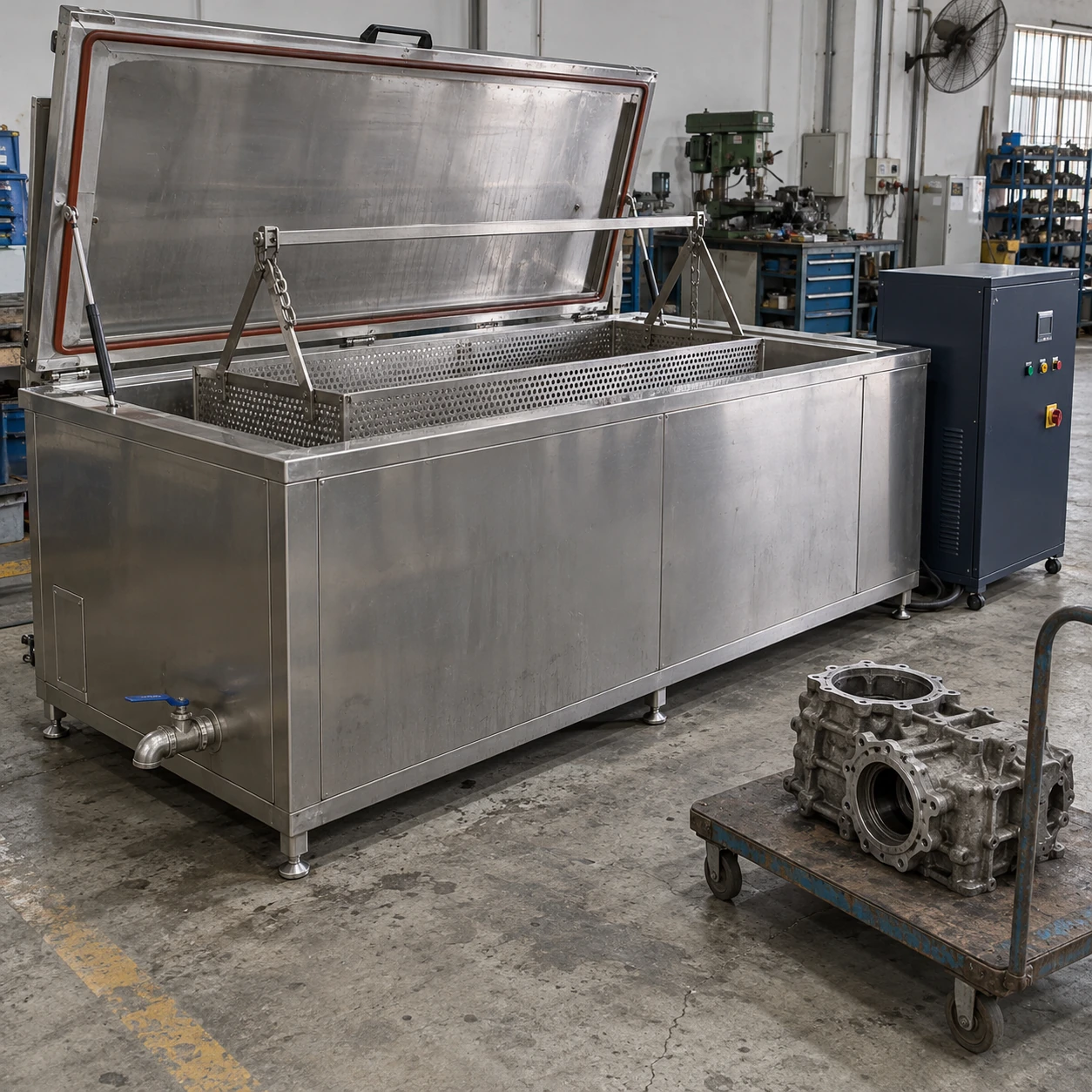
Ultrasonic Cleaners
large industrial ultrasonic cleaner
| Internal tank W × D × H (mm) | 600 × 450 × 450 / 1000 × 500 × 400 / 750 × 650 × 500 |
|---|---|
| External W × D × H (mm) | 780 × 550 × 800 / 1180 × 600 × 800 / 930 × 750 × 800 options, respectively |
| Ultrasonic frequency | 25 or 40 kHz, selected for the cleaning task |
| Nominal ultrasonic power | 1–2 kW across the listed tank families; generator matched to transducers |
| Heating / control | 4.8–7.2 kW options; thermostatic control up to 80 °C |
| Tank / frame | Welded stainless tank; 304 or 316L wetted construction selected for the solution |
| Loading / bath care | Suspended basket and lid; optional basket lift, filtration, oil separation and rinse stage |
| Electrical / discharge | 400 V three-phase, 50/60 Hz configuration; drain and overflow connection by tank design |
Dimensions describe the tank and cabinet, not the usable basket. Working liquid level, lift clearance and accessory footprint are specified with the selected arrangement.
Tank proportions, basket handling and cleaning stages can be configured for your parts and operating conditions.
Large industrial ultrasonic cleaning brings the cleaning liquid into contact with recesses and passages that are difficult to brush. The useful purchase is a complete loading and washing arrangement, with enough room around the part for liquid access and a practical route from dirty receipt to dry inspection.
Start with the largest part in its cleaning position
A long casting may fit through the opening but still sit too close to the walls. A deep housing may trap air when lowered upright. Both problems can leave untreated areas even when the bath looks large enough.
Use the loaded basket envelope, including fixtures and handles, to establish the tank opening. Then check that the part can be immersed at its intended angle without touching the tank floor. Heavy components need a basket and lifting arrangement rated for the combined wet load; the tank rim is not an improvised lifting support.
A larger bath also means more liquid to heat, replenish and dispose of. Leave useful clearance around the load, but do not buy excessive volume to compensate for a poorly arranged basket.
Cleaning capacity depends on the complete cycle
Prepare the load
Remove loose bulk debris before immersion. Chips and thick deposits otherwise settle in the tank and consume bath life before ultrasound can address the attached residue.
Maintain the bath
Choose compatible aqueous chemistry for the soil and substrate. Filtration handles suspended particles; an appropriate oil separation arrangement handles separable oil. Neither restores exhausted chemistry by itself.
Finish the part
Reserve space for draining, rinsing and drying. A clean surface can pick up dirty solution again as it leaves a contaminated bath or waits on an oily cart.
Make installation part of the equipment selection
Check the delivery route with the lid and accessories accounted for, then check the operating position with the basket raised. The electrical load includes heaters and pumps as well as the ultrasonic generator. Drainage must lead to the site's approved liquid collection route, with access for servicing valves and strainers.
For unusually long components, compare an industrial size ultrasonic cleaner around usable length rather than selecting the deepest tank. An enquiry should include part drawings, batch mass, residue type and the required condition after rinsing and drying.
Tank proportions, basket handling and cleaning stages can be configured for your parts and operating conditions.