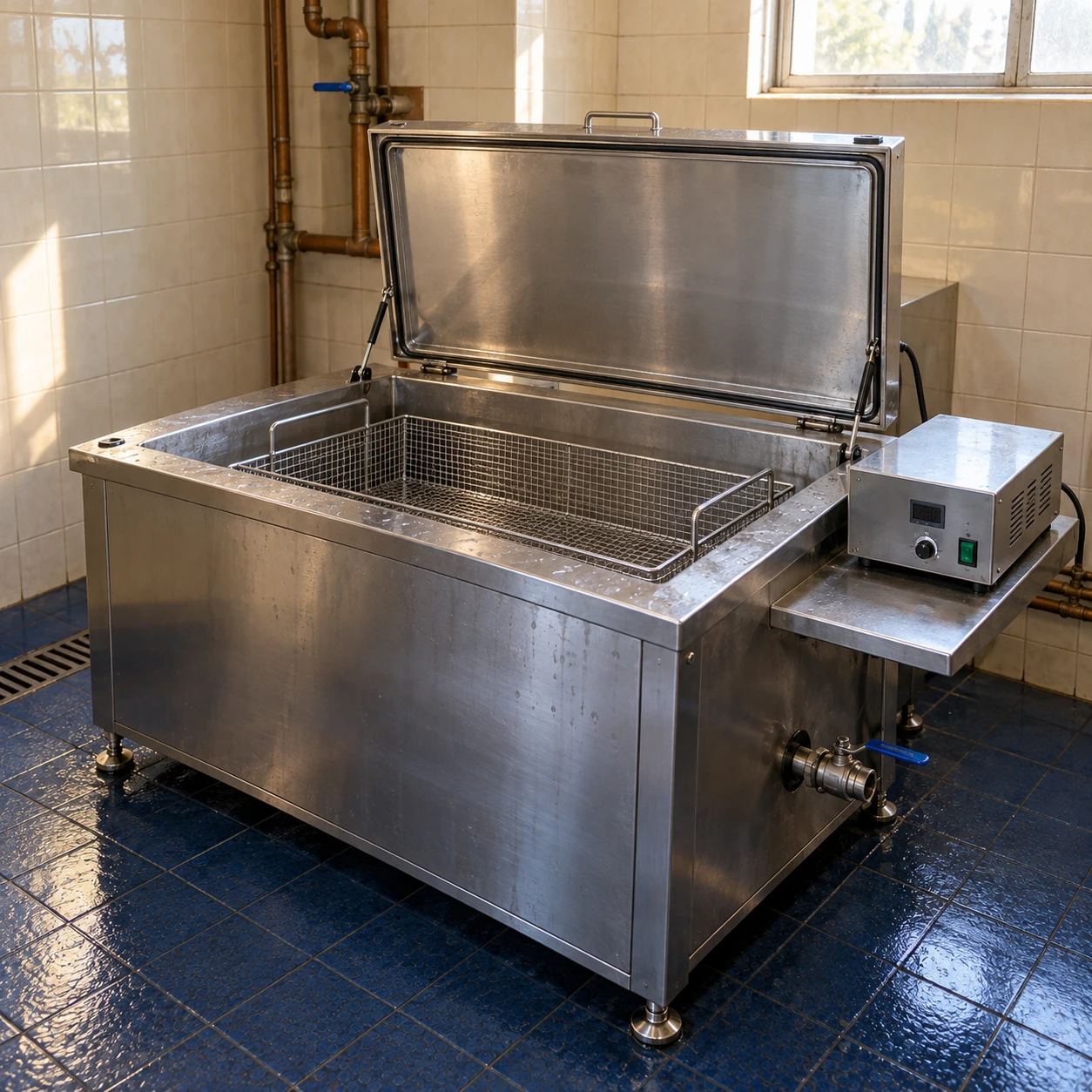
Ultrasonic Cleaners
large capacity ultrasonic cleaner
| Internal tank W × D × H (mm) | 600 × 450 × 450 / 1000 × 500 × 400 / 750 × 650 × 500 |
|---|---|
| External W × D × H (mm) | 780 × 550 × 800 / 1180 × 600 × 800 / 930 × 750 × 800 options, respectively |
| Ultrasonic frequency | 25 or 40 kHz, selected for the cleaning task |
| Nominal ultrasonic power | 1–2 kW across the listed tank families; generator matched to transducers |
| Heating / control | 4.8–7.2 kW options; thermostatic control up to 80 °C |
| Tank / frame | Welded stainless tank; 304 or 316L wetted construction selected for the solution |
| Loading / bath care | Suspended basket and lid; optional basket lift, filtration, oil separation and rinse stage |
| Electrical / discharge | 400 V three-phase, 50/60 Hz configuration; drain and overflow connection by tank design |
Tank dimensions are internal clear dimensions. Basket geometry, loaded operating volume and overall accessory space are confirmed together for each configuration.
Tank depth, basket arrangement and bath-care equipment can be adapted to your batch capacity requirements.
Large capacity is useful when it increases the amount of accessible work in each cycle. A high litre figure alone says little about how many components can be cleaned evenly, lifted safely and finished without a queue at the rinse stage.
Three different capacities affect the decision
- Liquid capacity
- The nominal or maximum tank volume describes the vessel. The operating fill is lower and changes as the immersed load displaces liquid.
- Basket capacity
- The usable basket opening and supported mass determine what can be handled. Handles, lift attachments and clearance reduce the space available for components.
- Process capacity
- Accepted parts per shift depend on loading, heat recovery, cleaning, rinsing, drying and inspection. A tank volume cannot be converted directly into a production rate.
More parts can create less cleaning access
Pouring a large quantity of small items into a deep basket creates contact points and shielded surfaces. Dividers or several shallower carriers may expose more area, although their own material also occupies the bath and affects liquid movement. A representative loaded trial is more informative than an empty-tank demonstration.
For bulky open housings, position passages so that displaced air can escape. Filling the outside of a part with liquid does not guarantee that every internal pocket is wetted. If the geometry needs repositioning, include that handling step in the cycle calculation.
Plan for a bath that changes throughout the shift
Incoming components can cool the solution and introduce a variable amount of oil and fines. Heater capacity, operating schedule and contamination control need to match this load. Increasing ultrasound to compensate for tired chemistry is unlikely to solve the root cause.
A circulation filter can remove particles, while oil separation depends on the oil and detergent behaviour. Establish a bath-change criterion based on cleaning results and bath condition, rather than assuming the liquid remains effective until it looks dark.
Compare the loading method with the heavy duty ultrasonic cleaner when individual pieces are heavy. Capacity requests should distinguish maximum component size from the normal production batch.
Tank depth, basket arrangement and bath-care equipment can be adapted to your batch capacity requirements.