Ultrasonic Cleaners
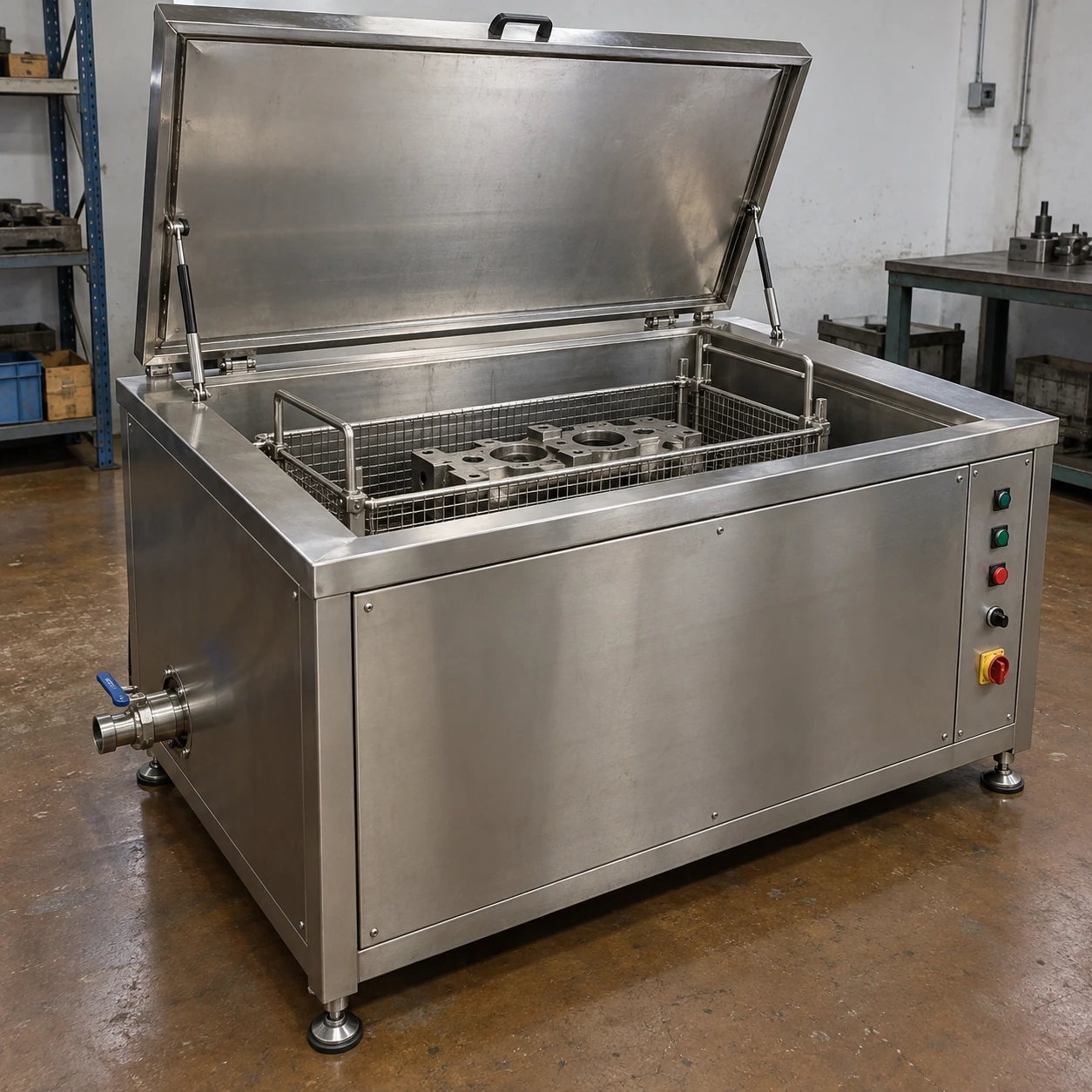
heavy duty ultrasonic cleaner
| Internal tank W × D × H (mm) | 600 × 450 × 450 / 1000 × 500 × 400 / 750 × 650 × 500 |
|---|---|
| External W × D × H (mm) | 780 × 550 × 800 / 1180 × 600 × 800 / 930 × 750 × 800 options, respectively |
| Ultrasonic frequency | 25 or 40 kHz, selected for the cleaning task |
| Nominal ultrasonic power | 1–2 kW across the listed tank families; generator matched to transducers |
| Heating / control | 4.8–7.2 kW options; thermostatic control up to 80 °C |
| Tank / frame | Welded stainless tank; 304 or 316L wetted construction selected for the solution |
| Loading / bath care | Suspended basket and lid; optional basket lift, filtration, oil separation and rinse stage |
| Electrical / discharge | 400 V three-phase, 50/60 Hz configuration; drain and overflow connection by tank design |
The frame, basket and lift are selected for the complete wet load. No basket mass rating or continuous-duty rating is implied by tank dimensions or generator power.
The basket support, service layout and contamination-control options can be tailored to your industrial duty.
Heavy duty ultrasonic cleaning is a combination of a suitable bath, a dependable loading method and serviceable equipment. A thick-looking cabinet or a large peak-power number does not establish that a machine suits repeated heavy industrial work.
Separate heavy parts from difficult contamination
A massive steel fixture creates a handling problem. A thin component covered in tenacious residue creates a chemistry and cleaning problem. They need different design decisions even when both are described as heavy duty.
For the heavy fixture, check the basket's support points, centre of gravity and route into the bath. Avoid dropping the load onto the tank bottom. For stubborn soil, assess a compatible pre-cleaning stage and cleaning solution before increasing ultrasonic exposure.
Mixed-material assemblies need particular care: the strongest component may tolerate a process that damages a softer coating, bonded insert or seal. Disassembly and separate cleaning can be preferable to treating the complete assembly aggressively.
Specify what repeated operation actually means
Load pattern
State cycles per shift, immersion time, pauses and the temperature of incoming work. These conditions define the thermal and electrical duty more clearly than a request for continuous use.
Soil burden
Estimate how much oil and particulate matter arrives with each load. The bath-care package must address this burden without obstructing acoustic access around the work.
Service recovery
Keep generator cooling, transducer connections and drain components accessible. Identify replaceable parts and the information required to order them before the machine enters service.
Protect the tank as a working component
Settled metal debris, incompatible chemicals and contact with the basket can shorten tank life. Regular removal of deposits allows the wet surface to be inspected, rather than hiding developing damage under sludge. Investigate a change in noise, cleaning consistency or heat behaviour instead of compensating with a longer cycle indefinitely.
A large capacity ultrasonic cleaner may solve a batch-volume constraint, while a reinforced smaller arrangement may suit fewer heavy parts. Agree the cleaning acceptance method using actual components; no universal heavy-duty label guarantees a result.
The basket support, service layout and contamination-control options can be tailored to your industrial duty.