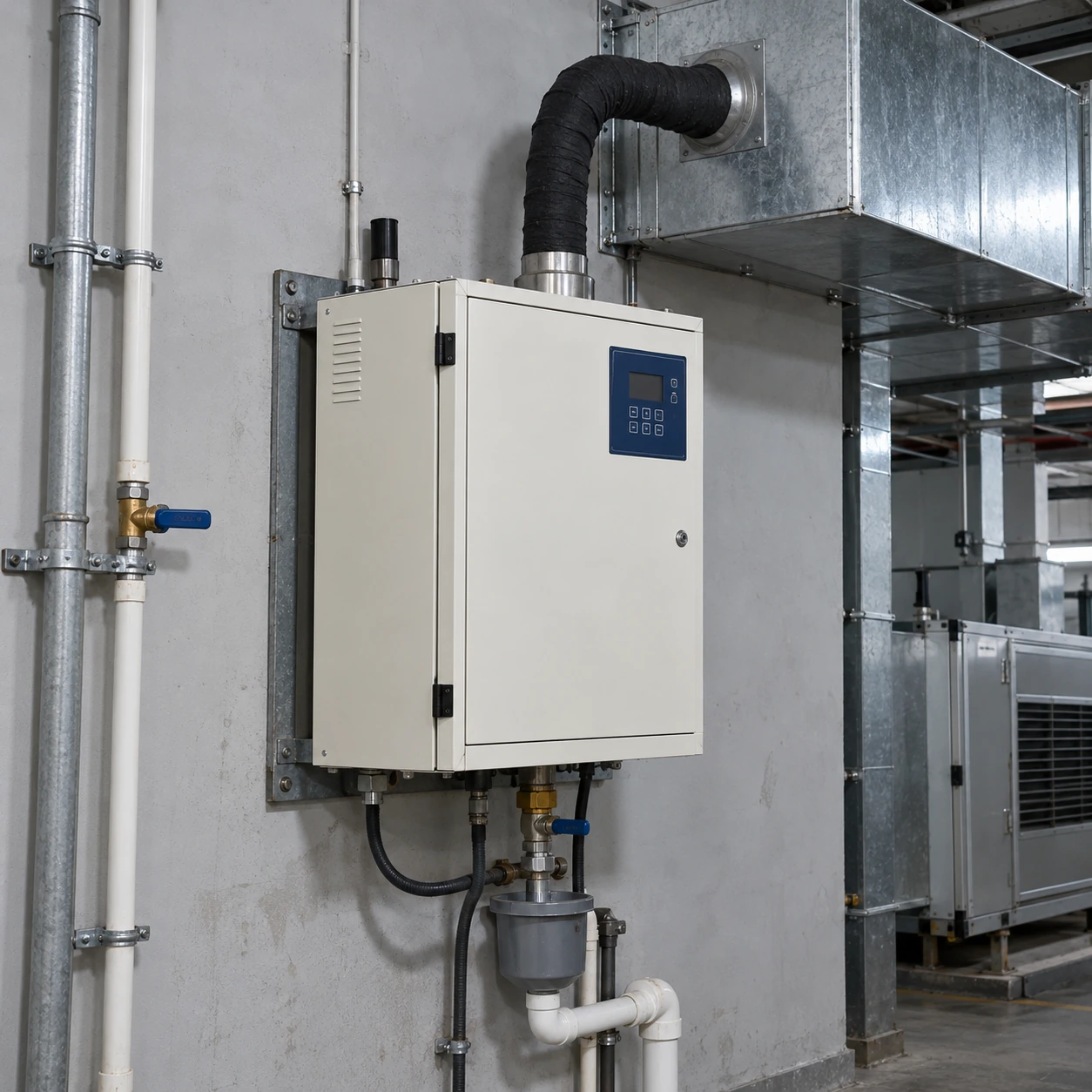
Steam Humidifiers
whole house steam humidifier
| Brand | shengtongJH |
|---|---|
| Equipment format | Industrial wall-mounted electrode cabinet for central air distribution |
| Steam output classes | 4 / 8 / 15 kg/h |
| Heating power | Approximately 3 / 6 / 11.3 kW, respectively |
| Supply options | 4 kg/h class: 220–240 V single-phase; larger selections: 380–400 V three-phase; frequency matched to destination |
| Cabinet envelopes, W × D × H (mm) | Compact class: approximately 360 × 240 × 560; medium class: approximately 430 × 300 × 650 |
| Water supply | Permanent cold-water feed compatible with the electrode cylinder |
| Steam distribution | Supply-air lance or manifold selected for the duct and airflow |
| Demand control | Central humidity sensor; outdoor-temperature reset where specified |
| System protection | Airflow proving, duct high-limit cutout and equipment enable interlock |
| Installation | Plant-room wall or support rack; permanent drain and electrical isolation |
Output classes describe alternative industrial equipment selections. Capacity, voltage and cabinet dimensions are confirmed as one package; no universal building-area coverage is implied.
The central steam package can be configured around the building's ventilation, zone arrangement, available services and operating schedule.
For a whole house steam humidifier enquiry, our scope is an industrial-grade central steam generator connected to an engineered air-distribution system. This is plant-room equipment with permanent services, rather than a refillable room appliance.
When a central steam arrangement makes sense
The essential requirement is an air system that reaches the areas requiring humidity control. A generator beside a duct cannot correct a room with little supply air, a closed balancing damper or no return path. Begin with the existing air distribution and identify which spaces actually belong to the same controlled zone.
Industrial cabinets can serve central building systems when their minimum controllable output, service requirements and electrical load suit the application. Choosing the largest available cabinet can make a small moisture demand harder to regulate. The right selection follows the building load and airflow, not the wording of a coverage claim.
Capacity is a load calculation
Account for fresh air before selecting output
Outdoor air introduced by ventilation carries a different amount of water vapour at different seasons. Air leakage, exhaust fans and operating hours change the replacement requirement. Indoor processes can also add moisture, reducing the amount that equipment needs to supply.
A useful design compares the entering-air moisture content with the required supply or room condition at the actual airflow. It then checks the lower demand as well as the peak. Two buildings with the same floor area can need different equipment because their ventilation and use are different.
One generator, one air system
A single central unit is easiest to coordinate when the connected zones share operating hours and a similar moisture target. The dispersion point must be upstream of the spaces it serves while retaining enough unobstructed distance for steam absorption.
When separate air handlers serve unrelated zones, forcing one humidifier to serve everything can introduce long steam runs and conflicting demand. Separate equipment or an engineered multi-distributor system may be more practical.
Cold surfaces set a real limit
The air can meet its humidity setting while a colder window, duct or wall surface becomes wet. Raising the setpoint to satisfy one distant room may worsen condensation elsewhere. Temperature, insulation and humidity control need to be considered together.
Where seasonal conditions require it, humidity reset can reduce the target as outside temperature falls. This is a control decision for the building, not a fixed promise that one humidity percentage suits every season.
What the installation needs beyond the cabinet
Include a suitable water supply, accessible drain, power circuit and a steam route that follows the selected equipment instructions. The air handler needs a defined permission signal for humidification. A humidity demand should not cause steam to enter a stopped or inadequately flowing duct.
The complete scope should identify who provides the distributor, sensors, fan interlock and commissioning of the connected controls. Separating these responsibilities before purchase avoids a delivered generator waiting for missing installation parts.
Match the proposal to the building
Send the air-system layout, airflow range, entering-air conditions and target humidity with the available power and water information. We can use these requirements to coordinate a suitable industrial equipment configuration. Installation feasibility remains dependent on the actual building and selected unit.
For the equipment and accessory schedule, see central steam package planning. For larger plant integration, review steam humidifier HVAC connections.
The central steam package can be configured around the building's ventilation, zone arrangement, available services and operating schedule.