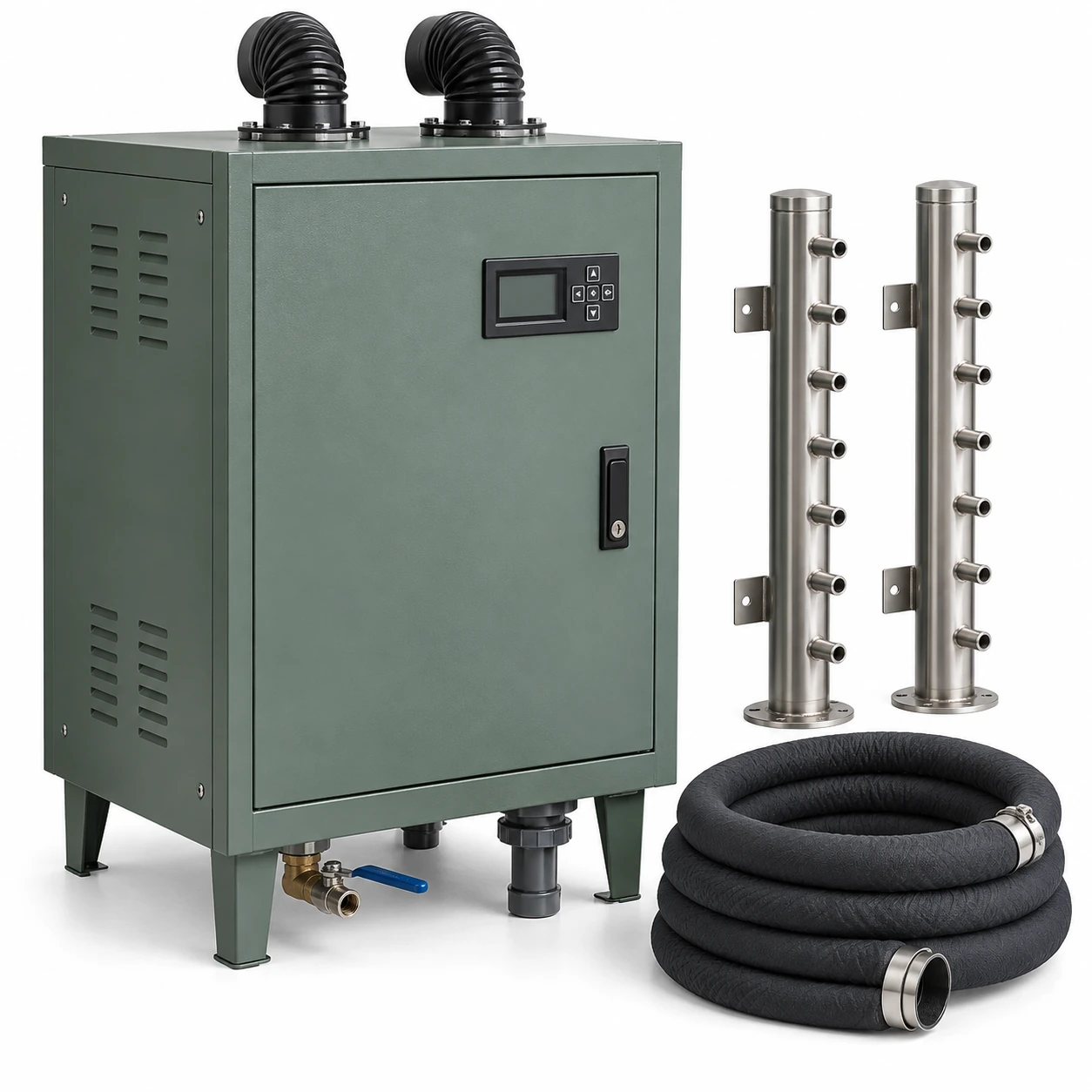
Steam Humidifiers
steam humidifier whole house
| Brand | shengtongJH |
|---|---|
| Generator classes | 8 / 15 / 23 kg/h electrode steam output |
| Heating demand | Approximately 6 / 11.5 / 17.5 kW |
| Electrical system | 380–400 V, three-phase, 50 Hz; destination-matched alternatives by specification |
| External cabinet, W × D × H (mm) | Approximately 360 × 240 × 560 for the compact class; 430 × 300 × 650 for medium selections |
| Distribution package | Single lance or multi-tube distributor; quantity and length matched to the air system |
| Steam connections | Steam-rated hose or engineered pipework; condensate return where required |
| Water and drain | Automatic feed and drain; water isolation and drain-temperature management included in installation scope |
| Controls package | Humidity demand, equipment enable, airflow confirmation and high-limit protection |
| Service access | Front cylinder access; water, electrical and drainage connections remain accessible |
| Optional interfaces | Remote alarm and building-control signal options |
Package components and installation work are identified separately in the quotation. Displayed capacities and sizes are configuration classes, not a fixed model or guaranteed whole-building coverage.
Generator capacity, accessory scope, mounting, duct distribution and control interfaces can be tailored to the central-air installation.
A steam humidifier whole house project needs a complete central-air package, not just a steam-producing cabinet. We supply industrial equipment configurations for engineered building services, with the distribution and controls selected to fit the connected air system.
A cabinet-only quotation can leave the important parts unresolved
The humidifier creates steam, but the distributor, sensors and air-handling sequence determine where that moisture goes. A price comparison is only useful when these items have the same scope. A low cabinet price may exclude the lance, steam hose, drain cooling or controls that the installation needs.
This page focuses on putting an industrial central package together. The related whole-building selection page covers load, zoning and suitability.
Separate the purchase into three connected parts
Generation
Choose the boiling technology, maximum output and controllable operating range. Match the cylinder to the water and the electrical configuration to the site. Reserve space for the complete working unit, including the fittings below it.
Delivery
Identify the duct entry point, distributor arrangement and route between it and the generator. Long or poorly supported steam runs can collect condensate. A route shown as a simple line on a drawing still needs workable falls, supports and service access.
Permission and feedback
Define which controller requests humidity, which signal proves airflow and what stops production if downstream humidity becomes excessive. A remote start contact alone does not provide all these functions.
Retrofit into an existing air system
Measure the usable straight duct section and identify nearby filters, coils, elbows and dampers. An apparently empty duct may not provide enough absorption distance under the lowest-airflow operating condition. Distributor selection can resolve some constraints; others require changing the installation position.
Check the route into the plant room as well as the final wall space. Cylinder replacement, a blocked drain or a failed valve should be serviceable without removing the air handler beside the humidifier.
Coordinate multiple zones
Spaces can have different targets and schedules even when they are within one building. A common return-air sensor averages conditions and may conceal a dry or over-humidified branch. Decide whether the zones can share a target before sharing a steam supply.
A separate air-handling unit may justify its own generator and controls. Do not split a steam hose between branches without an engineered distribution arrangement that deals with load, pressure and condensate.
Plan maintenance as part of the delivered arrangement
An electrode cylinder is a service item. Its life varies with water chemistry and operation, so a maintenance plan should identify the correct replacement rather than rely on a universal annual interval. Keep the unit identity, cylinder specification and controller settings in the handover information.
For a resistive alternative, consider how staff will isolate, cool, drain and clean the boiling vessel. The easier these tasks are to perform, the less likely maintenance is to be postponed because access is difficult.
Make the scope clear before ordering
List the generator, distributor, steam connections, sensors and interfaces as separate quotation items. Identify the installer-provided electrical circuit, water service and drain. Specify the intended building conditions and request a matched package rather than independently selecting accessories by connection diameter alone.
Our role is to coordinate equipment supply to the agreed requirements. Local installation, compatibility and commissioning must be completed for the selected equipment and site.
Generator capacity, accessory scope, mounting, duct distribution and control interfaces can be tailored to the central-air installation.