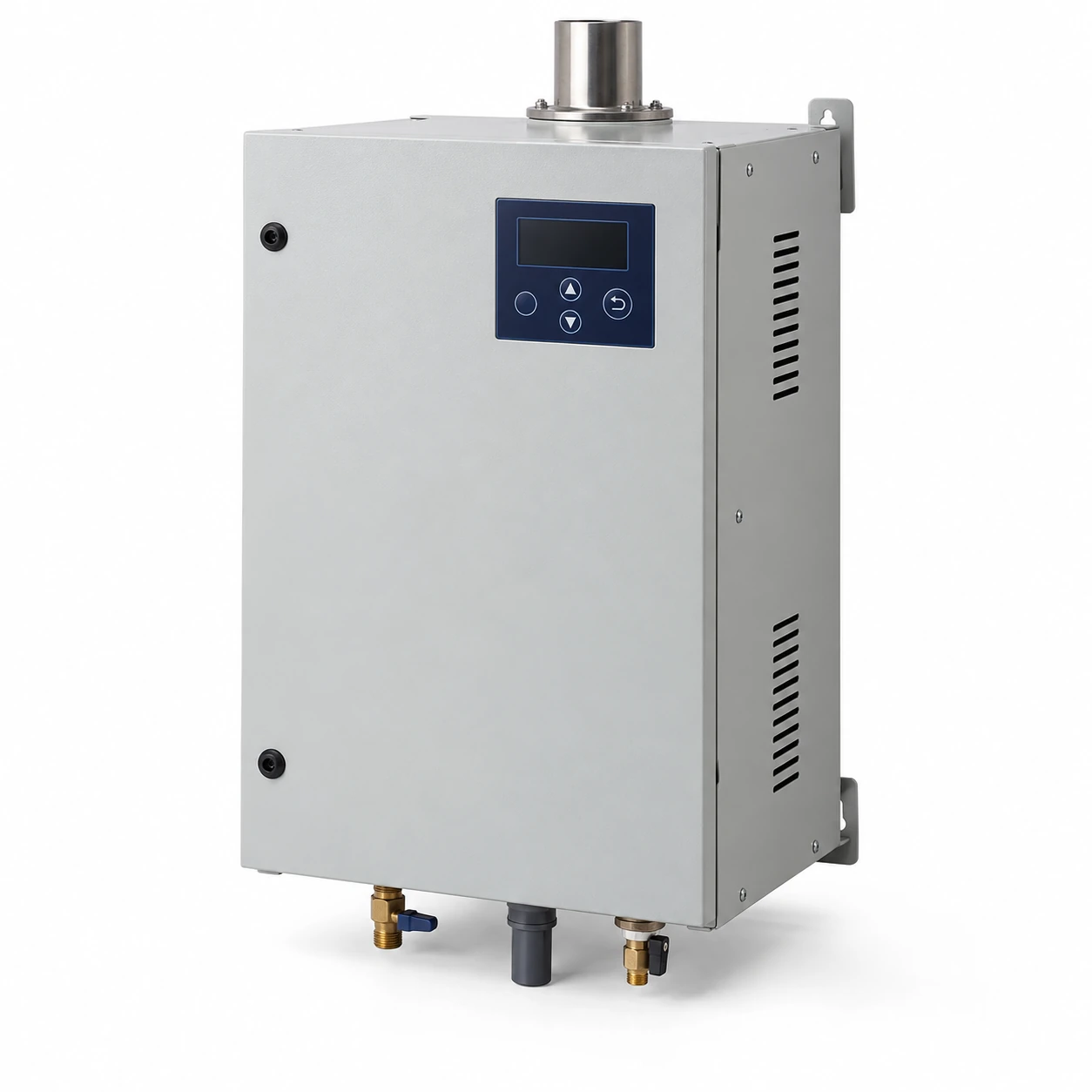
Steam Humidifiers
steam humidifier
| Brand | shengtongJH |
|---|---|
| Steam generation | Electrode boiler; resistive heating available for appropriate water supplies |
| Output classes | 8 / 15 / 23 kg/h |
| Heating input | Approximately 6 / 11.5 / 17.5 kW, respectively |
| Cabinet size, W × D × H (mm) | 8 kg/h class: approximately 360 × 240 × 560; 15–23 kg/h class: approximately 430 × 300 × 650 |
| Electrical supply | 380–400 V, three-phase, 50 Hz; other supplies require a matched electrical design |
| Water connection | G3/4 inlet option; water pressure and conductivity matched to the selected cylinder |
| Steam delivery | Duct lance, distribution manifold or compatible room fan unit |
| Controls | On/off demand or proportional input; water-level supervision and automatic drain |
| Cabinet construction | Coated sheet steel; stainless enclosure option |
| Drainage | Permanent drain connection; cooling arrangement where required by the installation |
These are selectable capacity and cabinet classes. The quotation identifies the compatible electrical, water and distribution package; dimensions exclude installation and service clearances.
Steam capacity, enclosure, distribution, water treatment and control interfaces can be configured for your industrial application and installation conditions.
A steam humidifier adds water vapour to industrial air through a controlled boiling process. The useful result is moisture delivered to the process or occupied zone, without leaving wet ducts, damp stock or a difficult maintenance burden.
From dry air to process stability
Start with what changes when the air becomes too dry
Paper can change dimensions, timber can exchange moisture with the room, and some production processes become harder to keep consistent as humidity moves away from their specified range. Humidification can address the air condition behind those changes. It does not replace material conditioning, temperature control or dedicated electrostatic protection.
A workshop with frequent door opening has a different demand from a closed laboratory. An extraction system can remove moisture as quickly as the humidifier adds it. Describe the process, ventilation and desired condition together so that the chosen unit treats the real moisture loss instead of an assumed floor area.
Choose the boiling method around the water
Electrode generation
Electrical current passes through water in a cylinder. Water conductivity is part of the operating requirement, so a cylinder must suit the supply. Extremely low-mineral water can prevent an electrode unit from developing its intended output. Routine cylinder replacement or cleaning depends on the cylinder design and accumulated mineral load.
Resistance heating
Heating elements transfer heat into the water. A compatible resistive design is useful when treated water is required or when a reusable boiling vessel fits the maintenance plan. Water treatment reduces some deposits, but it does not remove the need to inspect valves, drains, sensors and heating surfaces.
The steam path matters as much as the generator
A capable boiler can still deliver poor results if the hose collects condensate or the air cannot absorb the output. Position the unit near the distribution point, use the specified steam-rated connections and provide a route for condensate. The duct or room distributor must match both the output and available mixing space.
Steam remaining visible at an outlet is not a measure of successful humidification. Water on nearby surfaces indicates a distribution or control problem that should be corrected before increasing output.
Keep operation practical over a full production season
Provide enough access to remove the cylinder or open the boiling vessel without dismantling surrounding pipework. Make the water shutoff, electrical isolation and drain reachable. A serviceable installation is more useful than fitting the cabinet into the smallest available gap.
Account for electrical demand and drain water as operating costs. Feed-water consumption exceeds the moisture delivered because mineral control requires draining or flushing. Service intervals should follow actual water quality and operating hours rather than a universal calendar promise.
For a ducted installation
Airflow supervision, a humidity demand signal and a separate high-limit function help prevent steam production when the air system cannot accept it. See HVAC steam humidifier integration for the system interfaces.
For direct room distribution
A matched fan unit mixes the discharge into room air. Keep the discharge clear of workers, materials and cold surfaces, and locate the room sensor away from the immediate plume. The industrial warm steam arrangement explains this choice.
Steam capacity, enclosure, distribution, water treatment and control interfaces can be configured for your industrial application and installation conditions.