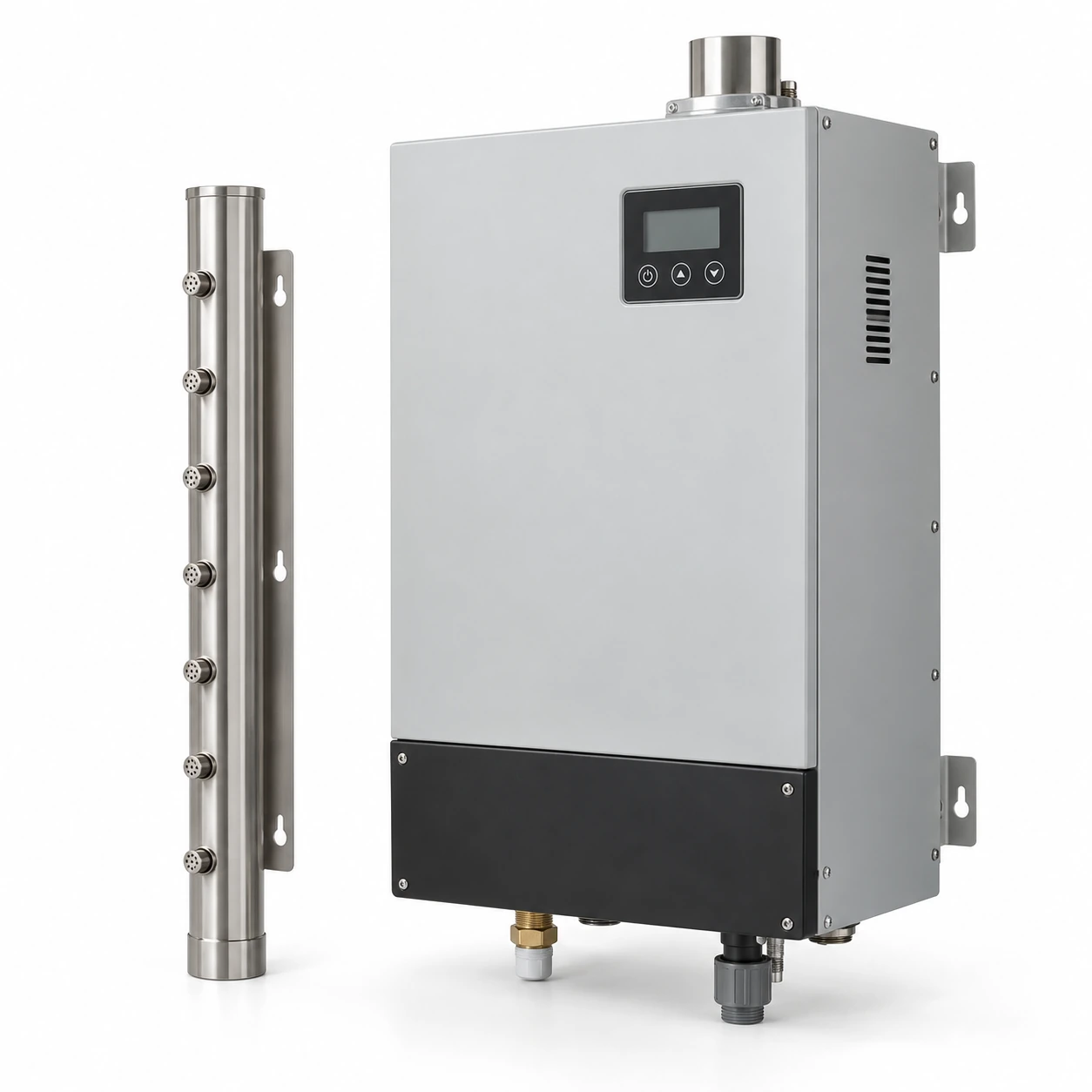
Steam Humidifiers
furnace steam humidifier
| Brand | shengtongJH |
|---|---|
| Equipment type | Industrial electrode steam cabinet with replaceable or serviceable cylinder |
| Output selections | 4 / 8 kg/h compact classes; 15 kg/h for a larger verified load |
| Power classes | Approximately 3 / 6 / 11.3 kW |
| Electrical choices | Compact single-phase 220–240 V; larger three-phase 380–400 V selections |
| External W × D × H (mm) | Approximately 360 × 240 × 560 or 430 × 300 × 650, according to class |
| Mounting arrangement | Independent wall or rack mounting; existing brackets require compatibility review |
| Distribution parts | Matched lance, steam hose and condensate components; existing parts reused only if suitable |
| Controls | Humidity demand and air-unit enable with airflow proof and high-limit protection |
| Water service | Permanent feed with isolation; cylinder selected for the actual water quality |
| Drain requirements | Correctly rated discharge route and temperature management |
| Maintenance access | Cylinder removal and connection access without obstructing furnace servicing |
A replacement is selected from the actual moisture load and available services, not just the old cabinet dimensions. Final voltage, fittings, control interface and clearances follow the supplied configuration.
The replacement cabinet, output, distributor and control package can be configured around the existing industrial warm-air system and site constraints.
A furnace steam humidifier retrofit should restore dependable moisture control without carrying old installation problems into the new equipment. This page covers industrial and commercial warm-air systems, using a separate steam generator and a compatible supply-air distributor.
Find out why the old installation stopped meeting the requirement
A dry work area does not always mean the generator is too small. A worn cylinder, an interrupted water supply, a restricted drain or a changed fan sequence can reduce useful output. Building use may also have changed: additional extraction, longer operating hours or open loading doors can create a larger moisture load.
Distinguish an equipment fault from an installation limit before choosing a replacement. This prevents spending more on a larger cabinet while retaining the same blocked steam route or unsuitable control condition.
Keep the usable evidence
Record the existing unit identity, electrical supply, cylinder type, water condition and operating settings. A photograph helps identify space and connections, but it does not prove capacity or control compatibility.
Question reused parts
A hose can fit a connector and still be unsuitable for its temperature, condition or routing. The distributor must match output and airflow, and reused controls need a compatible signal and operating logic.
Check changed conditions
Compare the present airflow and moisture requirement with the original installation. A replacement based only on the old nameplate can repeat an earlier sizing error or miss a new process demand.
Maintenance-led selection
Make the next cylinder change easier
The space around the cabinet matters when a technician needs to remove a cylinder, disconnect a hose or reach a drain valve. A compact replacement can still be inconvenient if pipes cross the service opening or a nearby furnace panel cannot be removed.
Use the replacement project to improve mounting height and service access where the equipment instructions permit. Keep the steam route within its allowed arrangement, however; moving the cabinet to a convenient wall can create unacceptable condensate collection or heat loss.
When like-for-like is reasonable
If the load, services and air-side arrangement remain suitable, a similar output class can reduce installation changes. The new cylinder, controller, distributor and protection functions must still be identified individually.
Match the actual supply voltage and frequency. Similar looking equipment is not necessarily electrically interchangeable, and a different controller may require a revised interface.
When the project needs redesign
Repeated duct wetting, inadequate absorption space or operation without dependable airflow permission points beyond a simple cabinet swap. Changed ventilation or separately controlled zones may also justify a different distribution strategy.
Repair the system relationship first. A larger generator can make local wetting worse if the available air cannot absorb its output.
Retain a clear service record after replacement
The handover should identify the supplied configuration, matching consumables, water requirements, final controls and the isolation points. Keep the controller settings associated with the installation rather than only on a technician's phone.
Service timing should reflect the actual water and operating hours. A cylinder service indication, unusual filling or drain behaviour deserves investigation instead of being treated as an instruction to increase output.
Build the replacement enquiry around the existing system
Send the current cabinet and connection information together with the warm-air unit documentation, duct layout and explanation of the problem being solved. We can coordinate a replacement equipment package and identify the interfaces that need installation review.
For a new installation rather than a replacement, see steam humidifier for furnace integration. The steam humidifier overview explains the alternative boiling methods.
The replacement cabinet, output, distributor and control package can be configured around the existing industrial warm-air system and site constraints.