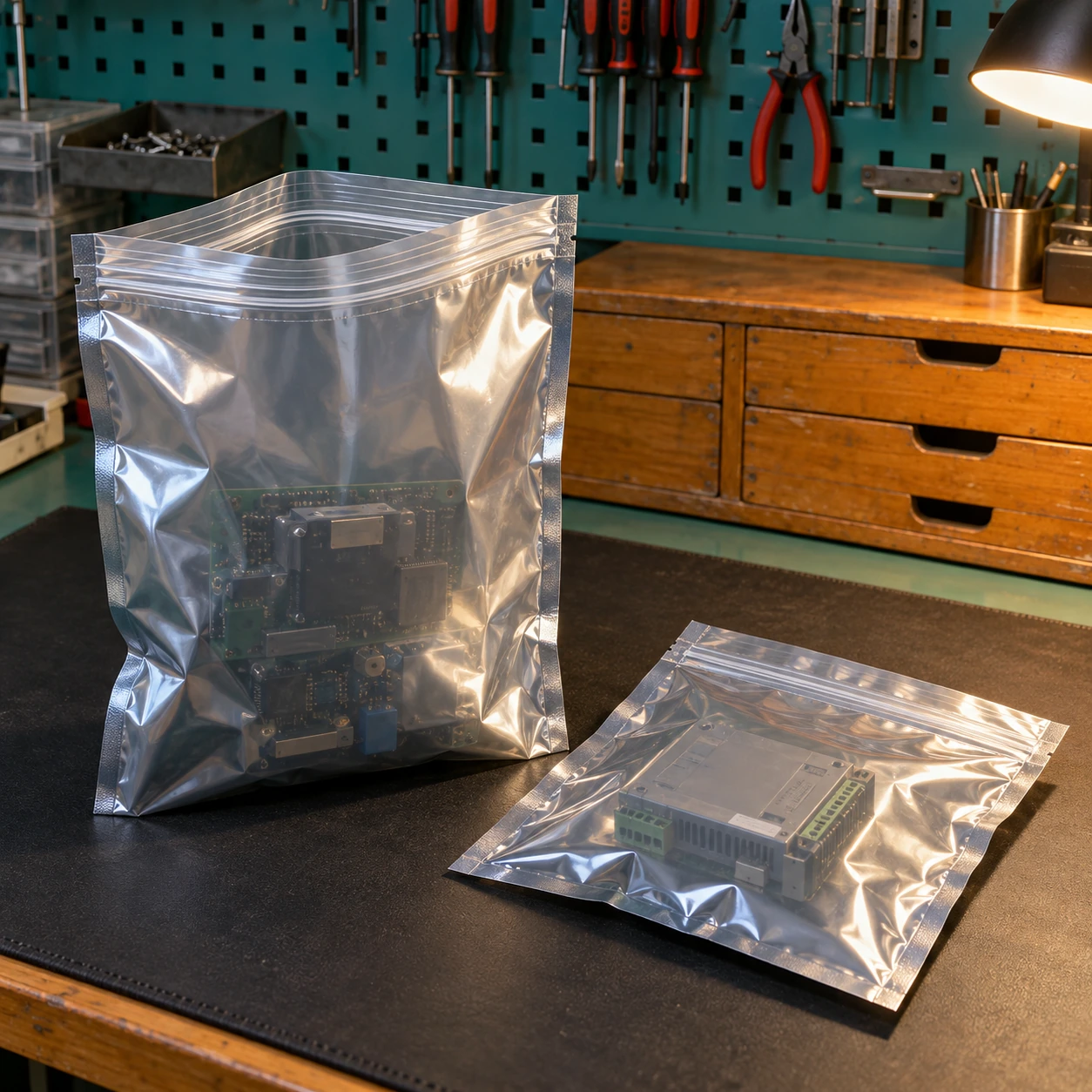
Static Shielding Bags
reclosable static shielding bags
| Closure | Press-to-close zipper integrated into metallized laminate |
|---|---|
| Nominal flat W × L | 127 × 203.2; 203.2 × 304.8; 254 × 304.8 mm |
| Film option | Approximately 0.071 mm metal-in laminate with suitable contact surfaces |
| Product visibility | Semi-transparent film; identification readability depends on material and marking |
| Handling format | Individual assembly, spare module or compatible protective tray |
| Reuse condition | Subject to film, seams, zipper condition and the site's verification plan |
The zipper and top lip affect the usable cavity. Nominal W × L must be checked against the offered bag drawing and the thickness of the packed assembly.
Reclosable static shielding bags provide a repeatable opening for electronic spares that move between storage, inspection and service. Their advantage is convenient access without cutting off a sealed edge each time, provided the bag remains suitable and the zipper is fully closed after use.
Make repeated access a controlled routine
A maintenance store may issue the same spare several times before it is installed. A zipper pouch can keep the original package available for each return, reducing cut edges and improvised tape closures. This works best when the bag is associated with one part type and there is a clear place to open, inspect and repack it.
Access convenience does not authorize opening wherever the part happens to be needed. Bring the closed package to a suitable ESD protected workstation before exposing the assembly. The bag's outer surface should not be used as a substitute for that work surface.
At the service bench
- Open without stressing the body. Use the top lips to separate the zipper rather than pulling on a seam or on the enclosed component.
- Keep the empty bag controlled. Set it aside where tools, loose screws and solder debris cannot puncture or contaminate it.
- Return the correct assembly. Check that projecting connectors and any protective insert sit below the closure without stretching the film.
- Close across the full width. Check the ends as well as the middle, then retain a readable part identity for the next handover.
When the zipper helps
Repeated inspection, repair stock and small-batch kitting benefit from a closure that does not consume bag length. Operators can use a consistent opening and return the item to the same protected cavity after a controlled task.
Visibility through the film can reduce unnecessary opening, but a heavily printed or less transparent material may need an external identification label. Place that label where it does not obstruct closure or hide a damaged seam.
When a sealed opening is more suitable
A single dispatch operation may favor an approved heat-sealed package with a defined opening step at the receiving site. A zipper by itself is not evidence of tamper security, airtightness or moisture-barrier performance.
Choose closure around the actual route. Where a separate barrier or tamper feature is required, specify the complete construction instead of assuming every reclosable pouch provides it.
Fit reduces closure mistakes
A crowded pouch encourages operators to leave the zipper partly open or push the contents against it. An appropriate cavity gives fingers room to work and lets the closed bag lie naturally in its tray. For a bulky module, review opening and usable-space selection. For returned stock, use a defined reuse and replacement process rather than assuming a zipper makes the film indefinitely reusable.
Reclosable bag size, zipper position, identification and packing details can be customized for repeated-access service or production work.