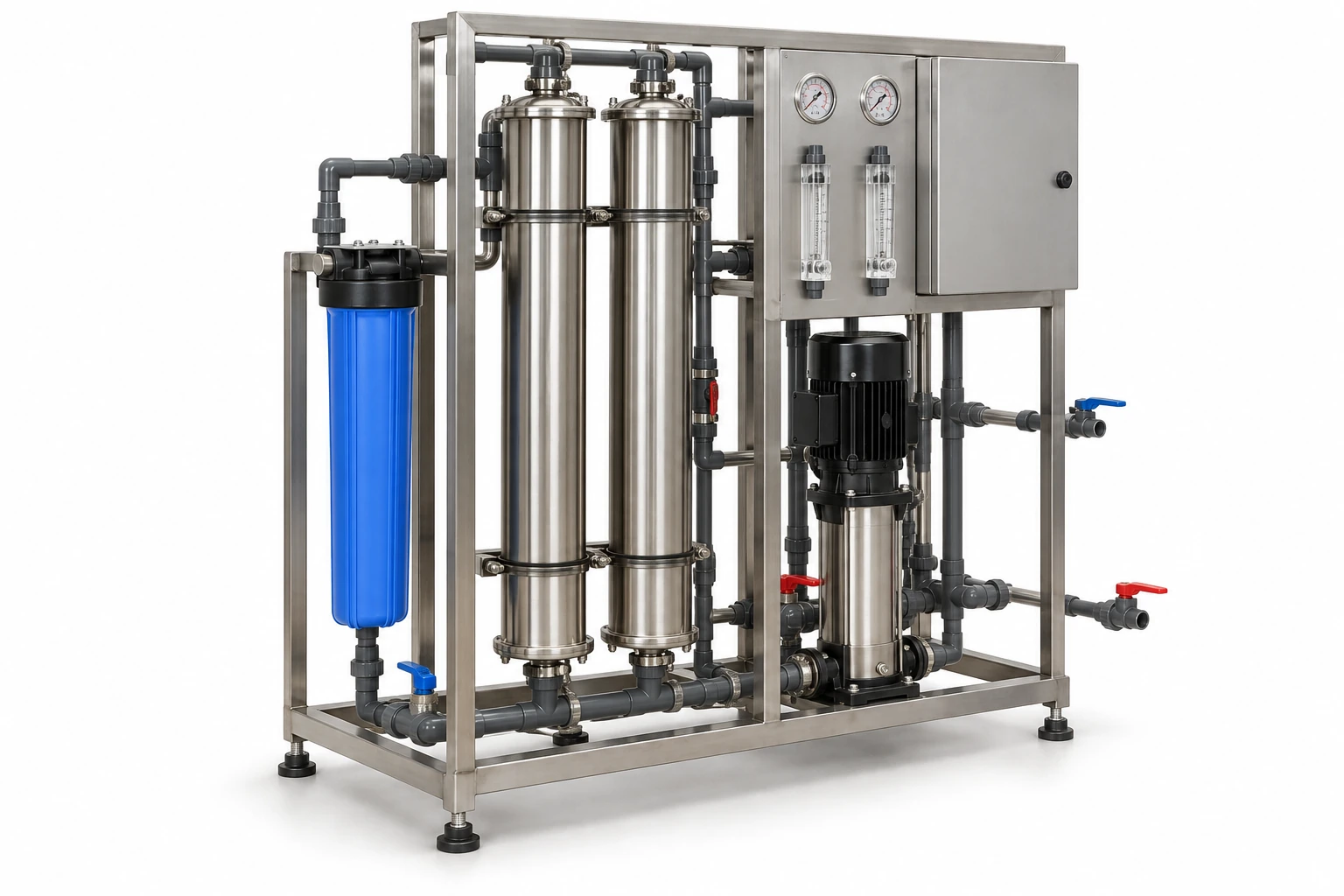
Reverse Osmosis Systems
reverse osmosis water purification system
| Service | Commercial utilities, industrial rinsing and process-water preparation |
|---|---|
| Permeate output classes | 250, 500 or 1,000 L/h; output specified at the selected feed composition, temperature and operating pressure |
| RO frame, L × W × H (mm) | 559 × 660 × 1,397; 559 × 787 × 1,397; pretreatment and storage occupy additional space |
| Membrane and housing | Spiral-wound polyamide RO; 2.5-inch or 4-inch elements; pressure-rated stainless steel or FRP housings |
| Construction | Stainless steel or coated steel frame; compatible pressure piping selected for water chemistry |
| Electrical options | 220–240 V single phase or 380–415 V three phase, 50 Hz; matched to the pump and controls |
| Controls and connections | Feed, permeate and concentrate connections; pressure gauges, separate flow meters, conductivity monitoring and tank-level interlock |
| Package scope | Media/carbon pretreatment, scale control, buffer tank, delivery pump and downstream treatment selected by application |
Dimensions describe the RO frame, not a complete treatment-room footprint. The quotation pairs the selected size, output and components with the feed-water analysis.
The treatment arrangement, frame layout, connections and control package can be customized to suit your application.
A reverse osmosis water purification system separates a feed supply into lower-salinity product water and a more concentrated reject stream. The useful result depends on the equipment around the membrane: pretreatment keeps the feed suitable, the pressure pump drives separation, and the storage and delivery arrangement gets the right water to the process.
Start with the water the process needs
Mineral spotting on a final rinse, deposits in a small steam service and inconsistent process-water conductivity are different purchasing problems. A low dissolved-solids supply can help with each, but the acceptable water quality and delivery pattern will differ. A laboratory instrument may also need a polishing step that an ordinary industrial wash station does not.
Define the requirement at the actual use point. Include conductivity or the relevant dissolved species, peak flow and operating hours. If the end use involves drinking water, food contact or a controlled laboratory procedure, add its specific chemical and microbiological requirements. An RO membrane rating alone does not establish compliance for the complete stored and distributed supply.
Feed-water testing then determines the equipment upstream. Hardness and scaling ions affect concentration limits; suspended solids can block feed channels; oxidants may damage susceptible membranes. A system selected from total dissolved solids alone can miss all three problems.
Three water paths, three different duties
Feed
The inlet must provide stable flow and enough pressure for the selected pump. Media filtration, carbon treatment and scale control address different parts of the feed-water problem; they are not interchangeable cartridges.
Permeate
Product water leaves the membrane at a rate governed by the operating conditions. Storage can buffer intermittent demand, while a separate delivery pump provides the pressure required by the users.
Concentrate
The reject stream carries material retained by the membrane. Its flow is part of the design water balance. Closing the reject valve merely to save water can increase scaling and damage the intended operating conditions.
Size the supply for a working day
A catalogue daily output usually assumes a stated number of running hours. A plant that operates only during a production shift has fewer hours available to refill its tank. Add filter servicing, flushing and planned downtime before choosing the required production rate. Storage should cover the expected demand peaks without creating unnecessary water residence time.
Cold feed water can reduce production even when the pump and membrane are healthy. A higher-salinity source can require a different pressure and membrane selection. Compare quotations at the same feed temperature, water analysis and recovery basis so that nominal capacities remain meaningful.
Install for service access
Allow room to withdraw membrane elements, open cartridge housings and work on the pump. Position drains for both reject flow and any pretreatment backwash. A short skid does not mean the complete package fits into the same floor area: pretreatment vessels, a brine tank and product storage may sit alongside it.
Keep the product-water line distinct from feed and reject lines. A suitable covered tank, accessible sampling points and a compatible distribution arrangement help preserve the quality achieved at the RO outlet.
Make changes visible
Record feed and product conductivity, the two outlet flows and pressure readings during commissioning. Later, a change in output can be compared with temperature and pressure rather than treated automatically as membrane failure. Filter differential pressure, declining normalized output and changes in salt passage point to different maintenance needs.
For the package choices behind this overview, compare commercial demand and storage with industrial continuity and service arrangements. shengtongJH coordinates equipment procurement around the agreed water duty and supply boundaries.
The treatment arrangement, frame layout, connections and control package can be customized to suit your application.