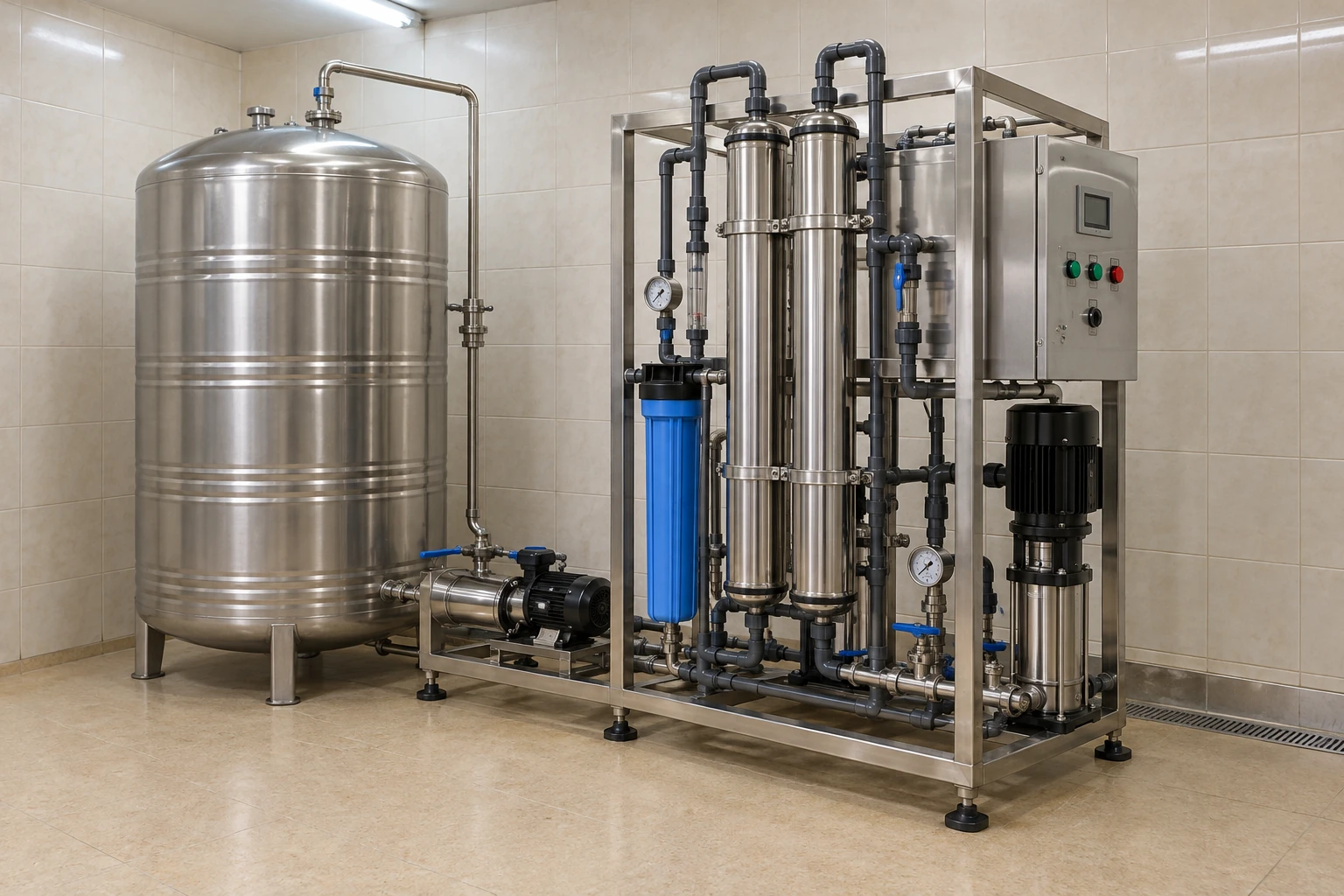
Reverse Osmosis Systems
commercial reverse osmosis water purification system
| Production choices | Compact commercial units and 250, 500 or 1,000 L/h package classes; rated output depends on feed conditions |
|---|---|
| Compact RO frames, L × W × H (mm) | 552 × 508 × 838; 584 × 610 × 1,397; 889 × 610 × 1,397 |
| Water path | Sediment and carbon pretreatment; RO; selected product-water storage and delivery |
| Membrane sizes | 2.5 × 21 inch, 2.5 × 40 inch or 4 × 40 inch elements, matched to the selected unit |
| Construction options | Open serviceable frame, stainless steel or FRP housings, water-compatible distribution materials |
| Power | 220–240 V single phase, 50 Hz; larger pump packages may use three-phase supply |
| Storage and controls | Covered atmospheric tank with delivery pump, or appropriately rated pressure storage; tank-level control and low-feed-pressure protection |
| Final water adjustment | Blending, mineral adjustment or downstream disinfection only where required by the end-use specification |
Frame sizes exclude external storage, pretreatment and maintenance clearances. Usable tank drawdown and peak delivery flow are selected separately from RO production.
The commercial RO system can be customized for your business's demand pattern, available space and water-quality requirements.
A commercial reverse osmosis water purification system often works steadily while the business uses water in short, uneven bursts. The purchasing challenge is to combine production, usable storage and delivery pressure so that the service continues through the busiest part of the day.
Production and peak demand are different numbers
A preparation room may take little water for an hour and then fill several vessels together. A wash service may draw heavily at shift change. Specifying the RO skid for the highest instantaneous demand can produce an unnecessarily large unit; selecting it only for average consumption can leave the tank empty at the critical moment.
Use the daily volume to establish replenishment demand, then examine the largest simultaneous draw and the time available for recovery. The storage tank supplies the difference during a peak. A delivery pump is selected for the pressure and flow needed downstream; the RO high-pressure pump serves the membrane and does not automatically provide that building-side duty.
Pressure-tank nominal capacity is not its usable drawdown. An atmospheric tank also needs a usable operating band between its start, stop and low-level settings. Choosing storage by the label volume alone can therefore overestimate the water actually available.
Match the water to the equipment receiving it
Rinsing
Reduced dissolved solids can limit residue after drying. The useful target depends on the item and final-rinse process. A conductivity limit at the point of use provides a clearer purchasing basis than a general promise of pure water.
Commercial food service
Water balance matters to some beverage and steam equipment. Very low mineral content is not automatically the preferred recipe. Where blending or mineral adjustment is specified, it must also preserve the required hygiene and chemical quality.
Facility utilities
Humidification, small process services and instrument feeds have different water requirements. Some need further polishing or specialized materials. Connect the package to the receiving equipment's specification instead of assuming one outlet suits every use.
A service room that remains serviceable
Put the equipment where filters can be replaced during normal access hours and leakage can be contained. The installation route matters as much as the final footprint: a tank may not pass through the same doorway as a narrow RO frame. Break the package into components where necessary and define the field connections before delivery.
Drain capacity must accommodate the concentrate stream and any filter backwash or softener regeneration. They can have different peak flows and disposal requirements. Electrical selection must likewise include the delivery pump and optional treatment equipment, not just the membrane skid.
Noise, heat and the access required for tank cleaning can make a public-facing cupboard unsuitable. A plain service room with suitable drainage and a planned water connection is often more practical than a tightly fitted enclosure that prevents maintenance.
Order a usable package, with clear boundaries
The enquiry should state business operating hours, the largest regular draw, the available feed and where the treated water will go. Include the water analysis and a simple room plan. These details let shengtongJH coordinate the RO skid, storage, transfer equipment and agreed controls as a consistent procurement scope.
For greater production continuity, compare the industrial arrangement. For a feed supply requiring substantial oxidant removal, examine the carbon-and-RO treatment relationship before selecting the pretreatment package.
The commercial RO system can be customized for your business's demand pattern, available space and water-quality requirements.