Reverse Osmosis Systems
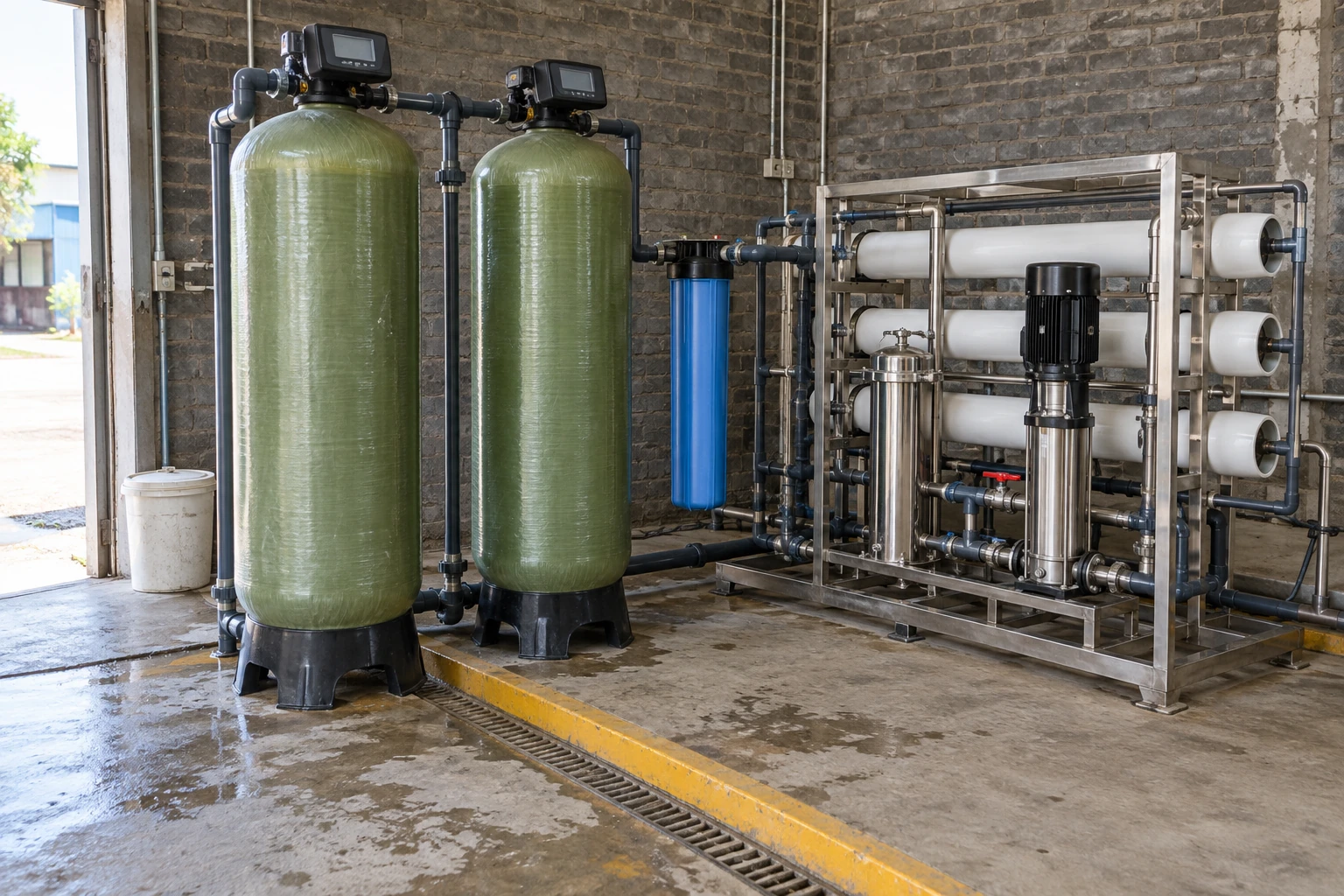
carbon filtration and reverse osmosis water purification system
| Treatment combination | Activated-carbon pretreatment, downstream cartridge protection and RO; other pretreatment as required |
|---|---|
| RO production classes | 250, 500 or 1,000 L/h; carbon sized for actual feed flow, not product flow alone |
| RO frame, L × W × H (mm) | 559 × 660 × 1,397 or 559 × 787 × 1,397; carbon vessels, backwash and service space additional |
| Carbon arrangement | Replaceable carbon cartridges or backwashable granular-carbon vessels; series/lead-lag arrangement where justified |
| Media selection | Activated carbon selected for the target contaminant; catalytic media considered for the actual chloramine duty |
| Cartridge and membranes | Replaceable final cartridge filter; polyamide RO elements with compatible pressure housings |
| Electrical supply | 220–240 V single phase or 380–415 V three phase, 50 Hz, according to pump selection |
| Monitoring | Pressure drop, water flow and a suitable oxidant check before RO; conductivity and separate product/reject flow indication |
Carbon-vessel size and media quantity follow the required contact time, contaminant loading and backwash conditions. The frame dimensions above apply only to the RO unit.
The carbon treatment, RO package and monitoring arrangement can be customized for your feed-water chemistry and operating conditions.
Carbon filtration and reverse osmosis perform complementary work. Carbon can reduce selected oxidants and organic contaminants before the membrane; RO then separates dissolved material into product and concentrate streams. A well-matched package protects the membrane without treating carbon as a universal purifier.
What carbon contributes
Activated carbon has a large internal surface that supports adsorption of suitable organic substances. It can also be selected to remove oxidants that are undesirable upstream of susceptible polyamide membranes. The relevant duty may be membrane protection rather than a noticeable change in water taste or colour.
Free chlorine and chloramine are different treatment challenges. A carbon selection that works for one disinfectant at a particular flow cannot be assumed to perform identically for the other. The inlet concentration, media type and available contact time belong in the selection.
What RO contributes
Carbon does not generally remove the dissolved salts responsible for conductivity or hardness. RO handles a different part of the water-treatment task by membrane separation. It still needs an assessment of scaling potential, solids and any feed constituents that require another treatment step.
A carbon filter cannot make an unsuitable oily or chemically complex industrial stream a routine RO feed by itself. For such water, the process needs a specific pretreatment evaluation rather than a standard carbon-and-membrane package.
Size carbon against the feed stream
The carbon unit sees the water entering the RO, including the portion that later leaves as concentrate. Sizing it solely from the stated permeate output can underestimate its flow and shorten contact time. A downstream storage tank may smooth demand at the user side while the pretreatment still sees the RO's full running feed rate.
A larger media bed can provide useful contact and capacity, but it also changes vessel size and backwash needs. The site must supply the required backwash flow and dispose of it appropriately. A vessel that cannot be backwashed as specified may develop uneven flow and lose useful performance.
Protect the membrane after the carbon
- Control fines
- New or serviced carbon can release particles. Proper commissioning and a suitable downstream cartridge reduce the chance of those particles reaching the membrane train. The cartridge should be accessible for inspection and replacement.
- Monitor breakthrough
- Pressure drop shows hydraulic restriction, not remaining adsorption capacity or oxidant removal. A suitable water-quality check downstream of carbon is needed for the actual protection duty. Its result should trigger a defined service response.
- Manage biological growth
- Removing a disinfectant also removes its residual protection farther downstream. Carbon vessels and subsequent equipment need a sanitation and operating approach suited to the application; indefinite stagnant storage is not a maintenance strategy.
- Plan continuity
- For a process that cannot tolerate a service interruption, multiple vessels can be arranged for controlled changeover or sequential treatment. That arrangement requires valves, isolation and monitoring appropriate to the intended duty.
Define the replacement scope early
Record media specification, vessel opening, distributor arrangement and replacement-cartridge dimensions with the equipment package. Carbon should be selected for performance and compatibility rather than colour or bag size. Membrane protection also depends on responding to changes in the incoming supply, including changes in its disinfectant.
For supply coordination, shengtongJH needs the source-water analysis, disinfectant information, required product flow and operating schedule. Compare the five-function arrangement if hardness and suspended solids also need dedicated treatment.
The carbon treatment, RO package and monitoring arrangement can be customized for your feed-water chemistry and operating conditions.