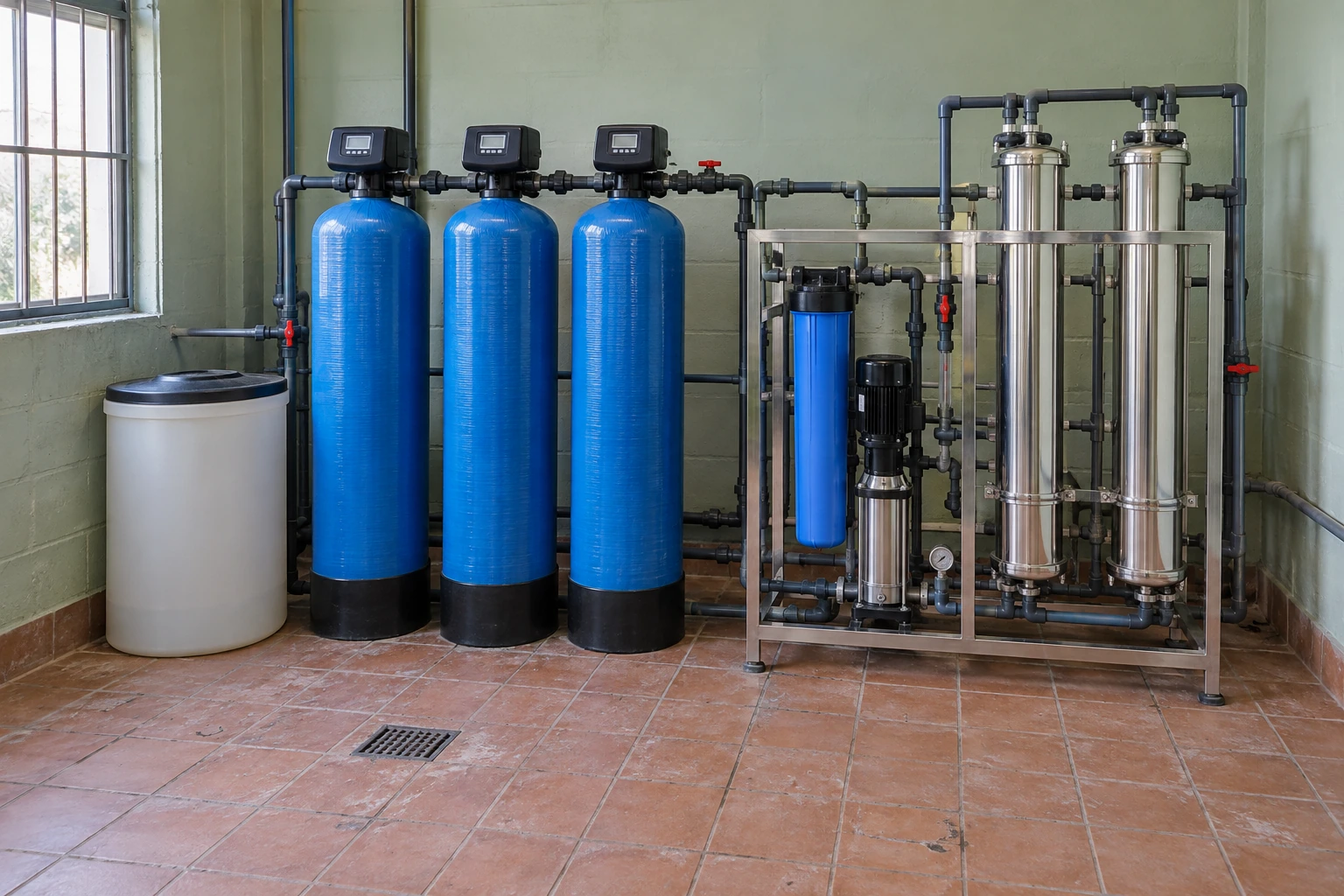
Reverse Osmosis Systems
5 stage reverse osmosis water purification system
| Five-function treatment route | Media filtration → activated carbon → softening → cartridge filtration → reverse osmosis |
|---|---|
| Suitable duty | Commercial process-water preparation and modest industrial supply where this pretreatment route matches the raw water |
| RO production classes | 250 or 500 L/h; selected and rated for the actual feed-water conditions |
| RO frame, L × W × H (mm) | 559 × 660 × 1,397 or 584 × 610 × 1,397; separate pretreatment vessels and tanks are additional |
| Prefiltration and scale control | Backwashable media, carbon vessel, regenerating softener and replaceable cartridge; other scale-control arrangements by water analysis |
| RO hardware | 4-inch spiral-wound membrane options; stainless steel frame and compatible membrane housings |
| Electrical supply | 220–240 V, single phase, 50 Hz; other pump arrangements on selection |
| Operating provisions | Pretreatment lockout, inlet pressure protection, product/reject flow meters and product-tank control |
The five functions above define this treatment route. A tank, a pump and a membrane array are not additional purification stages; the complete layout includes their space and access requirements.
The five-function package can be customized for your source water, operating schedule and installation conditions.
For a commercial or industrial installation, a 5 stage reverse osmosis water purification system should describe five useful treatment functions in an agreed water-flow diagram. Counting housings does not explain what the plant removes, how much usable water it makes or whether the membrane is protected.
Give each stage a separate job
- Media filtration manages the incoming solids load. A backwashable bed can reduce the material reaching later equipment. Its selection depends on the type of suspended matter and available backwash supply; a cartridge alone may be costly to maintain on a dirty source.
- Activated carbon addresses susceptible organics and oxidants. For chlorine-sensitive RO membranes, dechlorination is part of membrane protection. Media selection, contact time and monitoring must suit the disinfectant actually present.
- Softening controls the hardness load. Ion exchange removes hardness-forming ions before concentration in the membrane. It needs regeneration, salt handling and drain provision. Where a different scale-control strategy is more appropriate, the agreed treatment route must change with it.
- Cartridge filtration provides a serviceable final solids barrier. Installed downstream of media treatment, it can capture carryover before the RO pump and membrane train. Rising differential pressure indicates a restriction; it does not measure dissolved-salt removal.
- Reverse osmosis reduces dissolved material. Pressurized water passes through the membrane while a separate concentrate stream leaves the unit. Recovery and product quality must be selected together rather than adjusted independently to achieve an attractive water-saving number.
When this arrangement is useful
This route suits a water supply that genuinely needs solids treatment, dechlorination and hardness control before RO. It gives the operator separate components to service when the feed changes. A small industrial wash process can then add product storage and delivery around the required working pattern.
The route may be unnecessarily complicated for an already conditioned feed. Conversely, iron, manganese, oil or an unusual organic load can require treatment that these five functions do not provide. The number five should follow the water problem, not restrict the engineering response.
What the stage count does not promise
Five treatment functions are not five membrane passes. Several membrane housings can belong to one pass, and a single pretreatment vessel may perform more than one task. A supplier's stage count is therefore useful only when its flow diagram and component duties are available.
This package also does not establish final microbiological quality merely because RO is included. Storage and distribution remain part of the end-use assessment. Where downstream disinfection is needed, compare the six-function treatment arrangement with its additional control requirements.
Keep pretreatment and RO operation coordinated
A softener regenerating or a filter backwashing should not feed unsuitable water into an operating RO skid. The control arrangement can pause production and let a product tank support the users during those events. This makes the service schedule part of the package selection, alongside membrane capacity.
Accessible sampling points before RO and on the product line help separate pretreatment problems from membrane problems. Arrange the vessels so control valves can be reached, cartridges can be removed and salt can be replenished without disconnecting another component. shengtongJH can coordinate the component scope and connection details around that practical layout.
The five-function package can be customized for your source water, operating schedule and installation conditions.