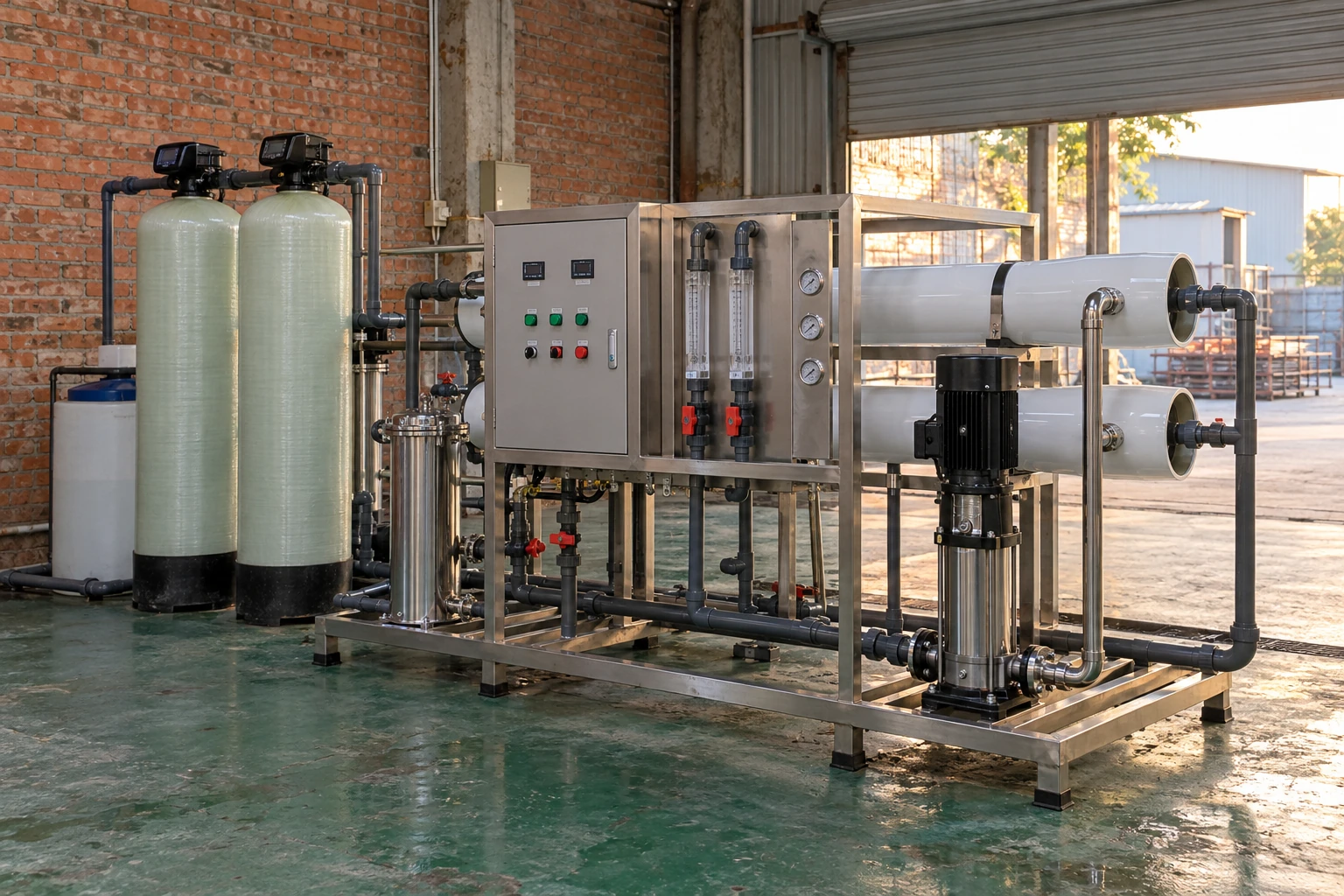
Reverse Osmosis Systems
industrial reverse osmosis water purification system
| Permeate duty classes | 1 or 2 m³/h packages, with other duties selected from the water analysis and process demand |
|---|---|
| RO frame sizes, L × W × H (mm) | 559 × 787 × 1,397; 864 × 940 × 1,524; 1,016 × 1,016 × 1,524 |
| Membrane train | 4-inch or 8-inch spiral-wound elements, selected for flow and feed chemistry; single-pass or additional treatment as required |
| Materials | Stainless steel or coated structural frame; pressure-rated stainless/FRP housings; compatible low- and high-pressure pipework |
| Electrical options | 380–415 V, three phase, 50 Hz; pump and control load selected with the duty |
| Instrumentation | Feed/product conductivity, product and concentrate flow, pressure measurements, sample points and optional data recording |
| Service provisions | Membrane-removal clearance, cartridge access, flushing and cleaning connections; maintenance isolation options |
| Process interface | Storage-level interlock, delivery-pump coordination, off-spec diversion and duty/standby scope by application |
Sizes refer to the RO frame, not the total water-treatment installation. Feed temperature, salinity, recovery and selected membranes determine the operating output and pump requirement.
The industrial RO package can be customized for your process-water duty, available utilities, maintenance plan and control interfaces.
An industrial reverse osmosis water purification system supplies a defined water duty to a production process. Its value is stable usable output with manageable service interruptions, not simply the largest membrane count or the highest nominal recovery on a quotation.
Keep water quality and availability in the same specification
An industrial rinse can stop when a tank runs low even though its water quality is satisfactory. Another process may have ample water but be unable to use it after conductivity drifts. Specifying these two requirements together prevents a capacity-only purchase that overlooks the actual production constraint.
Establish the normal and peak demand, production shifts, allowable interruption and acceptance limits at the use point. A batch wash, a continuously fed utility and a sensitive final rinse impose different storage and control duties. Feed variability and seasonal temperature changes should be included when checking whether the selected plant can sustain that demand.
Set recovery around the chemistry
As water becomes permeate, retained material becomes more concentrated in the remaining stream. Higher recovery can reduce the reject volume but also increase scaling and fouling risk. Antiscalant selection, softening, membrane arrangement and concentrate flow must be considered together.
A valve setting that appears to save water may move the system outside its intended hydraulic conditions. Use the approved water balance and membrane projection to set the operating limits. Any reuse of concentrate needs a separate assessment of its composition and the receiving process.
Use the right measure of efficiency
Compare usable water delivered over the required schedule, including planned servicing and the agreed quality limit. A nominal high-output unit can be inconvenient if it needs frequent cleaning on the actual feed or cannot operate efficiently at the required demand.
Additional storage, staged operation or a second duty unit can be more useful than oversizing a single skid. The appropriate arrangement depends on the cost of interruption, maintenance resources and the site's available floor space.
Make the plant diagnosable
Record operating conditions at commissioning so later trends can be interpreted. Temperature changes affect membrane output. An increasing pressure loss across a cartridge suggests a different intervention from a rise in salt passage or a change in normalized permeate flow. Pressure, flow and conductivity together are more informative than an isolated TDS display.
Sampling positions upstream, after pretreatment and at the product outlet help locate a change. Optional logging can support troubleshooting where operators rotate between shifts. Define alarm actions and diversion or shutdown behavior before connecting the package to a process that depends on its water.
Leave room for the maintenance that the design assumes
Membrane service
Vessel end access and element-withdrawal space must remain clear after surrounding equipment is installed. The service path can be much longer than the skid itself.
Cleaning and isolation
Cleaning connections, compatible valves and a suitable route for cleaning liquids are package decisions. A cleaning procedure must match the actual membrane, foulant and materials; it is not a universal operating recipe.
Consumables and spares
Record membrane dimensions, cartridge specification, pump seals and instrumentation details. Interchangeable-looking parts can have different ratings and connection arrangements.
Agree the factory-to-site interfaces
Define what arrives assembled and which vessels, tanks and pipework are installed separately. Include lifting and doorway limitations, electrical supply, drains, delivery controls and the receiving process's start/stop signals. These details reduce installation changes that do not appear in a nominal flow-rate comparison.
shengtongJH acts as an equipment procurement and supply coordinator. A project quotation can identify the equipment manufacturer's documentation, agreed testing scope and field responsibilities. See the factory supply and acceptance scope for the information needed to turn the selected duty into a maintainable package.
The industrial RO package can be customized for your process-water duty, available utilities, maintenance plan and control interfaces.