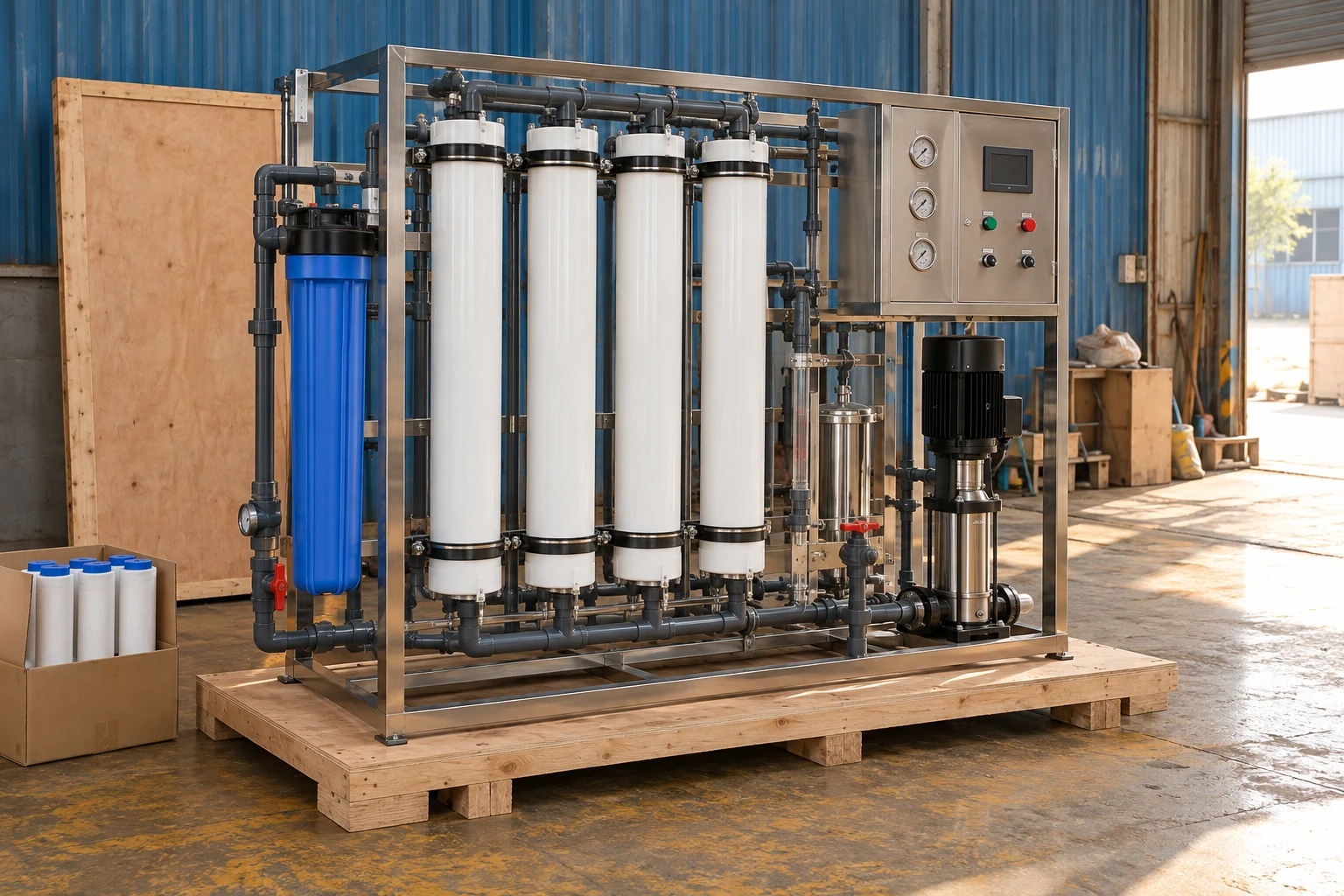
Reverse Osmosis Systems
reverse osmosis water purification system factory
| Supply scope | RO skid only, pretreatment plus RO, or coordinated treatment/storage/delivery package |
|---|---|
| Output classes | 250, 500 and 1,000 L/h; other duties selected against the source water and required product quality |
| RO frame, L × W × H (mm) | 559 × 660 × 1,397; 559 × 787 × 1,397; 864 × 940 × 1,524 |
| Construction choices | Stainless steel or coated frame; stainless/FRP membrane housings and chemically compatible pressure piping |
| Membrane format | 2.5-inch and 4-inch elements for compact packages; larger formats by duty |
| Electrical options | 220–240 V single phase or 380–415 V three phase, 50 Hz; alternative site supplies by agreement |
| Documentation scope | Flow diagram, component schedule, electrical drawings, operating instructions and agreed inspection records |
| Packing and interfaces | Separate or integrated skids, protected connections, dimensional layout and defined site installation responsibilities |
Configuration dimensions and output are paired in the agreed equipment selection. The final drawing defines the supplied assembly, separate modules and required service access.
The equipment package, frame arrangement, documentation and connection details can be customized to suit your procurement and site requirements.
Buying a reverse osmosis water purification system from a factory involves more than selecting a skid from a photograph. The treatment duty, construction details and supply boundaries must agree before the equipment is built. shengtongJH coordinates sourcing and supply with equipment manufacturers as a trading and procurement business.
Turn a water duty into a buildable package
The factory needs a consistent basis for selecting membranes, pressure vessels, pumps and pretreatment. If one quotation assumes warm municipal water and another assumes a cooler, higher-salinity feed, their stated outputs cannot be compared directly.
A useful purchase specification links the source-water analysis to the required output quality and operating schedule. It then defines equipment materials, utilities and the limits of the supply. This is how a nominal RO capacity becomes an assembly that can be connected and maintained at the intended site.
Where the source analysis is incomplete, identify what remains conditional before freezing the component schedule. A photograph cannot establish membrane suitability, vessel pressure rating, electrical compatibility or treatment performance.
Construction choices that affect everyday work
Frame and arrangement
Corrosion exposure, lifting access and membrane withdrawal influence the frame and vessel layout. A compact build is useful only if its filters, gauges and service valves remain accessible after installation.
Water-contact components
Specify appropriate materials and ratings for the water and operating conditions. A stainless steel frame does not establish that every wetted part is stainless steel, nor does it determine the grade of the piping or seals.
Controls and instruments
Define the signals exchanged with pretreatment, storage and the receiving process. Clear instrument identification and a component list make future replacement easier than an enclosure containing undocumented parts.
Agree what factory inspection is meant to establish
Dimensional checks, component identification, wiring checks, leak checks and functional operation each answer a different question. A water trial should record its actual feed conditions and operating settings. Results on the factory's test water cannot automatically prove the same output or water quality on a different site supply.
When an acceptance criterion depends on the customer's raw water or installed distribution system, allocate it to the appropriate site test. Define the responsible party, measurement method and supplied records in the purchase agreement. Certification and performance claims require evidence for the equipment actually ordered.
Separate the skid from the installation contract
Raw-water storage, pretreatment media loading, drains, incoming power, product-water tanks and final pipework can sit outside a basic skid quotation. Listing these boundaries avoids an apparently complete delivery that still lacks a way to supply, drain or distribute water.
The packing plan should also protect instruments, membrane vessels and pipe connections while allowing the site to move the equipment into position. Membrane transport and preservation conditions come from the selected equipment's instructions. Accessory cartons and spare parts should correspond to the component schedule, not simply be described as a standard service kit.
For a procurement enquiry, send the water analysis, required duty, site utility details and any restrictions on assembly size. shengtongJH can coordinate manufacturer selection, package details and the agreed documents. Compare the industrial service arrangement when continuity, instrumentation and maintenance isolation drive the purchase.
The equipment package, frame arrangement, documentation and connection details can be customized to suit your procurement and site requirements.