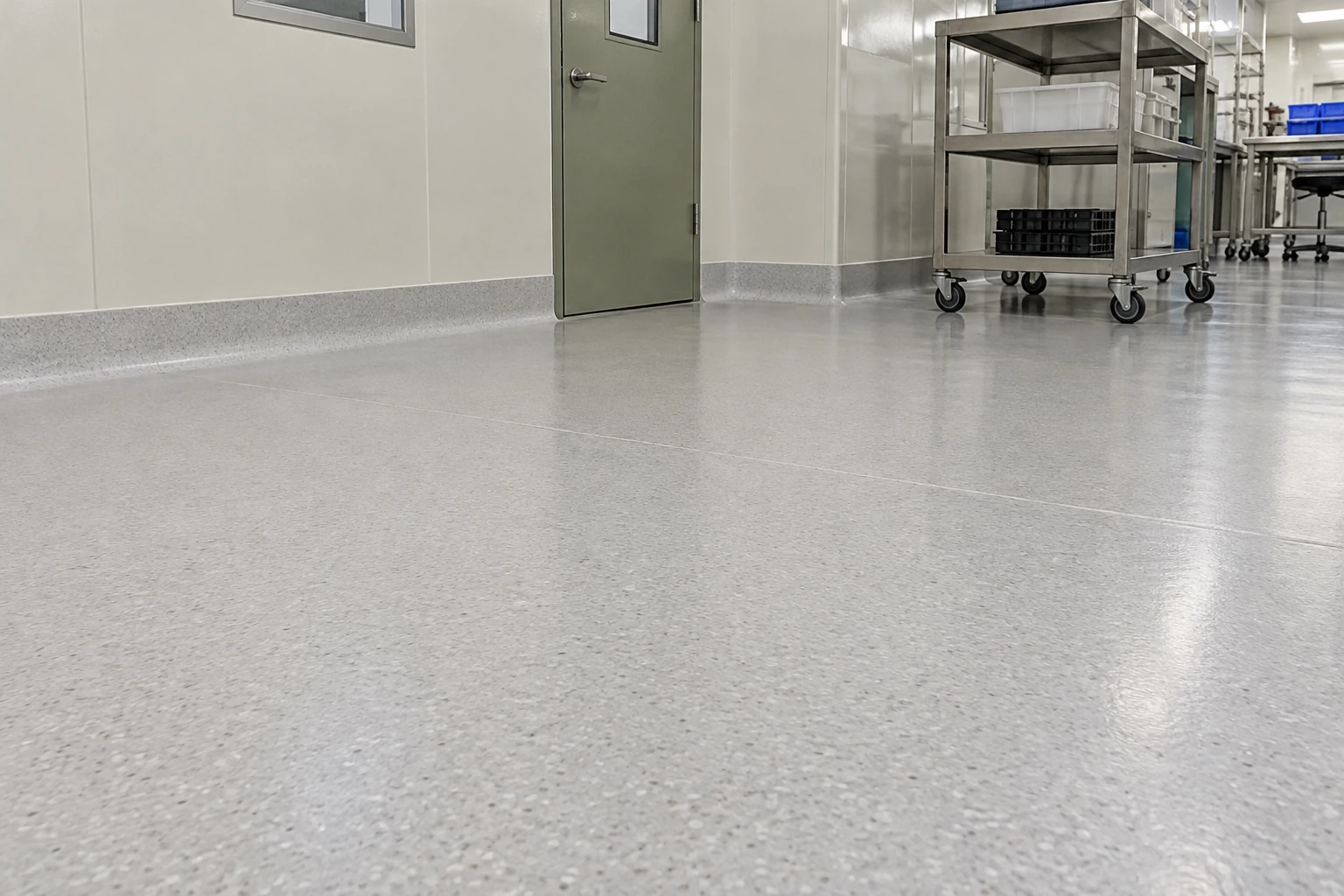
PVC Flooring
Cleanroom Vinyl Flooring
| Construction | Homogeneous PVC sheet; smooth finish suited to the agreed cleaning regime |
|---|---|
| Sheet format, W × L | 2 × 20 m at 2.0 mm; 2 × 15 m at 2.5 mm |
| Alternative tile format, W × L | 300 × 300 mm at 2.0 or 2.5 mm; 608 × 608 mm at 2.0 mm |
| Junctions | Compatible weld rod, formed coves, capping and sealed service interfaces |
| Installation | Bonded finish on a prepared substrate with a compatible adhesive system |
| Electrical option | Standard or specified ESD construction, selected for the process |
Formats are nominal configuration choices. The selected floor, adhesive and junction details must suit the cleaning chemicals, wheeled loads and substrate; a flooring material alone does not establish a cleanroom classification.
A cleanroom floor has to remain easy to clean where people walk, trolleys turn and services meet the room envelope. Vinyl sheet flooring can provide a smooth, joined surface, but its usefulness depends as much on the perimeter and installation details as on the floor material itself.
A continuous surface needs continuous details
The broad floor area is usually the easiest part to wipe. The difficult locations are the base of a partition, the foot of a machine and the narrow gap beside a doorframe. A sharp, open floor-to-wall joint can retain wash water and residues even when the surrounding floor looks clean. Taking the sheet up a supported cove removes that abrupt internal corner and gives cleaning tools a more accessible junction.
A welded sheet joint closes a cut between adjacent lengths. It cannot compensate for a moving substrate or an unsuitable adhesive beneath the floor. Substrate joints, moisture and surface strength should therefore be assessed before the sheet layout is fixed. Covering a defect may hide it briefly while leaving the cause of later lifting in place.
At walls and doors
Coordinate the cove with wall panels, door clearances and threshold materials. A neat upstand is of little benefit if its upper termination opens during cleaning. At a doorway, protect the edge without creating a trolley impact point or a recess that is hard to wipe.
Around equipment
Agree how legs, floor-mounted frames and service penetrations meet the finish. Installing a large machine first may leave inaccessible strips behind its supports. Installing the floor first requires a plan to protect it during positioning and to seal subsequent fixings.
Along traffic routes
Small hard wheels concentrate contact pressure. Turning and braking can be more demanding than straight travel. Review the actual trolley wheel material, load and route, including crossings into adjoining rooms, rather than selecting the finish only from pedestrian use.
Match the finish to the cleaning task
A smooth homogeneous surface suits many controlled-room cleaning routines, but no single PVC formulation should be assumed compatible with every disinfectant. Evaluate the named cleaning agent at its working concentration and contact time, together with the adhesive and weld. Residue removal matters: a film left on the surface can affect traction and, where relevant, electrical behavior.
Flooring for an electronics process may also need an ESD system. That requirement is separate from ease of cleaning. Conversely, specifying an electrical floor does not establish particle cleanliness, microbiological control or the classification of the completed room.
Handover should cover the edges as well as the open area
Inspect seams, cove terminations, thresholds and repairs before equipment blocks access. Keep the accepted material identity, adhesive and weld details with the maintenance instructions. A spare sheet offcut is useful only if its construction, color and batch are known. These records make later service penetrations and local repairs easier to manage without introducing incompatible materials into the floor.
Floor format, cove details, transitions and the installation package can be customized to the room layout and operating conditions.