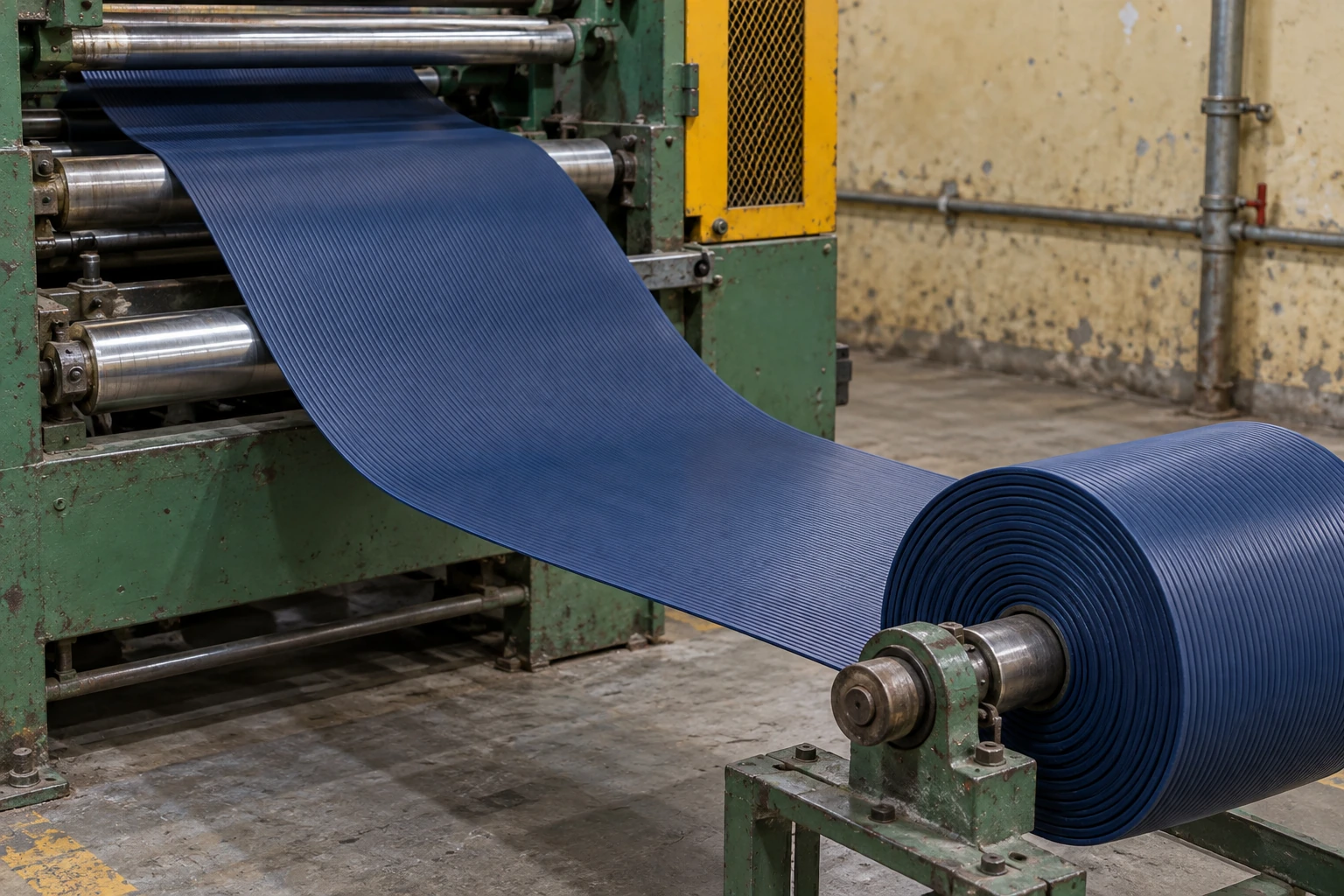
PVC Floor Mats
pvc flooring mat factories
| Construction families | Solid ribbed, embossed solid and open-grid flexible PVC matting |
|---|---|
| Thin solid roll, L × W | 25 × 1 m at 2.0 mm; coin-profile 25 × 0.98 or 25 × 1.5 m at 1.6 mm |
| Open-grid roll, L × W | 5 or 10 m long × 0.6 or 0.91 m wide; 20 mm nominal height |
| Process controls to agree | Material identity, profile geometry, conditioning, cut dimensions and finish |
| Finishing scope | Roll winding, cut pieces, compatible ramps and connectors as ordered |
| Traceability | Approved sample, batch identity, inspection record and agreed change notification |
These are separate construction choices, not a factory capacity claim. Manufacturing location, process capability and product evidence are verified for the selected supply source.
Comparing PVC flooring mat factories is useful only when the products being compared have the same intended duty. A thin solid runner, an embossed sheet and a deep drainage grid require different profiles and finishing controls. Evaluate the manufacturing route through its effect on the delivered mat.
Compare the construction before comparing the production line
Extrusion can form continuous PVC profiles, while solid sheet products may use a different forming and surface-patterning route. The process name alone does not establish quality. What matters to the buyer is whether the chosen route consistently produces the required backing, ribs or openings and a mat that fits the agreed duty.
A thin solid runner needs a continuous usable face and controlled thickness. An open grid needs consistent openings and sound connections throughout its structure. An embossed profile needs an agreed definition of overall height so that a quoted dimension is not confused with the thickness beneath the raised pattern.
Material and profile consistency
The PVC formulation influences flexibility and service behavior. Two mats with the same color and profile can still differ in composition. Keep material identity and any specified restrictions in the purchase specification, and require changes to be disclosed before supply.
Check dimensions at meaningful locations across the material, not only at an easy-to-reach edge. For open profiles, assess the repeated geometry and connection condition. A single attractive sample is useful for approval but does not establish consistency across a production batch.
Conditioning and finishing
Flexible PVC can change dimensions as manufacturing stresses relax and as temperatures vary. The measurement and conditioning procedure therefore belongs beside the tolerance. Comparing an immediately wound product with a relaxed sample without an agreed method can produce misleading conclusions.
Cutting, attaching edges and packing may take place separately from the main forming process. Identify who controls those steps. A satisfactory base roll can still arrive as poorly fitting modules if finishing dimensions and accessory compatibility are not controlled.
Use an inspection scope that follows likely failures
- Confirm identity. Relate the inspected batch to the approved construction and retained sample.
- Check usable geometry. Measure the agreed width, length and profile height using the specified method; examine cut edges and module fit.
- Review the working surface. Look for damage, contamination or inconsistent features that interfere with the intended contact.
- Check the completed package. Reconcile ramps, connectors, cut pieces and labels with the order, then assess protection of the roll ends and finished edges.
Separate the source's capability from the supply coordinator's role
shengtongjh coordinates industrial equipment and material purchasing. Factory identity, capacity, certification and product test evidence must be established for the actual source; they are not implied by a sourcing page. A practical comparison links each quotation to a defined mat and inspection scope. For a changed profile or special cut arrangement, the manufacturing specification and approval process should be agreed before production.
The mat construction, finishing scope and inspection requirements can be customized to the application and purchasing specification.