PVC Floor Mats
pvc flooring mat manufacturer
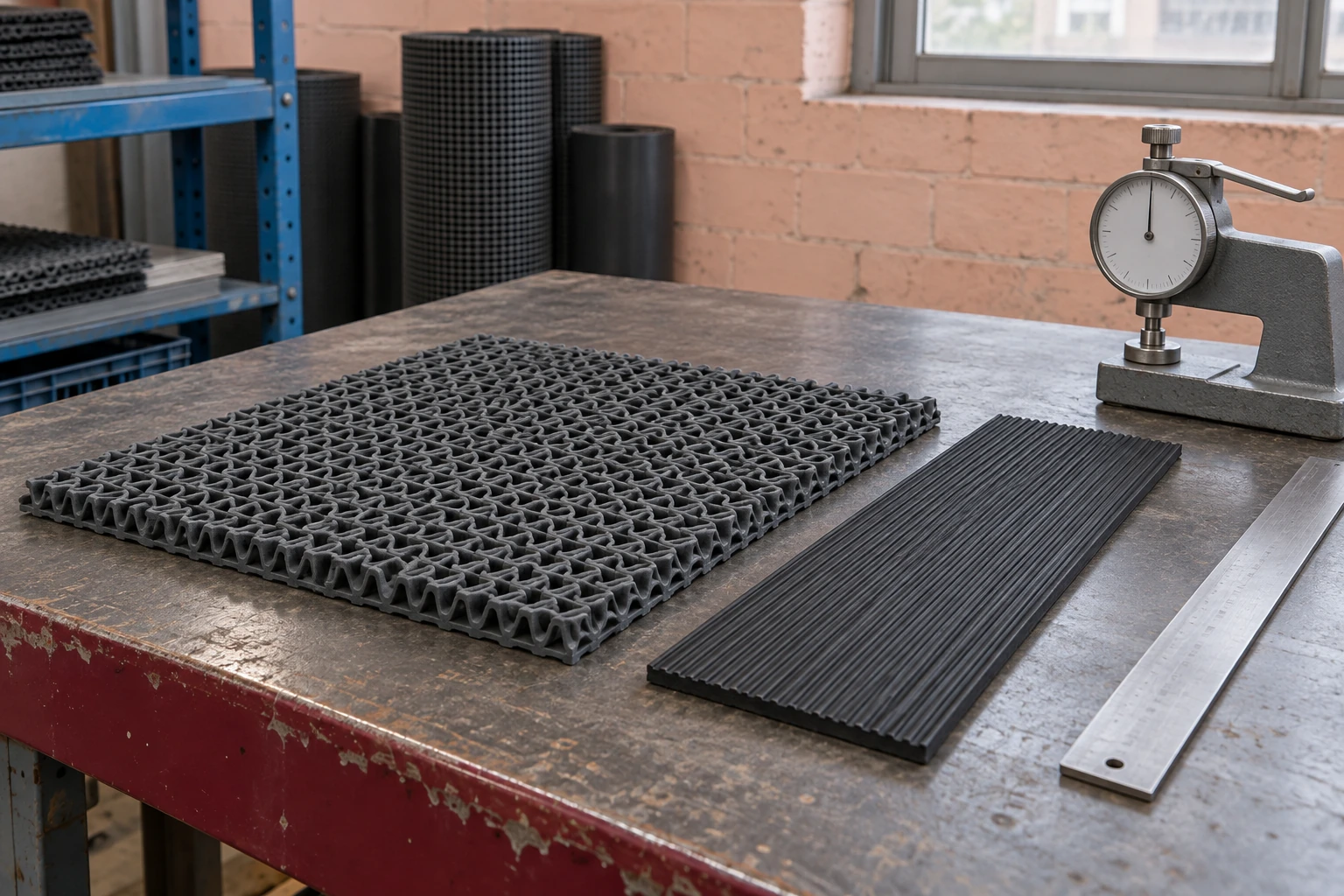
| Material and profile | Flexible PVC; solid ribbed, coin-patterned or selected open-grid construction |
|---|---|
| Solid profile formats, L × W | 25 × 1 m at 2.0 mm; 25 × 0.98 or 25 × 1.5 m at 1.6 mm |
| Open-grid module, L × W | 1.8 × 0.6 or 1.8 × 0.91 m; 20 mm nominal height |
| Customization scope | Cut length, outline, edge arrangement and compatible accessories |
| Approval information | Dimensioned drawing, retained sample and product-specific supporting evidence |
| Acceptance basis | Agreed dimensions, tolerances, conditioning method and batch identification |
New profile tooling, formulation changes or special performance requirements need separate manufacturer assessment. Listed formats do not establish an unlimited customization capability.
A manufacturer-facing mat specification should translate the workplace problem into a controllable product. It needs to describe the contact surface, material construction, finished shape and acceptance method, so that a custom cut or profile change improves use without creating a new handling or cleaning problem.
Define the problem that the mat must solve
A request for a thicker mat can hide several different needs: cushioning, drainage clearance, protection of the floor below or resistance to a particular contact. Those needs do not necessarily lead to the same construction. Start with the operating task, then decide which product characteristics address it.
For example, increasing an open grid's height also changes the edge that staff and carts must cross. Making openings smaller may change how debris passes through. A solid surface can be easier to wipe from above but retains spills on top. Treat these as linked decisions rather than independent options on a drawing.
Separate a cut-size change from a new construction
Cutting an established roll into a workstation shape is a different task from creating a new rib pattern or changing the material formulation. The first may use existing material and finishing methods; the second can require tooling, development samples and new supporting evaluation. The quotation should make that distinction visible.
A drawing for a cut mat should show its orientation, finished outline, cut-outs and edge treatment. Include the position of ramps and connectors where they are required. Avoid narrow projections around equipment feet if those pieces would be difficult to support or clean in service.
Approve the geometry
Define where width and height are measured and whether edges are included in the finished size. State the condition in which flexible material is measured. A drawing without a measurement convention can leave both parties using different interpretations.
Approve the construction
Retain the accepted material and profile sample. Connect any requested performance evidence to that construction. Color similarity does not establish equivalent flexibility, chemical behavior or electrical properties.
Approve the complete use
Try the proposed arrangement at the workstation with the actual footwear and relevant movement. Check access, edges and cleaning removal. A short trial can reveal a practical fit problem before a larger quantity is made.
Control changes after approval
If the material, profile, edge attachment or manufacturing source changes, review what the change affects before accepting it. A replacement additive or revised geometry may alter characteristics that are not visible in a photograph. Keep the revised sample and specification aligned so that production and receiving use the same definition.
Inspection should cover both the base material and finishing work. Check the specified dimensions and condition of the working surface, then reconcile the finished pieces and accessories against the order. The aim is to receive a usable workplace component, not only a roll that resembles the original sample.
Coordinate the manufacturer through one agreed specification
shengtongjh's role is to coordinate the material requirement and supply package. Any source-specific capability or performance claim needs evidence from the selected manufacturer. Keeping the approved drawing, sample identity and acceptance requirements together gives the purchaser a clearer basis for ordering and for handling a later change.
Mat sizing, edge layout and the manufacturing approval package can be customized to the operating task and installation footprint.