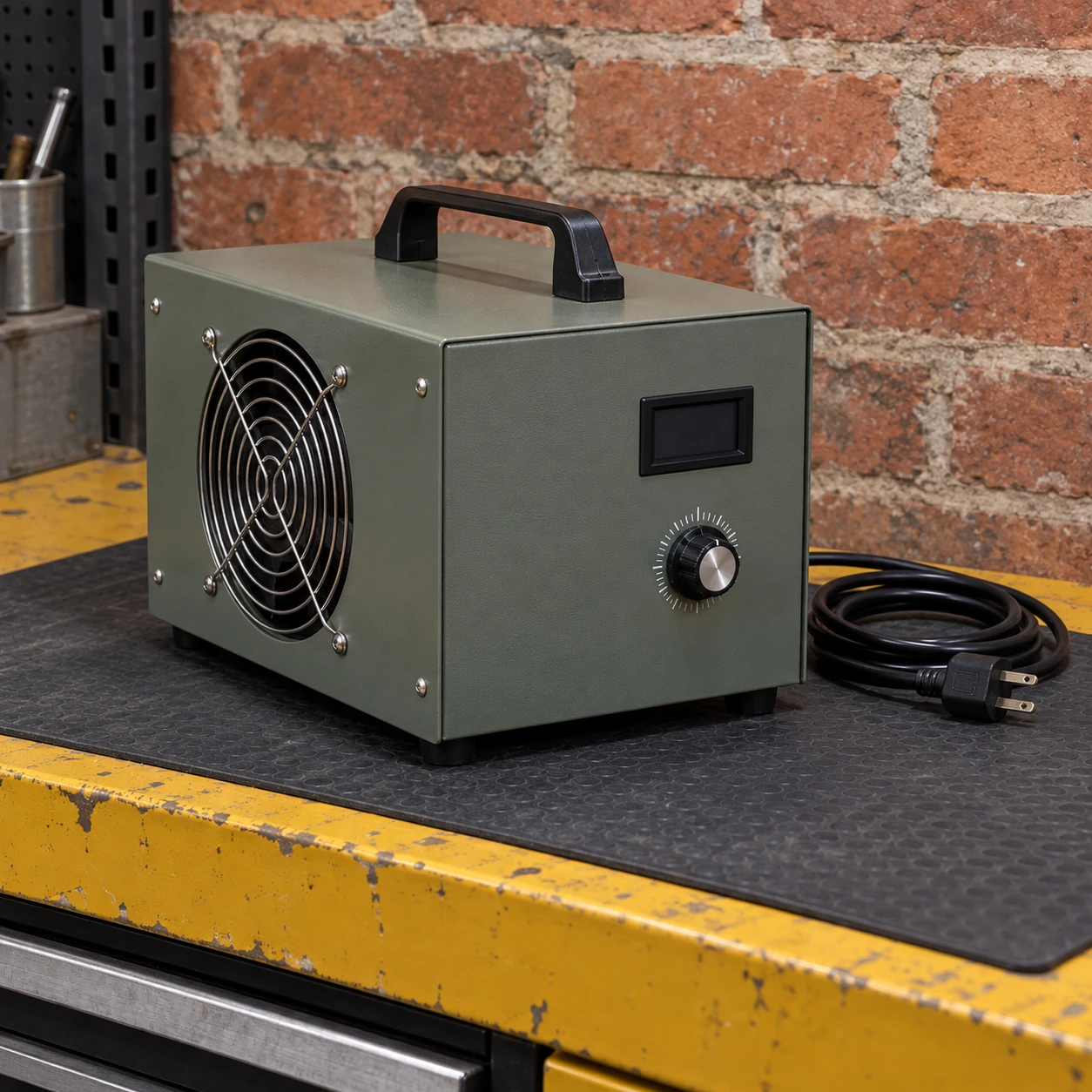
Ozone Generators
air purifier ozone generator
| Equipment scope | Professional ozone-treatment equipment; not an occupied-space particle purifier |
|---|---|
| Portable generation options | 3.5, 7 or 10 g/h nominal configurations |
| Portable external L × W × H (mm) | 460 × 310 × 310; gas-output enclosure 650 × 350 × 250 |
| Gas-output external W × D × H (mm) | 180 × 135 × 295; 280 × 140 × 350 |
| Discharge options | Fan-assisted delivery or dedicated gas outlet by configuration |
| Control functions | Output setting and timer; separate ambient measurement required for the site |
| Particle filtration | A unit intake prefilter protects components; it does not establish clean-air delivery performance |
| Electrical configuration | Destination-specific mains supply; approved installation and operating arrangement |
Different enclosure types require different delivery equipment. The dimensions do not describe a certified air-cleaner model, and no occupied-space emission certification is represented.
Equipment selection can be customized around the actual pollutant, professional treatment arrangement and destination requirements.
An air purifier ozone generator introduces a reactive gas; it does not clean air in the same way as a particle filter. For a workplace that remains occupied, start with the pollutant source, ventilation and appropriate filtration. Intentional ozone treatment belongs only in a suitable controlled professional process.
Identify the pollutant before choosing a machine
Dust and suspended particles
Mechanical filtration captures particles from air passing through a filter. Selection depends on the particle requirement, airflow and pressure available. An ozone production figure does not describe particle capture.
Explore the appropriate Air Filters or a Recirculating Air Purifier when this is the primary duty.
Selected gases and odours
Suitable adsorption media can retain particular gas contaminants, subject to the gas, concentration and contact conditions. Media selection and replacement planning are important. A generic carbon label cannot establish suitability for every gas.
A controlled oxidation task
Ozone reacts with materials and contaminants rather than physically collecting particles. The process needs a defined purpose and exposure controls. A device should not be chosen merely because an odour is described as difficult.
Why a low setting is not an occupied-use claim
The U.S. EPA explains the limitations of ozone generators sold as air cleaners, including inhalation hazards and potentially harmful reaction products. An output knob does not measure what people are breathing.
A purchase specification should therefore keep the intended function explicit. A portable treatment device, a recirculating filtered-air unit and an in-duct device have different system boundaries. Combining these descriptions in a listing does not establish that the equipment is suitable for continuous use around people.
Do not confuse an intake filter with room purification
A small filter at the machine inlet may protect internal components from dirt. That is a maintenance function. It is not evidence that the complete machine provides a particular particle-cleaning rate, filtration class or cleanroom condition.
If an offered assembly includes both ozone generation and a filter stage, request separate documentation for each function and for the intended operating mode. The specification must explain which functions can operate together and what restrictions apply.
A practical enquiry begins with the problem
Describe whether the concern is airborne dust, a continuing chemical release, a one-off contamination event or odour remaining after cleaning. Include the occupied schedule and any existing ventilation or filtration. This can lead to a filtration or source-control solution instead of an ozone package.
shengtongJH coordinates industrial equipment and materials around those requirements. Where controlled professional ozone treatment is appropriate, specify the generator, monitoring, ventilation and operating responsibilities as a complete scope. For sales into California, the California product page explains the model-specific review required before an order can proceed.
Equipment selection can be customized around the actual pollutant, professional treatment arrangement and destination requirements.