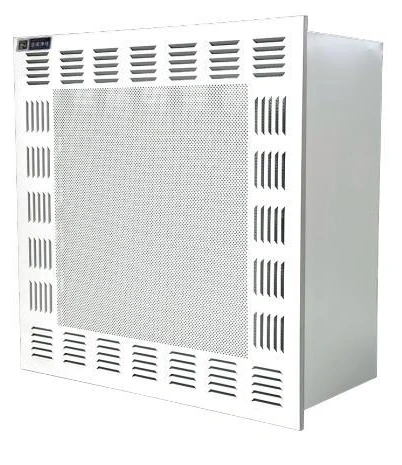
Cleanroom HVAC & Environmental Control
Recirculating Air Purifier
| Specification | AS-01 | AS-02 | AS-03 | AS-04 |
|---|---|---|---|---|
| External size, W × D × H (mm) | 360 × 360 × 400 | 530 × 530 × 400 | 640 × 640 × 400 | 860 × 640 × 400 |
| Filter size (mm) | 320 × 320 × 70 | 484 × 484 × 70 | 600 × 600 × 70 | 820 × 600 × 70 |
| Filtration stages | Prefilter and high-efficiency filter | |||
| Housing options | Coated steel or brushed 304 stainless steel | |||
| Air velocity setting | 0.45 m/s ±20% | |||
| Power supply | 220 V, 50 Hz | |||
| Installation | Suspended or mobile arrangement | |||
| Fan adjustment | Rotary speed control | |||
| Customization | Installation and configuration to suit the room | |||
Dimensions and configurations can be customized for your application.
Filter air already within the room through a compact recirculating unit. Position the inlet and outlet to serve the occupied space while keeping filters accessible for routine maintenance.
Remove particles through a recirculating path
The unit draws room air through a prefilter and high-efficiency filtration stage, then returns filtered air to the space. The prefilter intercepts larger particles before they reach the final stage, helping organize maintenance around the actual loading conditions.
This approach can supplement particle control in a working area. It does not introduce outdoor air, remove equipment heat or automatically correct humidity. Those duties remain with the building's ventilation and environmental-control systems.
Position matters more than an empty corner
An inlet needs clear access to the room air. A unit pushed behind stored materials or placed where the discharge immediately returns to the inlet can circulate mainly through a small local loop. Arrange the unit to encourage useful movement through the area being served.
Consider shelving, machinery and partition walls. They can divide a nominally open room into poorly connected zones. The best position on a floor plan may not be the best position once the room is furnished and operating.
Keep the discharge appropriate to the work
A strong stream directed at an open product, precision balance or dusty surface may create a new disturbance. Coordinate the outlet direction with the task and with existing ventilation. The aim is useful room-air treatment without disrupting the operation.
Choose an installation that remains serviceable
Suspended installation can preserve floor space, but needs suitable structural supports and a safe route for filter replacement. Allow enough clearance to remove the intended panels and components. Do not hide a maintenance face above fixed equipment that cannot be moved.
A mobile arrangement can be repositioned as the room changes. Plan a stable parking location, protect the electrical connection and keep the inlet free of temporary storage. Reassess the air path after moving the unit instead of assuming that every location gives the same result.
Set expectations for the complete room
The required number and arrangement of units depend on the room, particle sources, activity and the airflow each unit actually delivers in service. Filter face velocity alone should not be used as a substitute for a verified room-treatment rate. An installed room classification requires assessment of the complete environment.
Particle filtration should also not be treated as a universal answer to odours, gases or hazardous vapours. Identify the contaminant before choosing treatment. Where a process releases harmful material, capture at source or dedicated containment may be more appropriate than recirculating it through the room.
Inspect prefilters and final filters according to loading and the operating procedure. Damaged seals or poorly seated filters can undermine filtration even while the fan continues to run. Housing, mounting and control arrangements can be customized for the application. Discuss the room layout and particle-control objective to select a useful installation.