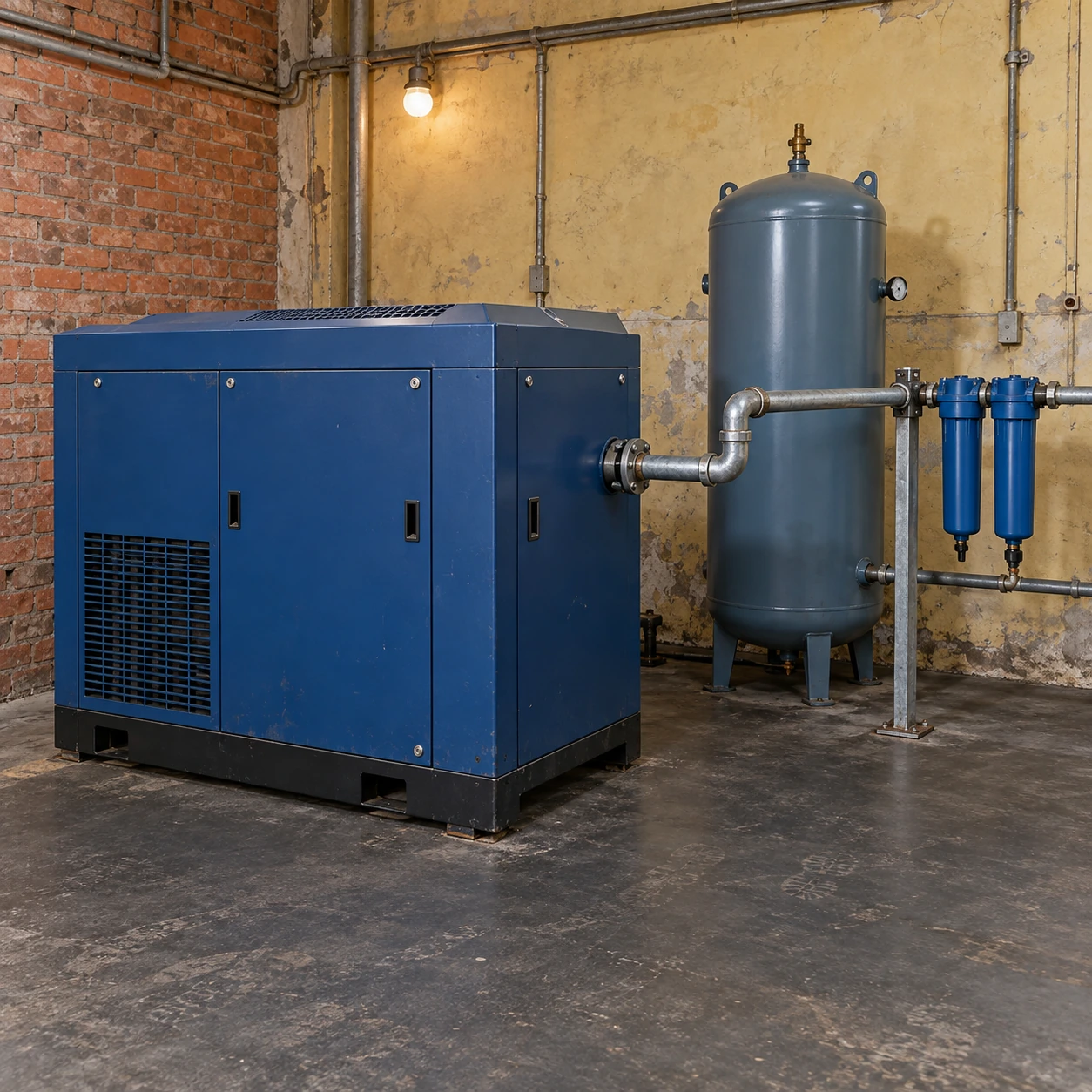
Oil-Free Air Compressors
oil or oil free air compressor
| Supply choices | Local oil-free branch, separate critical-air network or central replacement |
|---|---|
| Compact branch power | 2.2, 3.7 or 5.5 kW scroll selections |
| Cabinet W × D × H (mm) | 600 × 850 × 930 compact; 750 × 1020 × 1645 multi-element format |
| Pressure options | 8 or 10 bar(g) packages, selected around pressure needed after treatment and piping |
| Network interfaces | Receiver, isolation, suitable non-return arrangement and dedicated point-of-use regulation |
| Treatment options | Drying and filtration sized for the new quality requirement and actual inlet conditions |
| Handover scope | Duty confirmation, air-quality acceptance points, operating instructions and service access |
These cabinet formats cover local and multi-element supplies. Final equipment and pipe interfaces depend on the measured duty and the selected connection arrangement.
A local branch or complete oil-free supply package can be customized to suit your existing network and new process requirements.
When deciding between oil or oil free air compressor equipment for an existing facility, start with what the air network must now do. A new sensitive process may need a separate supply even when the general workshop compressor still works.
Three useful routes for an existing facility
Keep the general supply and improve its treatment
This may be reasonable when the compressor has sufficient capacity and the required air quality can be achieved and maintained with a suitable treatment arrangement. First establish why the current outlet is unsatisfactory. Water, particles and oil have different causes; replacing a compressor will not repair a failed drain, corroded branch or saturated treatment component.
Consider how treatment failure would be detected and what it could damage. A process with a serious contamination consequence may justify eliminating compressor oil injection as an additional design measure, even when a filtration solution is technically possible.
Add a dedicated oil-free branch
A small instrument or sensitive assembly operation does not necessarily justify replacing the whole plant supply. A separate compressor, dryer and pipe run can serve that duty while the existing network continues to operate general tools. This also allows the critical branch to run at its own pressure and operating schedule.
Separation has to be real. Shared hoses, downstream lubricators, a casually opened cross-connection or an unqualified backup supply can undo the purpose of a dedicated branch. Define isolation and backup arrangements as part of the design.
Replace the central compressor
A central change becomes more attractive when much of the demand needs the same quality, the old compressor is near renewal or the existing machine is a poor match for the duty. Review total flow, low-load periods, cooling, electrical capacity and standby provision together. Matching the old motor size alone can reproduce the original oversizing problem.
The old distribution system does not become clean when the compressor changes
Receivers, pipework and hoses may retain oil and deposits from earlier service. Assess whether cleaning, component replacement or a new dedicated route is needed, then verify the delivered quality at the intended use points. A satisfactory compressor outlet result cannot establish the condition of an untested downstream branch.
Plan the cutover around production
List the users that must stay supplied during installation and maintenance. A temporary or standby source must meet the appropriate pressure and quality requirements; it should not silently bypass the treatment that protects a critical process.
Allow time for electrical work, pipe connections, dryer commissioning and quality acceptance. Put the isolation points where technicians can reach them, and retain sufficient space for removal of service parts. The best replacement is one that can be maintained after the first start.
Use the load record to choose controls
If the facility has a steady base demand and a changing trim demand, several coordinated compressors may be more appropriate than one large machine cycling through unloaded periods. A local unit can also avoid running an oversized central system for a small night-shift load.
Compare recorded demand with package performance across the operating range. Variable-speed control is useful only within the selected compressor's stable range; it is not a guarantee that every oversized machine will become efficient.
Make the purchase decision with clear responsibilities
Agree which party supplies the compressor, treatment, receiver, connecting pipe, electrical work and commissioning. Define the quality acceptance location and the documents needed for the equipment at the destination. This makes a retained, dedicated or replacement system comparable on both cost and responsibility.
shengtongJH can coordinate sourcing against that scope. For the underlying mechanism differences, see oil vs oil free air compressor; for the separate cost items, review oil free air compressor price.
A local branch or complete oil-free supply package can be customized to suit your existing network and new process requirements.