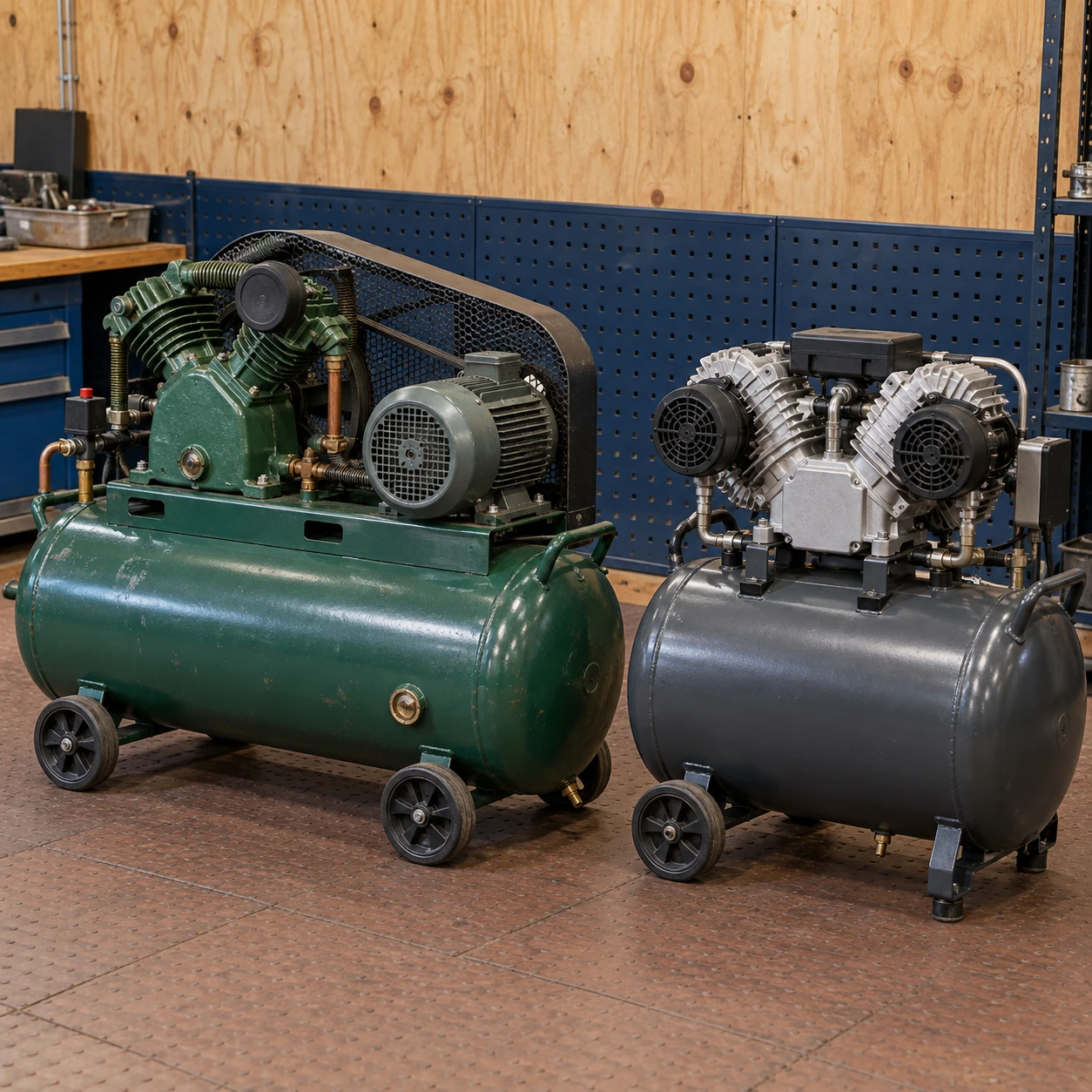
Oil-Free Air Compressors
oil vs oil free air compressor
| Comparison scope | Oil-lubricated piston or oil-injected screw versus oil-free piston, scroll or dry screw |
|---|---|
| Oil-free package formats | Portable receiver-mounted, enclosed scroll and central dry screw |
| Compact package W × D × H (mm) | 405 × 375 × 335 portable; 600 × 850 × 930 cabinet |
| Operating-pressure options | Compact and scroll selections commonly 8–10 bar(g); select rated delivery at the actual duty |
| Duty and controls | Intermittent piston, demand-sequenced scroll or industrial screw package as specified |
| Verification basis | Delivered flow, total package input, air-quality limits and maintenance schedule |
| Treatment scope | Water, particles and total oil assessed independently of compressor lubrication type |
Dimensions describe different oil-free package formats, not equal-output alternatives. Compare quotations at the same pressure, delivered flow and air-quality target.
An oil-free supply package can be customized around the application's duty, air-quality requirement and available installation space.
The difference begins inside the compression chamber, but the purchase decision reaches further: the process, air treatment and service routine determine whether each approach is suitable.
What changes inside the machine?
In an oil-lubricated piston compressor, lubricant reduces friction at moving surfaces. In an oil-injected screw compressor, oil also helps seal and cool the compression process. Separation equipment removes much of that oil from the discharged air, but the remaining aerosol and vapour must be considered in the treatment design.
Oil-free designs avoid introducing oil into the compression chamber. Piston designs use suitable dry-running materials; scroll equipment compresses air in moving pockets; dry screw machines keep their rotors separated and isolate lubricated drive components from the air path. These designs solve the lubrication problem differently, which is why their service needs should not be treated as interchangeable.
| Issue | Oil-lubricated / oil-injected | Oil-free |
|---|---|---|
| Compressor oil entering the air path | Lubricant separation and downstream control are part of the system. | No deliberate oil injection into the compression chamber; intake and downstream contamination still need assessment. |
| Routine maintenance | Includes the specified lubricant, separation components and other normal service items. | Includes filters, drains, cooling surfaces and technology-specific wear parts; some designs also have lubricated gear systems. |
| Water removal | Drying and condensate management follow the process requirement. | Drying and condensate management remain necessary. |
| Operating duty | Depends on the actual machine design and cooling. | Also depends on the actual design; the oil-free label is not a continuous-duty rating. |
Compare the contamination pathway, not a slogan
If air touches a sensitive surface, coating, ingredient or instrument, reducing compressor-origin oil can simplify an important part of the contamination strategy. It does not remove humidity, every particle or all vapours taken in from the surroundings. Old pipework and a downstream tool lubricator can introduce contamination after either type of compressor.
A correctly designed treatment system can reduce contaminants from lubricated equipment, but it depends on component selection, operating conditions, maintenance and verification. Oil-free equipment removes the deliberate injection source. The choice should consider the consequences of a treatment failure as well as the expected air quality in normal operation.
Service cost follows the technology
Removing routine compressor-oil changes from a small dry piston package can be convenient. It does not remove seal wear, intake-filter service or receiver drainage. A dry screw system has a different service pattern again. Ask for the actual intervals, parts, labour access and skills required rather than comparing only the number of consumables listed on a brochure.
Energy cost follows the duty
An oil-free label does not establish an efficiency advantage. Compare package input against delivered air at the required pressure, including part-load operation. A machine that spends much of a shift idling, unloading or rapidly cycling may cost more to operate than a well-matched alternative with a different purchase price.
Match the choice to the consequence of failure
For a general tool circuit, practical duty and service support may dominate the decision. For product contact or precision instrumentation, the contamination risk and evidence of delivered quality deserve more weight. Avoid prescribing one purity class for an entire industry; the process owner and equipment requirements establish the target.
Turn the comparison into an equipment enquiry
Record the air users, operating pattern and rejection risk before comparing offers. Keep supply boundaries equal: a compressor-only price and a compressor-plus-dryer price are not like-for-like. shengtongJH can coordinate an oil-free package against that defined requirement without implying that the compressor alone qualifies the complete process.
If you already have a working air network, the next question is how to change it without carrying contamination or downtime into the new supply. See oil or oil free air compressor for that replacement decision.
An oil-free supply package can be customized around the application's duty, air-quality requirement and available installation space.