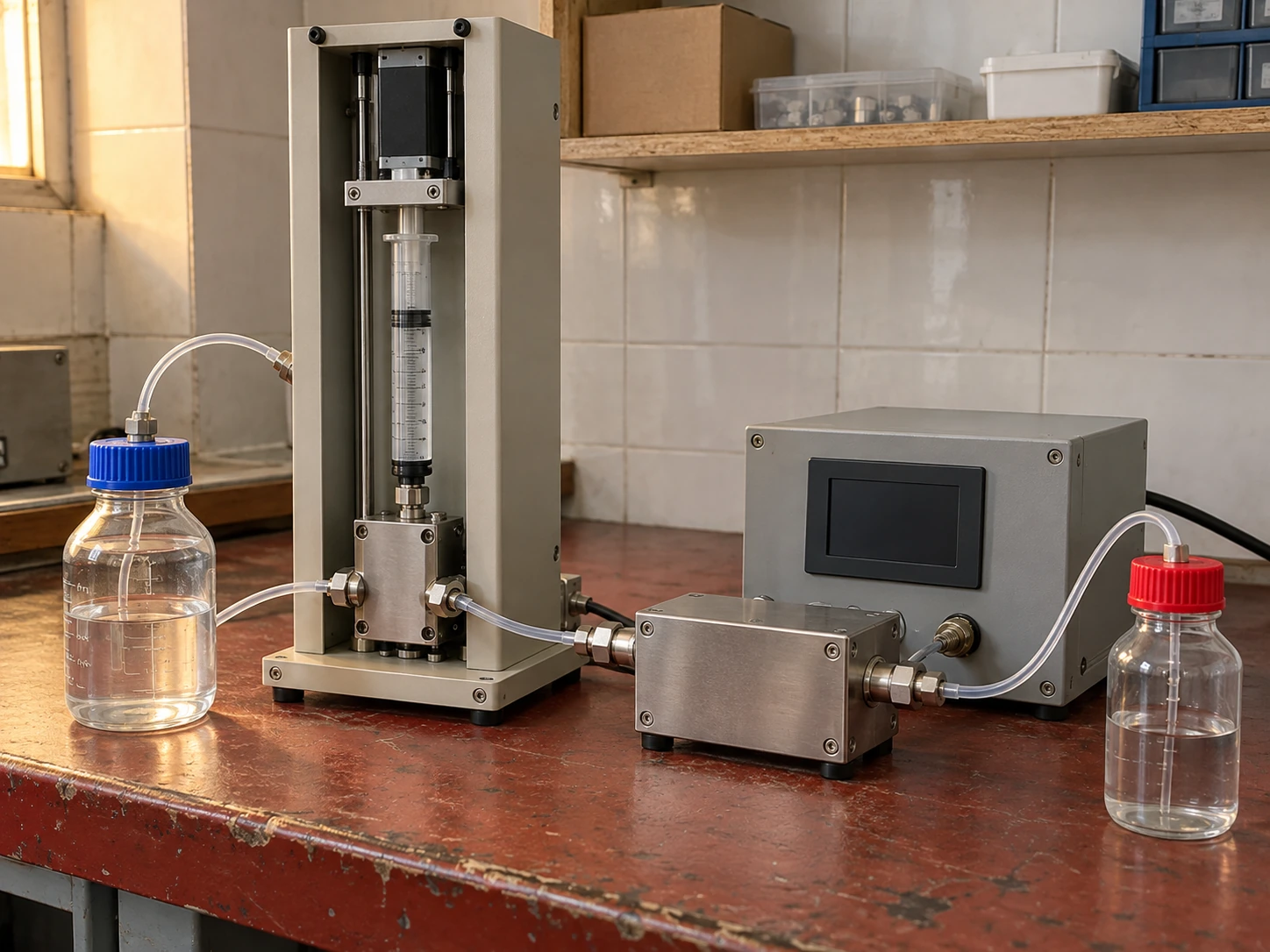
Liquid Particle Counters
liquid particle counters equipment
| Brand | shengtongjh |
|---|---|
| Integrated equipment, W × D × H (mm) | Bottle counter format: 343 × 337 × 482; pressure-assisted syringe format: 400 × 280 × 600 |
| Separate sampler, L × W × H (mm) | 254 × 229 × 312 for a modular syringe sampler; particle counter and controller are additional components |
| Sample-metering options | Integrated syringe drives: 1, 10 or 25 mL; separate sampler format: 25 or 50 mL. Syringe capacity is not the minimum sample requirement. |
| Fluid circuit | Compatible sample pickup, tubing, flow control, optical cell and waste connection; pressure conditioning where the selected arrangement requires it |
| Control and records | Local operation or connected software; sample identification, size-channel settings, volume records and export options |
Equipment sizes are outer envelopes; the separate sampler retains its stated L × W × H axis order. Module dimensions do not include a complete workstation. Allow space for connections, bottles, external utilities and maintenance.
The sampler, fluid connections, equipment layout and data interface can be customized to the measurement task and installation.
Liquid particle counters equipment can be supplied as an integrated bottle instrument or assembled from compatible sampling, sensing and control modules. A usable package must move a known volume through the sensor under suitable conditions and preserve enough information to interpret the result.
Specify the path from sample to saved result
- Introduce the sample. A bottle station, syringe sampler or process connection presents the liquid without adding avoidable contamination.
- Control its movement. A compatible pump or metering drive moves the required volume through the sensing region at the appropriate flow.
- Detect optical events. The selected sensor converts changes in light into pulses associated with particles in the flowing liquid.
- Record the measurement. A controller or software package assigns events to channels and retains the sample identity, volume and settings alongside the result.
Each stage has a separate responsibility. A sensor head alone may have no means of drawing liquid from a bottle. A syringe sampler may contain no particle detector. A display can show counts without providing the record structure required by the laboratory. Defining the entire path prevents a technically capable component from arriving as an incomplete working system.
Integrated and modular packages solve different installation problems
An integrated instrument
A combined enclosure keeps the operator controls, sampling drive and sensor close together. It can simplify a routine bottle-testing station and reduce the number of external interfaces. The tradeoff is that its bottle access, software and supported sensor arrangements are determined by that platform.
Check what belongs to the instrument and what remains external. Waste vessels, a computer, pressure assistance and protective accessories can still need bench space even when the product is described as integrated.
A modular arrangement
Separate modules are useful when the sampling method or process connection needs to be adapted independently of the counter. They also allow the operator station to be positioned away from a fluid-handling area where the configuration supports this.
The additional interfaces need explicit coordination. Confirm the mechanical connections, flow requirements, trigger signals, communications and software support as one package. Matching connector threads does not establish measurement compatibility.
Review every wetted component
The liquid touches more than the optical cell. It can contact a pickup tube, seals, valves, a syringe, fittings and waste tubing. A chemically resistant sensor housing does not protect an incompatible seal elsewhere in the path. Selection must consider the complete liquid composition, temperature and cleaning method, including any rinse fluid that will enter the equipment.
Dead spaces and unnecessary tubing also affect practical operation. They retain earlier liquid and increase the volume needed before a new sample reaches the sensing region. Keep the fluid route purposeful and accessible, while preserving the lengths and arrangements required by the equipment design. Connections should be identifiable so maintenance does not reverse inlet and outlet paths.
Flow control is part of the measurement
A pump that moves liquid is not automatically a suitable counting-system pump. The delivered flow, measured volume, sensor calibration and controller settings must agree. Unstable flow, bubbles or a partially obstructed path can produce unreliable results even when the electronics appear to operate normally.
For a pressurized process, specify the complete pressure boundary and any conditioning assembly. Do not infer an allowable line pressure from the case, connector size or sensor appearance. An appropriate installation also provides a defined destination for measured liquid and a safe way to service the equipment.
Make delivery acceptance about the whole package
Agree which items arrive together: counter, sampler, tubing and fittings, controller, software entitlement, connection documentation, calibration records and operating instructions. Identify who supplies external utilities, the waste container and the host computer. For installed systems, document the sampling and discharge points as well as the power connection.
A useful handover demonstrates the agreed sequence from sample identification to saved result, with the selected settings and fluid-handling arrangement. Include a suitable background check and a means of investigating carryover; a bright screen and a running pump alone do not establish readiness. Laboratory workflows are covered further under liquid particle counters for laboratory.
Send the liquid description, sampling arrangement, available space and required output to shengtongjh so the quotation can state component boundaries clearly. Request an equipment package.
The sampler, fluid connections, equipment layout and data interface can be customized to the measurement task and installation.