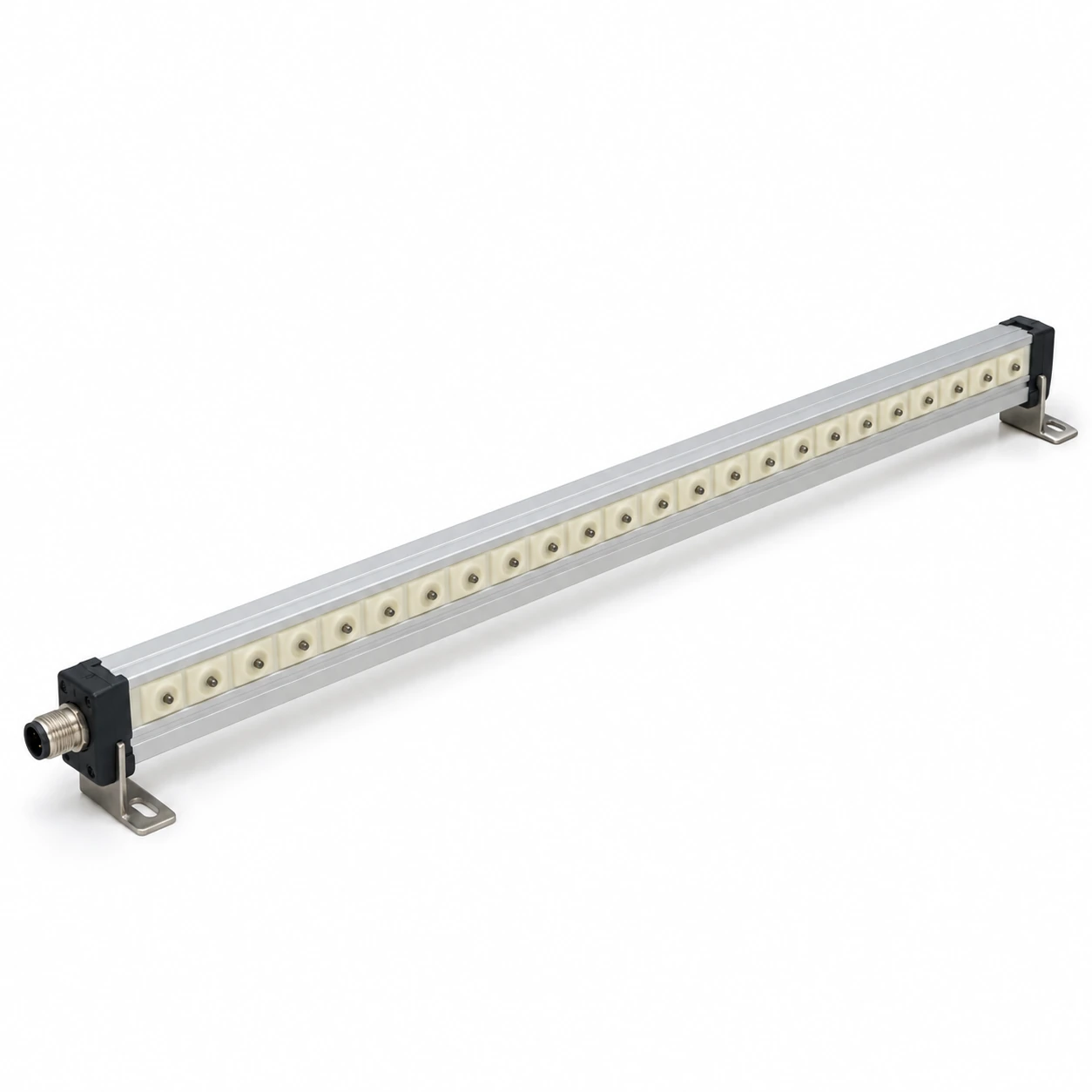
Ionizing Bars
ionizing bar
| Equipment type | Active bar ionizer for local surface-charge neutralization |
|---|---|
| Bar length selections (mm) | 340; 580; 820; 1120; 1600 |
| Electrical supply | 24 V DC input configurations with a matched supply and grounding arrangement |
| Ion generation | AC, alternating-polarity or pulsed-DC operation according to the selected bar family |
| Emitter construction | Fixed emitter array or replaceable insulated cartridges |
| Ion delivery | Unassisted or clean compressed-air-assisted configuration |
| Mounting | End brackets or adjustable rail fixings, with intermediate support where required |
| Status and integration | Local indication; remote enable, fault output and balance-monitoring options |
Lengths describe selected bar bodies. Active coverage, connector space, brackets and required clearance must be checked for the chosen assembly; different control and emitter options are not interchangeable.
The ionizing bar package can be customized for the working width, material, available mounting space and machine controls.
An ionizing bar supplies positive and negative air ions across a defined working width. A charged surface attracts ions of the opposite polarity, reducing its electrostatic charge. The bar is useful around insulating films and parts that cannot be discharged effectively through a simple grounding connection.
Cover the charged surface, not just the machine opening
The material may be narrower than the frame, or it may move sideways during operation. Select the active ion-emitting width around the surface that actually needs treatment and its permitted movement. Leave room at the ends for connectors and mounting hardware.
Distance is just as important as length. A bar placed farther away has a different ion-delivery duty from one close to a fixed material path. Consider nearby metalwork and the time the material remains in the treatment zone before choosing the configuration.
Decide how ions will reach the target
Without added air
An unassisted bar can suit a close, accessible surface or a location with suitable existing airflow. It avoids introducing a compressed-air stream into a delicate handling process. The installation still needs enough exposure time and a clear path from emitters to the target.
With air assistance
Air can help transport ions to a more distant or less accessible surface. Include air quality, consumption and the effect on loose parts or light film in the choice. Blowing harder can disturb the process without solving an unsuitable mounting position.
Make the electrical scope clear
Some bars contain their high-voltage generation and take a low-voltage input; other designs require a separate matched high-voltage power unit. The external connector alone does not establish compatibility. Include the power unit, cable, grounding arrangement and control interface in the purchase scope.
Agree how the machine should respond to a fault or maintenance indication. A power light confirms only part of the operating condition. Process verification should establish whether the surface charge has been reduced sufficiently where the result matters.
Buy an installation that can be maintained
Emitter access should be possible without dismantling the whole machine. Provide a safe means of isolating power and any air supply before cleaning, and protect the bar from accidental contact during roll changes or tool access. A specified inspection and performance-check routine makes later deterioration easier to identify.
shengtongJH can coordinate a bar and its supporting components around the material, process speed and installation drawing. For film-handling problems, see ionizing bar static eliminator. Replacement emitters are covered separately under ionizing bar electrode.
The ionizing bar package can be customized for the working width, material, available mounting space and machine controls.