Ionizer Electrodes & Accessories
ionizing bar electrode
| Component formats | Replaceable emitter point or complete insulated cartridge, according to the host design |
|---|---|
| Emitter material options | Tungsten, silicon or titanium in their respective compatible bar families |
| Host-bar length selections (mm) | 340; 580; 820; 1120; 1600 — host configuration identifiers, not electrode dimensions |
| Mechanical interface | Tip projection, seating, retention and insulator geometry matched to the approved assembly |
| Electrical compatibility | Correct electrode and insulation arrangement for the bar's specified output system |
| Air-assisted variants | Cartridge air passages and seals matched to the original delivery configuration |
| Supply scope | Individual service component or matched replacement set, as permitted by the bar design |
| Post-service verification | Correct seating, normal status and application-specific discharge-time and balance checks |
Bar length alone does not identify a compatible electrode. Pin and cartridge dimensions follow the selected host drawing; parts with a similar appearance or material are not automatically interchangeable.
The electrode supply scope can be customized around the confirmed bar configuration, maintenance requirements and required replacement quantity.
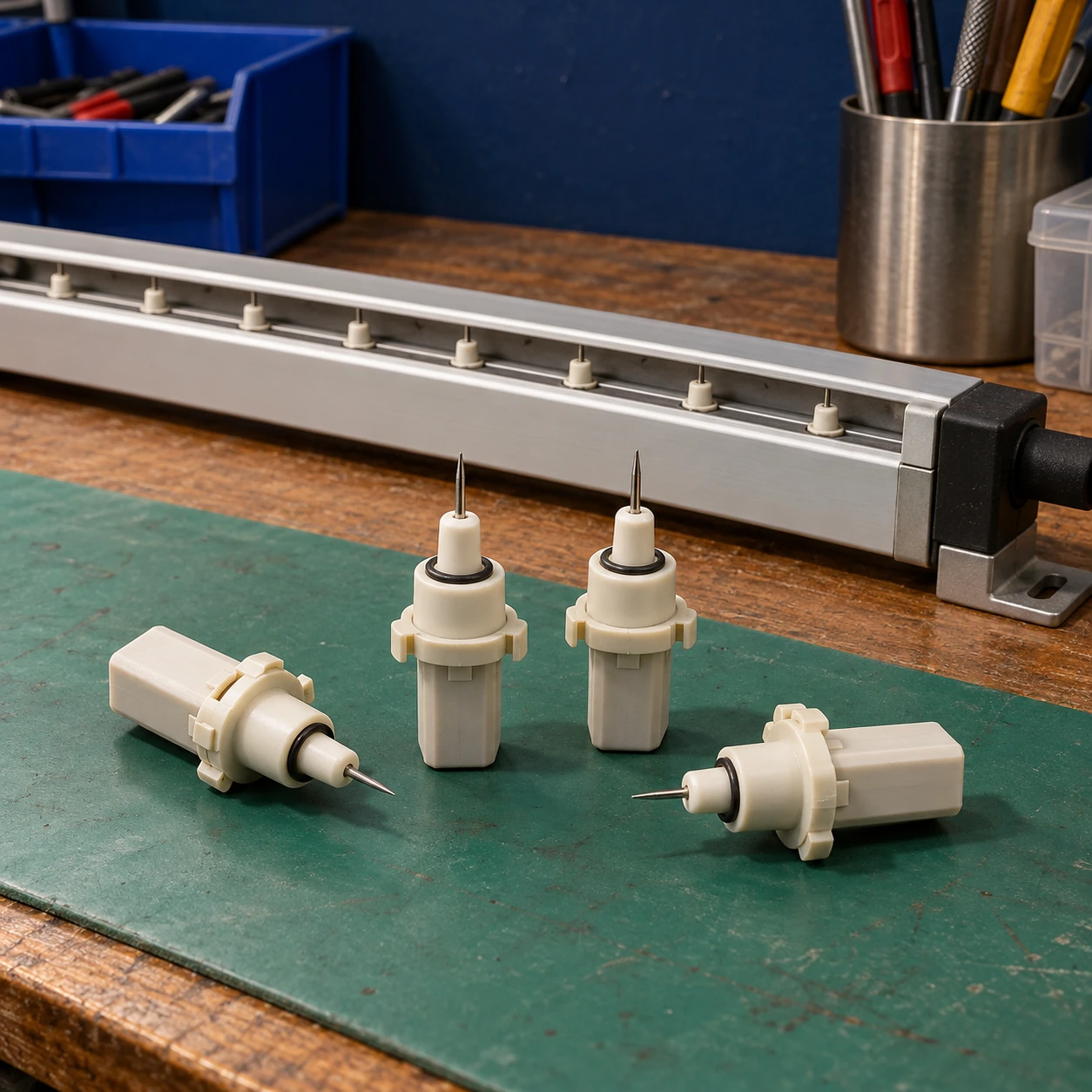
An ionizing bar electrode forms the ion-emitting part of a static-neutralizing assembly. Depending on the design, it may be a serviceable needle, an insulated cartridge or a fixed component within the bar. Replacement selection starts with the exact host assembly and its approved service arrangement.
Identify what is actually replaceable
Some bars allow a complete emitter cartridge to be exchanged; others have fixed points that require a different service approach. A protruding needle should not be assumed to unscrew or pull out. Establish the equipment series, revision and service-part reference before selecting a replacement.
A useful identification set includes the bar label, the complete emitter assembly and the connection or retaining form. An isolated photograph of the needle tip rarely establishes compatibility. Where documentation is unavailable, confirm the part against the equipment drawing rather than guessing from the bar's overall length.
Keep the electrode, insulation and mounting geometry together
Tip material and form
Different bar families use different emitter materials and geometries. Their service behaviour depends on the full design. A material advertised for low wear is not a reason to substitute it into an unrelated bar.
Insulating body
The surrounding insulator supports the intended electrical field and separates the electrode from other parts. A cracked, tracked or poorly fitting body can remain a problem even when the metal point looks intact.
Retention and air path
The correct seating and retaining arrangement keep the tip in its designed position. In air-assisted cartridges, passages and seals also affect ion delivery. Matching only the visible tip misses these interfaces.
Separate contamination from damage
Deposits can reduce ion output without meaning that every electrode needs replacement. Use the specified cleaning method and assess the result before deciding the service scope. Persistent deterioration may involve the bar position, power system or airflow as well as the emitters.
Worn tips, damaged insulation or a failed retaining feature need the corrective action permitted by the equipment manufacturer. Do not grind, bend or reshape an emitter to make a visually similar spare fit.
Return the complete bar to a known condition
After an approved replacement, check assembly and operating status before evaluating performance at the normal work location. Where ESD control is the purpose, compare positive and negative discharge times and offset voltage with the established limits. The disappearance of a warning light alone is not the full acceptance check.
Keep the confirmed spare identification with the maintenance record so the next order does not start from an uncertain visual match. shengtongJH can coordinate component sourcing for a documented assembly; if the bar is unserviceable or its identity cannot be established, review a complete ionizing bar package.
The electrode supply scope can be customized around the confirmed bar configuration, maintenance requirements and required replacement quantity.