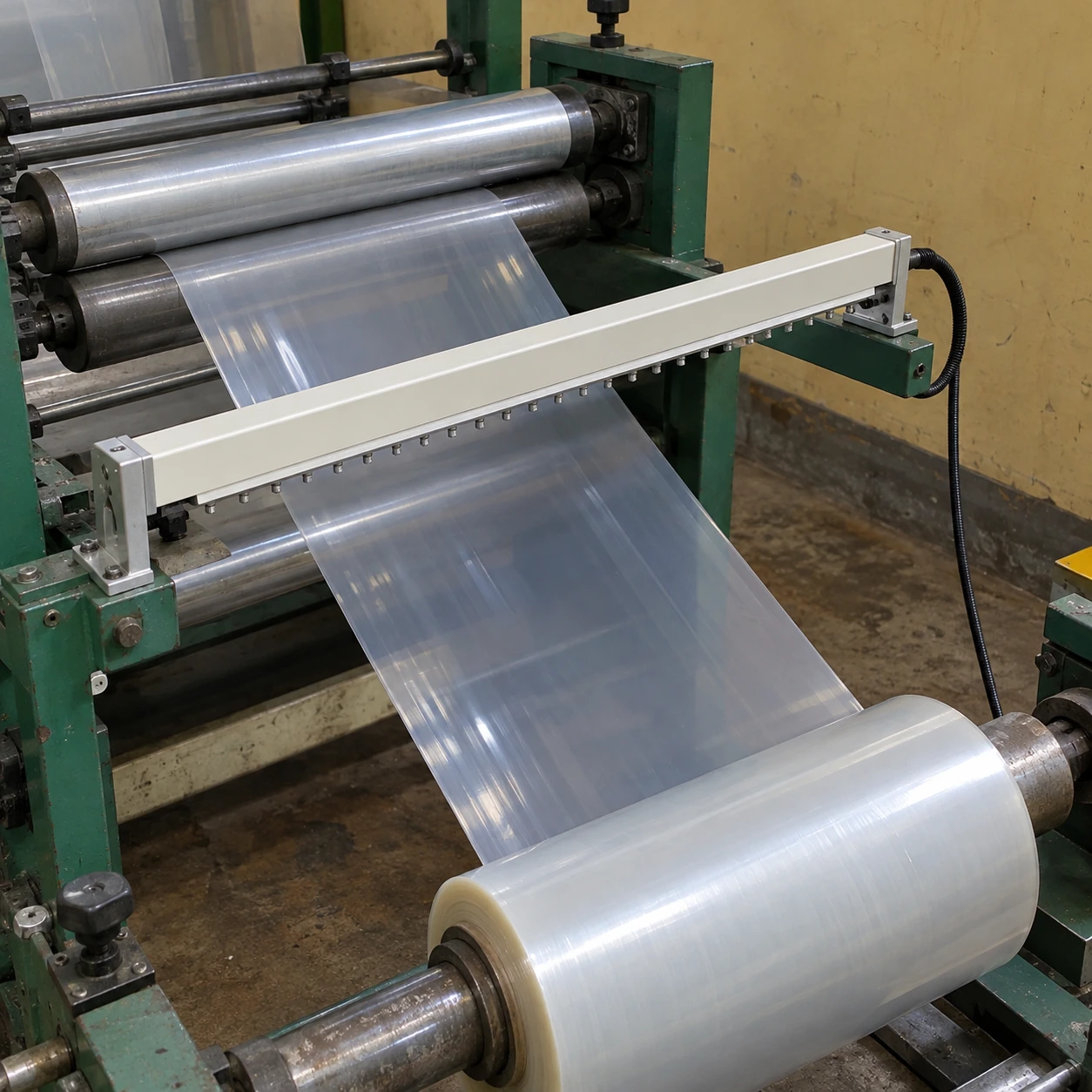
Ionizing Bars
anti static ionizing bars
| Order lengths (mm) | 500 / 1000 / 1500 |
|---|---|
| Body envelope (L × W × H, mm) | 506 × 22 × 41.5 / 1006 × 22 × 41.5 / 1506 × 22 × 41.5 |
| Length definition | Listed body lengths include 6 mm end allowance; mounting and cable space are additional |
| Electrical input | 24 V DC configuration with the correctly matched supply and cable |
| Treatment versions | Close-range or extended-range emitter arrangement |
| Installation options | Sliding mounting fixings; local status indication; compatible remote on/off and fault output |
These dimensions describe one slim-profile configuration family; emitter version and installation gap are selected together.
The bar length and installation arrangement can be customized for the material path and operating conditions.
Anti static ionizing bars address charge on exposed insulating materials such as plastic films and sheets. They are useful when earthing the machine alone cannot remove charge from the product surface, especially before stacking, sealing, printing or inspection.
Follow the symptom back to its source
Film clinging to a roller, sheets feeding together and particles returning after cleaning can look like unrelated faults. Record when the problem starts and where it first becomes visible. Measure charge before and after the relevant contact point while keeping the measuring distance and machine condition consistent.
Ionization reduces electrostatic attraction; it does not repair uneven web tension, a damaged roller or adhesive contamination. Separating these causes prevents a static-control device from being asked to solve a mechanical feeding problem.
Before stacking
Place treatment where the sheet is exposed after its last significant separation step. A downstream belt can generate charge again, so a satisfactory reading earlier in the line may not explain sticking at the stack.
Before surface inspection
Neutralize the surface in coordination with the cleaning stage. Loosened particles still need a collection route; a bar does not provide extraction or filtration. Keep the treated product away from dirty air that could immediately redeposit material.
Across a moving web
Keep the emitter row aligned with the useful width and check both edges. Sag, flutter and changing roll diameter can alter the gap. Select the treatment version for that actual geometry instead of moving any bar farther away to gain clearance.
Check a process result, not only a voltage reading
Compare charge measurements with the fault that motivated the installation: double feeds, particle attraction or release from a fixture. Record material grade, line speed and treatment position alongside the readings. A change that works on one film formulation may need adjustment when thickness, coating or speed changes.
Conductive machine parts still require their intended grounding and bonding. Ionization complements those measures for necessary insulating surfaces; it is not a substitute for protective earthing or a complete ESD-control programme.
The bar length and installation arrangement can be customized for the material path and operating conditions.