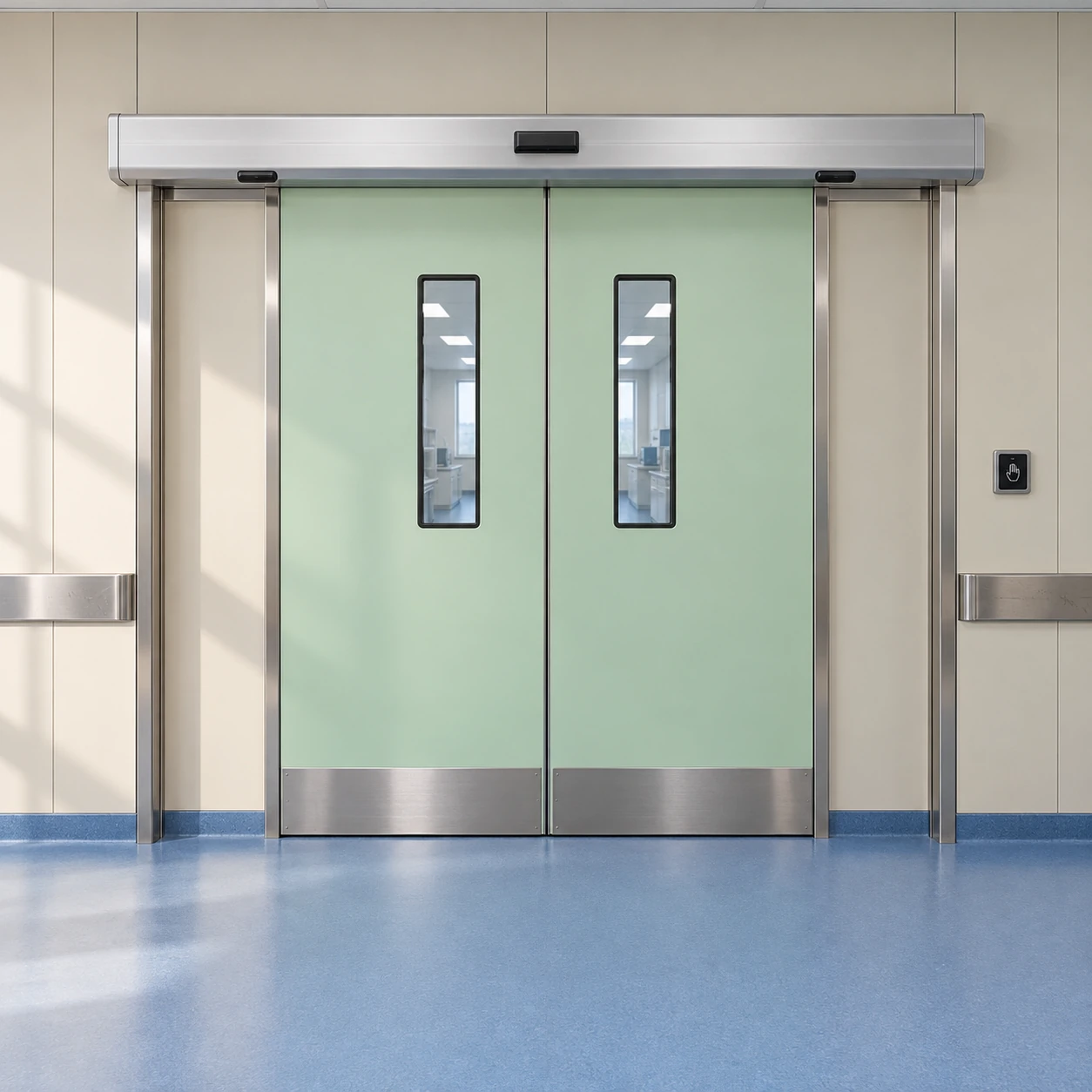
Hermetic Doors
automatic sliding hermetic doors
| Inside-frame opening W × H (mm) | 1200 × 2100; 1500 × 2100; 1800 × 2100; 2000 × 2200 |
|---|---|
| Layout | Single slide to left / right or bi-parting |
| Leaf system | 50 or 60 mm panel construction, selected with drive |
| Facing | HPL or stainless steel; optional flush glazing |
| Sealing arrangement | Perimeter seal; coordinated meeting seal for bi-parting |
| Operator / support | Covered head drive and rail with structural fixing interface |
| Activation / protection | Request device plus detection for doorway and moving-leaf zones |
| Service access | Head cover, guide and seal access shown on assembly drawing |
Each layout has its own leaf, rail and parking envelope. Opening options must be matched to the selected drive and complete sealing construction.
Automatic sliding hermetic door layout, opening, materials and control package can be customized to fit the wall space and intended traffic.
Automatic sliding hermetic doors are a coordinated moving system. The single-sided or bi-parting layout determines where the leaves park, how the seals meet and which areas need protection around the powered movement.
Single-sided travel
One leaf moves to a defined side of the opening. This offers a straightforward perimeter arrangement, provided there is enough clear wall length for the parked leaf and its hardware.
The design needs to include nearby corners, sockets, protection rails and anything installed later beside the opening. A wall-mounted cabinet can remove required travel space even when it does not obstruct the doorway itself.
For a retrofit, show the fully open position on the site elevation before choosing the handing. A clear route on one side of the room does not guarantee a workable arrangement on the operator side.
Bi-parting travel
Two leaves move away from the center. This distributes the parking requirement between both sides and can suit a wider opening where a single leaf would demand too much uninterrupted wall length.
The meeting line adds another sealing interface. The leaves, guides and closing sequence must bring that interface together reliably, while the outer edges seat against the frame. It is not enough for both leaves simply to reach the middle.
The complete layout also affects operator selection, protective detection and maintenance access. Specify it as one assembly rather than combining two independent single-door packages.
Keep three envelopes on the drawing
The first is the usable route for people and equipment. The second is the moving and parked leaf envelope, including handles and guides. The third is the installation and service space required above and beside the assembly.
Conflicts often occur between these envelopes. A service cover can be present but impossible to remove below a ceiling detail. A door can open fully while its lower guide projects into the equipment route. Resolving these relationships before fabrication is more effective than altering a completed hermetic assembly on site.
Build the closing accuracy into the installation
Stable mounting
The support and fixing arrangement must hold the rail and frame in their intended relationship. Movement of a lightweight partition can affect the final seal contact even if the operator continues to run.
Aligned travel
Guides and hangers control how the leaf approaches the closed position. Misalignment can lead to rubbing, uneven gaps or inconsistent seating. The drive should move a correctly installed leaf, not pull a distorted assembly into place.
Continuous contact
The frame and finished floor provide the surfaces against which the selected seals work. Transitions, joints and changes in level need to be included in the detail. A seal can bridge only the conditions for which its profile is designed.
Protect more than the central opening
The passage is an obvious area to consider, but powered leaves also move beside the opening. The actual arrangement determines where trapping, impact or contact risks must be addressed by layout, guarding and protective devices.
Choose the activation and detection arrangement with the whole movement in mind. A request plate starts a cycle; it does not protect every moving zone. Commissioning needs to cover the selected system and its operating modes, including relevant lock and alarm interfaces.
Changes to nearby furniture or equipment can alter how people approach and occupy those zones. Keep the installed arrangement consistent with the accepted layout and have significant changes reviewed.
Specify a complete package and a clear supply boundary
The door schedule should connect leaves, frame, seals, rail, drive, guides and protective devices to the same configuration. State which activation devices and system interfaces are included. This prevents a mechanically complete door arriving with an incomplete operating arrangement.
For the operating sequence and status signals, see automatic hermetic doors. For spatial planning without committing to automation, see sliding hermetic doors. Share a wall elevation and traffic plan with the enquiry so the layout can be selected around actual conditions.
Automatic sliding hermetic door layout, opening, materials and control package can be customized to fit the wall space and intended traffic.